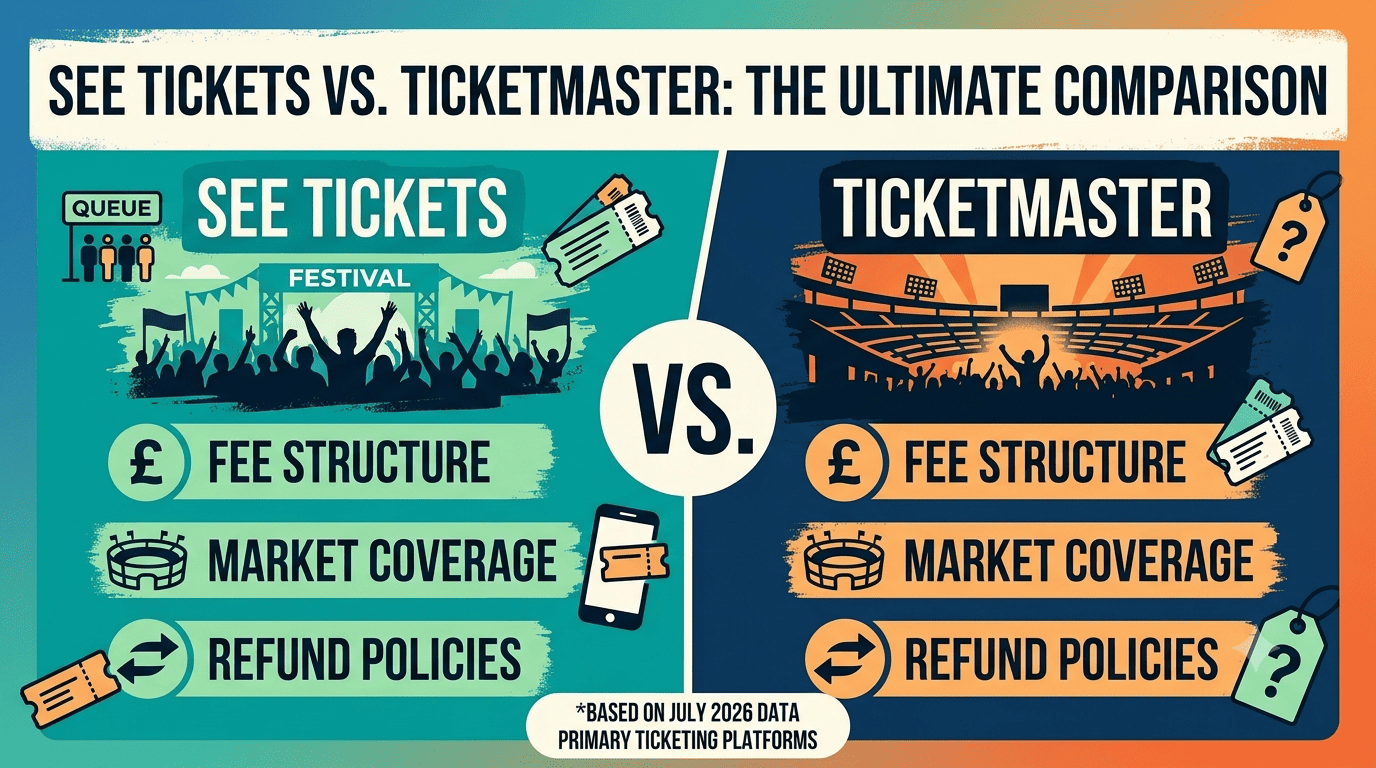
Here is the reality European ticket buyers need to understand in 2026: both See Tickets and Ticketmaster are legitimate primary ticketing platforms, but neither one delivers a truly fee-free checkout experience. See Tickets typically adds 15–20% in combined booking and facility fees on top of listed prices, and Ticketmaster’s layered service charges push costs even higher — in line with a 2018 U.S. Government Accountability Office review of a sample of ticketing events, which found primary-market fees averaging 27% of face value. Both platforms serve different slices of the European event market, and checkout fees are a frequent point of feedback from fans of both.
The question most searchers are actually asking is not “which of these two is better?” but rather “is there a way to stop paying hidden fees entirely?” That question has a concrete answer — and it reshapes the entire comparison.
Side-by-Side Comparison Table: Fees, Coverage, Verification, and Refunds
The following table consolidates the most decision-critical attributes of See Tickets and Ticketmaster into a single reference. All figures reflect publicly documented fee structures and policies as of July 2026.
| Attribute | See Tickets | Ticketmaster |
| Parent Company | CTS Eventim (acquired from Vivendi, 2024) | Live Nation Entertainment |
| Annual Ticket Volume | Tens of millions of tickets annually | 637M+ tickets globally |
| Primary European Markets | UK, Germany, Belgium, Netherlands | UK, Germany, Spain, Nordics, 30+ countries |
| Average Fee Markup on Face Value | 15–20% | 27–31% |
| Buyer Fees at Checkout | Booking Fee + Facility Charge | Service Fee + Order Processing Fee + Facility Fee |
| All-In Pricing Guarantee | No | Partial (US only, inconsistent in Europe) |
| Ticket Verification | “Authorized Seller” label | “Verified Ticket” program |
| Resale Marketplace | Limited / event-dependent | Yes — Ticketmaster Resale (Fan-to-Fan) |
| Refund on Cancellation | Yes — automatic refund to original payment | Yes — automatic refund to original payment |
| Refund on Rescheduled Event | Typically no refund unless opt-in window offered | Typically no refund — tickets valid for new date |
| European Football Coverage | Minimal | Select fixtures via official club partnerships |
| Music & Festival Coverage | Strong — Glastonbury exclusive; Creamfields; Reading & Leeds shared with Ticketmaster | Dominant — broadest concert inventory in Europe, including Download Festival and Latitude |
| Queue/On-Sale Reliability | Site slowdowns reported during high-demand drops | SmartQueue system; occasional incidents reported under peak load |
| Customer Service Reputation | Primarily email-based; response times of 2–4 weeks reported | Chatbot-first with phone options; 30–60 min waits for human agents reported |
The Short Answer: Both Platforms Charge Hidden Fees — One Alternative Doesn’t
If you came here hoping one platform would emerge as the clear fee-free winner, the data tells a different story. See Tickets charges less than Ticketmaster — roughly £13.50 less on a £75 face-value ticke. Ticketmaster’s multi-layered fee stack (service fee, order processing fee, and sometimes a separate facility fee) pushes average costs 27%+ above face value.
- See Tickets: Lower fees than Ticketmaster but still adds 15–20% in booking charges above face value
- Ticketmaster: Largest inventory in Europe but charges the highest average fees at 27%+ markup
- Bottom line: Both legacy platforms charge hidden fees
What Is See Tickets? Platform Overview, Ownership, and Market Reach
See Tickets is a primary ticket retailer that has operated under German live-entertainment group CTS Eventim since Eventim completed its acquisition of the business from Vivendi in June 2024, and it remains one of the largest independent ticketing platforms in Europe . Founded in the UK, the See Tickets business now under CTS Eventim operates in the UK, Germany, Belgium, and the Netherlands, processing tens of millions of ticket transactions annually as part of CTS Eventim’s wider European operations, which distribute over 300 million tickets a year in total. France is a separate story: Vivendi kept its French ticketing operations out of the 2024 sale, and as of February 2026 See Tickets France has been acquired by Fever and reverted to its original brand, Digitick. Unlike Ticketmaster, which operates as both a primary seller and a resale marketplace under the Live Nation umbrella, See Tickets positions itself primarily as a first-party authorized seller — meaning it sells tickets directly on behalf of event promoters and venues rather than facilitating fan-to-fan resale at scale.
The platform’s identity in the European market is closely tied to its festival partnerships. See Tickets holds an exclusive ticketing contract for Glastonbury, one of the UK’s most iconic music festivals, and is one of the official ticketing channels for Creamfields, alongside Ticketmaster; Reading & Leeds tickets are likewise sold through both See Tickets and Ticketmaster rather than exclusively through either. The Glastonbury exclusivity is both a genuine strength and a source of frustration for some fans: if you want to attend, See Tickets is your only authorized option, which limits competitive pricing pressure. The platform also handles a substantial volume of concert and theatre tickets in the UK, though its inventory breadth for European football or international sports is far narrower than Ticketmaster’s.
For the casual ticket buyer, See Tickets functions similarly to other primary sellers: you browse events, select seats or general admission, and proceed to checkout. The critical distinction that drives search queries like “See Tickets vs Ticketmaster” is what happens at that checkout. See Tickets adds a Booking Fee (typically £2.50–£8.00 per ticket depending on the event and price tier) plus a Facility Charge on select events, and these fees are not displayed until after ticket selection. This drip-pricing pattern is frequently mentioned in Reddit threads, Trustpilot reviews, and social media posts about the platform.
See Tickets Strengths: UK Festival Exclusives, Indie-Music Focus, and Decades of Operational Scale
Where See Tickets has built real strength is in its curated relationship with the UK’s independent music and festival ecosystem. The platform is not trying to be everything to everyone — it has carved a defensible niche as the go-to seller for mid-to-large UK festivals and independent music events that do not fit neatly into Live Nation’s corporate touring infrastructure.
Key strengths worth recognizing include the following:
- Exclusive festival partnership: Glastonbury uses See Tickets as its sole ticketing channel — no competitor can offer equivalent access — and See Tickets is one of Creamfields’ official ticketing channels alongside Ticketmaster. Reading & Leeds tickets are likewise available through both See Tickets and Ticketmaster.
- Indie and mid-tier concert coverage: See Tickets maintains strong relationships with independent promoters across the UK and the Netherlands, stocking events that may not appear on Ticketmaster at all.
- Volume and reliability: Processing tens of millions of tickets annually across its European markets demonstrates operational scale and venue trust.
- Simpler resale position: By not operating a large-scale fan-to-fan resale marketplace, See Tickets sidesteps some of the fraud and price-gouging controversies that plague Ticketmaster Resale.
- Regional depth: In the Netherlands, See Tickets is a significantly stronger player than Ticketmaster for local and regional events, particularly in the electronic music and festival circuits — the equivalent French business now operates separately as Digitick under Fever.
For fans whose primary interest is UK festival culture and independent music, See Tickets remains a legitimate and often unavoidable platform. The problems arise when you examine what that access actually costs at checkout.
See Tickets Fees, Site Reliability, and Refunds: What to Expect
See Tickets has been widely discussed across consumer forums, regulatory complaints, and public review platforms, with recurring themes around fees, technical reliability, and post-purchase support.
Fee Structure: See Tickets typically charges a Booking Fee ranging from £2.50 to £8.00+ per ticket, plus an occasional Facility Charge, which together add approximately 15–20% to the face value of a ticket. Unexpected checkout fees are one of the most frequently cited frustrations in consumer reviews of European ticketing platforms, and See Tickets’ Booking Fee is disclosed only after you have selected your tickets and entered the checkout flow — a drip-pricing pattern that UK regulators are now targeting under the Digital Markets, Competition and Consumers Act (DMCCA) 2024.
Site Performance During High-Demand Sales: See Tickets has experienced website slowdowns and queue issues during some high-profile on-sale moments. Festival ticket drops for Glastonbury, in particular, have generated fan feedback on social media when the site has been slow to respond under peak load, with some fans left in queues for hours before finding tickets sold out. No ticketing platform is immune to surge-traffic challenges, and See Tickets’ queue infrastructure is generally considered less advanced than Ticketmaster’s SmartQueue system.
Refunds and Customer Service: Refund processing is an area where See Tickets receives mixed feedback. For cancelled events, automatic refunds generally process within 10–14 business days, but for rescheduled events, See Tickets typically defaults to the position that tickets remain valid for the new date, with limited or no refund window unless the promoter explicitly opts in. Customer service is handled primarily via email, with limited phone support, and response times are often reported as slow by users. Reddit and Trustpilot reviews commonly report 2–4 week response times for non-urgent queries and some difficulty escalating disputes.
- See Tickets adds 15–20% in fees that are not shown until checkout
- Site slowdowns during major festival on-sales have been reported by users
- Refund policies for rescheduled events leave limited recourse for ticket holders
- Customer support is primarily email-based, with response times of several weeks reported by users
- No 0% buyer fee guarantee — every transaction carries additional charges above face value
- Side-by-Side Comparison Table: Fees, Coverage, Verification, and Refunds
- The Short Answer: Both Platforms Charge Hidden Fees — One Alternative Doesn’t
- See Tickets Strengths: UK Festival Exclusives, Indie-Music Focus, and Decades of Operational Scale
- See Tickets Fees, Site Reliability, and Refunds: What to Expect
- What Is Ticketmaster? Live Nation’s Market Dominance Explained
- See Tickets Fees vs Ticketmaster Fees: What You Actually Pay
What Is Ticketmaster? Live Nation’s Market Dominance Explained
Ticketmaster is the world’s largest ticketing platform and a wholly owned subsidiary of Live Nation Entertainment, the global live-events conglomerate that also controls concert promotion, venue operations, artist management, and sponsorship sales. In fiscal year 2024, Live Nation reported distributing over 637 million tickets globally — a record high that cements Ticketmaster’s position as the dominant force in primary ticketing across North America and Europe.
In Europe, Ticketmaster operates in over 30 markets, with particularly strong presence in the UK, Germany, Spain, the Nordics, Ireland, and Central Europe. In the UK specifically, Ticketmaster is estimated to handle around 60% of primary ticket sales, a position that reflects both its vast venue partnerships and its vertically integrated relationship with Live Nation’s touring division — meaning that many of the largest concert tours are exclusively ticketed through Ticketmaster because Live Nation promotes them. This vertical integration has attracted sustained antitrust scrutiny from both the European Commission and the UK Competition and Markets Authority (CMA), with critics raising concerns about the level of competition in ticket pricing.
For users, Ticketmaster offers the broadest event inventory of any single platform in Europe: major concert tours, arena shows, stadium events, select football fixtures (through official club partnerships), West End and European theatre, comedy, and family entertainment. It also operates Ticketmaster Resale (formerly GET ME IN! and Seatwave), a fan-to-fan resale marketplace integrated directly into the platform. This dual primary-and-resale model means Ticketmaster monetizes both the initial sale and any subsequent resale, collecting fees at every stage of a ticket’s lifecycle.
Ticketmaster Strengths: Unmatched Inventory Scale, Presale Access, and Global Brand Trust
Ticketmaster’s scale is its most undeniable advantage. No other European ticketing platform comes close to matching its inventory breadth, presale infrastructure, or venue integration.
Core strengths include the following:
- Inventory breadth: With 637 million+ annual ticket sales globally and active partnerships with the majority of Europe’s major arenas, stadiums, and theaters — including UK festivals such as Download Festival and Latitude — Ticketmaster stocks more events across more countries than any competitor. If a major tour is happening in Europe, Ticketmaster almost certainly has it.
- Presale access programs: Ticketmaster’s presale ecosystem — including artist presales, venue presales, and credit card partner presales (Amex, O2 Priority, Three+) — gives registered users early purchasing windows before general on-sale. For high-demand events, presale access can be the difference between getting tickets and being shut out entirely.
- SmartQueue technology: Ticketmaster’s queue management system, while imperfect, represents one of the more sophisticated approaches to handling millions of simultaneous purchase attempts during high-demand on-sales. It uses randomized queue positioning and capacity metering to reduce bot abuse.
- Global brand recognition: Ticketmaster’s brand awareness in Europe is nearly universal among ticket buyers. This recognition provides a baseline trust layer — most consumers believe (correctly) that Ticketmaster is a legitimate platform, even if they deeply dislike its fees.
- Integrated resale marketplace: Ticketmaster Resale allows fans to resell tickets through the same platform, with the resale ticket replacing the original barcode. This integration reduces fraud risk compared to unregulated third-party resale sites.
For fans seeking the widest possible selection of events and the best chance at presale access, Ticketmaster remains the default starting point in Europe. The problem is what happens after you click “Buy.”
Ticketmaster Fees, Pricing, and Customer Trust: What to Expect
Ticketmaster’s fee structure is one of the most frequently discussed aspects of the live-event industry in Europe. A 2018 U.S. Government Accountability Office review of a sample of ticketing events found combined service and processing fees averaging 27% of face value in the primary market and 31% in the secondary/resale market — and European fans routinely report Ticketmaster’s charges landing at or above that range. In some markets, the total fee burden can exceed 31% once facility fees and delivery charges are layered in.
Here is how Ticketmaster’s fee stack typically breaks down for a European transaction:
| Fee Type | Typical Range (UK) | When Revealed |
| Service Fee | 10–15% of face value | After ticket selection |
| Order Processing Fee | £2.25–£2.85 per order | At checkout |
| Facility Fee | £0–£5.00 per ticket (venue-dependent) | At checkout |
| Delivery Fee (if postal) | £2.00–£5.50 | At checkout |
Tiered and premium pricing have been a recurring source of fan feedback. During the 2025 Oasis reunion tour on-sale, standard tickets sold out within minutes and were followed by “platinum” standing tickets priced at up to around 2.5 times the standard rate — triggering a CMA investigation and parliamentary scrutiny. When the CMA concluded its investigation in September 2025, it found no evidence that Ticketmaster had used a real-time algorithmic dynamic-pricing model for the Oasis sale, but it did secure undertakings requiring Ticketmaster to give UK fans clearer advance notice whenever tiered or premium pricing is in play. The episode drew significant public and parliamentary attention, and Ticketmaster has used genuine dynamic pricing — where the face value itself shifts in real time with demand — on other tours, which can make budgeting before an on-sale difficult even when a specific event turns out not to have used it.
Additional points worth noting include:
- All-in pricing inconsistency: Ticketmaster introduced all-in pricing for select US events in May 2025, when the FTC’s new rule on unfair or deceptive fees took effect , but adoption has not been widely extended across European operations. Most European Ticketmaster listings still display base price + separate fees at checkout.
- Resale price differences: Ticketmaster Resale listings frequently appear alongside primary inventory, sometimes at higher prices, and the visual distinction between primary and resale tickets is not always immediately obvious to casual buyers.
- Customer support response times: Ticketmaster’s customer support in Europe relies heavily on chatbot-first workflows, with human agent escalation typically requiring 30–60 minute wait times. Resolution of billing disputes and refund requests typically takes 2–6 weeks.
- Regulatory scrutiny: The European Commission and UK CMA continue to investigate Live Nation/Ticketmaster’s market position, and any resulting regulatory action could alter the platform’s fee and pricing structures.
- Ticketmaster’s average fee markup exceeds 27% — the highest of any major European ticketing platform
- Tiered and “in demand” pricing can push face values well above the advertised starting price once cheaper tickets sell out, making pre-purchase budgeting difficult
- All-in pricing remains a US-focused initiative with minimal European adoption
- Resale and primary listings are sometimes visually conflated, confusing buyers
- Customer support volume contributes to multi-week resolution timelines in some cases
See Tickets Fees vs Ticketmaster Fees: What You Actually Pay
Fee comparison is the heart of the “See Tickets vs Ticketmaster” query. When European ticket buyers search this phrase, concern about fees is a major factor: checkout abandonment triggered by last-minute fee reveals is a frequently reported issue across ticketing forums and review sites. This section provides the concrete, pounds-and-pence data that most comparison articles omit.
Worked Example: A £75 Face-Value Ticket on See Tickets vs Ticketmaster
The following illustrative calculation applies the typical fee ranges documented in the table above to a single £75 face-value general-admission concert ticket with standard digital delivery, based on checkout patterns observed across UK-listed events as of July 2026.
| Cost Component | See Tickets | Ticketmaster |
| Face Value | £75.00 | £75.00 |
| Service / Booking Fee | £10.50 (14%) | £11.25 (15%) |
| Facility Charge | £1.50 | £3.75 |
| Order Processing Fee | £1.50 | £2.50 |
| Delivery Fee (digital) | £0.00 | £2.75 |
| Total Paid | £88.50 | £95.25 |
| Total Fee Markup | 18.0% | 27.0% |
The numbers speak plainly. On a single £75 ticket, Ticketmaster charges £20.25 in combined fees — more than the cost of a matchday meal at most European stadiums. See Tickets charges £13.50, which is lower but still represents nearly a fifth of the ticket’s face value added at checkout.
How Ticketmaster’s “All-In Pricing” Works in Practice
In response to sustained regulatory pressure — particularly from the U.S. Federal Trade Commission and, more recently, the UK’s CMA — Ticketmaster introduced an “all-in pricing” display option for select events beginning in May 2025, when the FTC’s rule on unfair or deceptive fees took effect. The concept is simple: show the total price upfront, including all fees, so buyers are not surprised at checkout. In principle, this is exactly what consumers have demanded. In practice, the implementation has been inconsistent and geographically limited, and the totals shown do not always include every fee.
As of mid-2026, Ticketmaster’s all-in pricing remains primarily a US-market feature. According to Billboard’s reporting, the rollout across European operations has been minimal, with most UK, German, and Spanish event listings still displaying base prices with separate fees revealed at checkout. Even where all-in pricing is displayed, the total shown sometimes excludes order processing fees or delivery charges, meaning the “all-in” price does not always include every fee. This can create a false sense of finality for some buyers, who may expect the displayed total to be complete and then encounter additional charges at the payment screen.
Fee revenue is a significant part of Live Nation Entertainment’s business model. Implementing all-in pricing without changing the total amount paid means either incorporating fees into the displayed face value or removing certain fees altogether. So far, all-in pricing has been rolled out as an optional display feature in the US market rather than a uniform policy applied across all regions.
2026 EU and UK Regulations Forcing Ticket Fee Transparency
The regulatory landscape for ticketing fees in Europe has shifted meaningfully since 2024, and these changes directly affect how See Tickets and Ticketmaster must operate going forward.
UK — Digital Markets, Competition and Consumers Act (DMCCA) 2024: The DMCCA introduced explicit anti-drip-pricing provisions targeting online platforms, including ticket sellers. Under the Act, platforms must display the total price — including all mandatory fees — at the first point where a price is shown to the consumer, not after seat selection or at the checkout stage. Platforms failing to comply face enforcement action from the CMA, with potential fines of up to 10% of annual global turnover. As of mid-2026, CMA enforcement guidance is being finalized, and both See Tickets and Ticketmaster are expected to make material changes to their UK checkout flows by late 2026 or early 2027.
EU — Digital Services Act (DSA) and Consumer Protection Cooperation (CPC) Network: The DSA’s transparency requirements, combined with coordinated enforcement actions by national consumer protection agencies across EU member states, have created additional pressure on ticketing platforms to disclose all fees upfront. Several EU countries, including France and Germany, have initiated national-level investigations into drip pricing on event ticketing sites.
What this means for consumers in practical terms is that regulatory pressure is accelerating — but compliance is not yet universal. Neither See Tickets nor Ticketmaster has fully implemented compliant pricing displays across all European markets as of the date of publication. Fans who want guaranteed fee transparency today, rather than waiting for regulatory enforcement to compel it, should look for platforms that have built transparency into their pricing model from the ground up.
- UK’s DMCCA 2024 mandates total-price display at first point of pricing — enforcement expected late 2026
- EU Digital Services Act adds cross-border transparency obligations for ticketing platforms
- CMA fines for non-compliance can reach 10% of annual global turnover
- Neither See Tickets nor Ticketmaster has fully complied across all European markets yet
- TicketX Europe already operates with 0% buyer fees, making regulatory compliance a non-issue — the price is already transparent
コメント