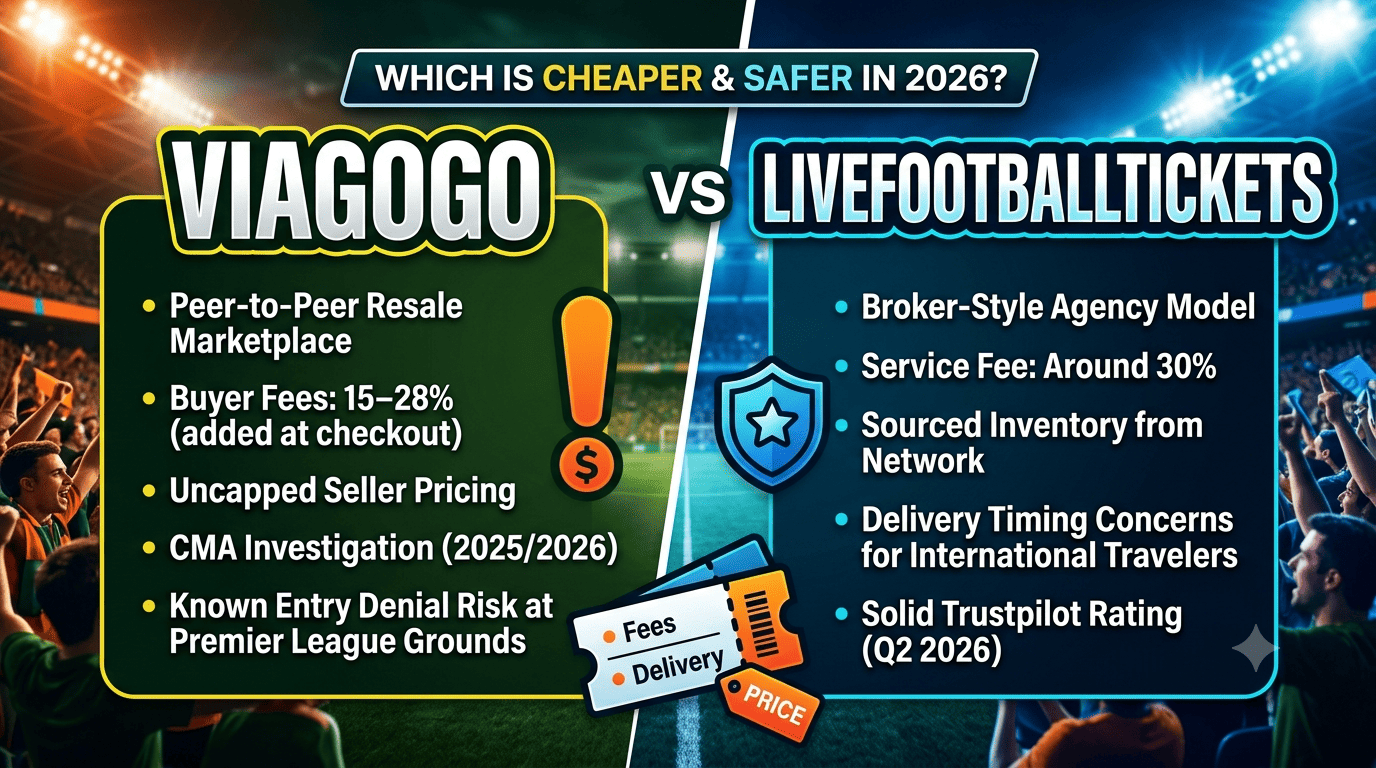
Choosing between Viagogo and LiveFootballTickets is the kind of decision that can cost you anywhere from a few extra pounds to an entire matchday experience. Both platforms serve the European secondary ticket market — an industry that market researchers estimate at roughly USD 1 billion (about €0.95 billion) in 2025 — but they operate on fundamentally different models, charge very different fees, and carry distinct levels of risk. Before the detailed breakdowns, here is the short version: Viagogo is a peer-to-peer resale marketplace where third-party sellers set prices and the platform layers on buyer fees of 15–28%. LiveFootballTickets is a broker-style agency that sources tickets from its own network and applies a service fee of around 30% plus delivery charges. Neither platform shows you the true all-in cost at first glance, and neither guarantees 0% buyer fees. If transparent pricing and verified ticket inventory are your non-negotiables — as they should be when hundreds of pounds and international travel plans hang in the balance — a third option exists that neither Viagogo nor LiveFootballTickets can match. That alternative is explored in full later in this article, but the comparison table below includes it for complete context.
- Side-by-Side Comparison Table — Fees, Trust Score & Ticket Guarantee
- What Is Viagogo and How Does It Work?
- What Is LiveFootballTickets and How Does It Work?
- Head-to-Head Fee Comparison — Viagogo vs LiveFootballTickets for Popular European Matches
- The Bottom Line — Viagogo vs LiveFootballTickets: Which Platform Should You Trust?
Side-by-Side Comparison Table — Fees, Trust Score & Ticket Guarantee
The following table consolidates the most decision-critical data points across all three platforms. Figures are drawn from public pricing reviews, Trustpilot review aggregates, and regulatory records current through Q2 2026.
| Criteria | Viagogo | LiveFootballTickets | TicketX Europe |
| Business Model | Peer-to-peer resale marketplace | Broker-style ticket agency | Direct verified-inventory platform |
| Buyer Fee | 15–28% added at checkout | Around 30% service fee | 0% buyer fees |
| Delivery / Booking Fee | £5–£20 depending on method | £5–£15 | Included in displayed price |
| Total Markup vs Face Value | 40–100%+ above face value | Roughly 45–85% above face value | What you see is what you pay |
| Trustpilot Rating (2026) | ~3.8 / 5 (UK) | ~4.0–4.8 / 5 | Verified positive reviews |
| Ticket Source | Third-party sellers (unverified individuals) | Broker network (sourced inventory) | Official & verified tickets only |
| Refund on Cancellation | Credit voucher default; cash refund requires request | Refund or replacement (case-by-case) | Clear buyer guarantee policy |
| Regulatory Compliance | CMA court order (2018); further CMA investigation opened 2025 | No major regulatory actions publicly recorded | Aligned with UK/EU price-transparency rules |
| All-Inclusive Pricing Displayed? | No — fees revealed at checkout | No — service + delivery fees added later | Yes — 0% buyer fees, no hidden charges |
- Viagogo adds the highest percentage in buyer fees among the three when measured against low listing prices, and its uncapped seller pricing can turn a seemingly competitive listing into the most expensive option at checkout
- LiveFootballTickets often lands below Viagogo on the total in our examples because its base listing prices run lower — but its service fee of around 30% is actually steeper than Viagogo’s on a percentage basis, and delivery timing is a recurring complaint theme
- TicketX Europe is the only platform in this comparison offering 0% buyer fees and transparent, all-inclusive pricing from the first price display
The Real-Price Test — What You Actually Pay at Checkout
Abstract fee percentages only become meaningful when applied to a real match. Consider a Category 2 seat for a high-profile Premier League fixture — Arsenal vs Manchester City at Emirates Stadium — with a face value of £65. The breakdown below is illustrative, reflecting typical pricing patterns observed across all three platforms during the 2025–26 season.
| Cost Component | Viagogo | LiveFootballTickets | TicketX Europe |
| Listed Ticket Price | £80 | £75 | £65 |
| Buyer / Service Fee | £22 (27.5%) | £23 (30%) | £0 |
| Delivery / Booking Fee | £10 | £8 | £0 |
| Final Checkout Total | £112 | £106 | £65 |
| % Above Face Value | +72% | +63% | 0% |
The gap is not marginal. A Viagogo buyer pays £47 more than a TicketX Europe buyer for an identical seat at an identical match. Scale that across two tickets for a couple’s matchday trip and you are looking at nearly £100 in unnecessary fees — money that could have covered pre-match dinner near Holloway Road and a program from the club shop. The LiveFootballTickets buyer fares slightly better than the Viagogo buyer on the total, but still pays £41 above face value once the roughly £31 in service and delivery charges — none of it shown on the initial listing page — is added.
This is the drip pricing problem in action: the listed price lures you in, and the final checkout total punishes you for committing. UK regulators have repeatedly identified hidden fees as one of the biggest sources of consumer harm in online purchases, and demand for genuinely all-in pricing has grown as fans learn to distrust the number on the listing page. The preference for transparent pricing is not theoretical — it is the direction both consumers and regulators are moving.
What Is Viagogo and How Does It Work?
Viagogo is a secondary-market ticket resale marketplace headquartered in Geneva, Switzerland. Founded in 2006, it operates as an intermediary connecting individual ticket holders (sellers) with buyers across more than 70 countries. Viagogo does not own ticket inventory. Instead, it provides the digital infrastructure for third-party sellers — ranging from season ticket holders offloading a single match to large-scale professional resellers listing thousands of tickets — to set their own prices and sell to global demand. The platform covers sports, concerts, theater, and festivals, but European football is one of its highest-traffic verticals, particularly around the Premier League, Champions League, and international tournaments.
The critical distinction to understand is that Viagogo is not a ticket retailer. It is a marketplace. When you buy on Viagogo, you are buying from a stranger who listed tickets at whatever price they chose, and Viagogo takes a cut from both sides of the transaction — a commission from the seller and a separate buyer fee from you. This dual-extraction model is what drives the wide gap between face value and final checkout price. Viagogo’s role is facilitating the trade and providing a guarantee framework (the “Viagogo Guarantee”), but the quality of that guarantee has been the subject of sustained regulatory scrutiny and consumer backlash across Europe.
Viagogo Fee Structure Explained — Buyer Fees, Booking Fees & VAT
The fee structure on Viagogo is neither simple nor transparently displayed at the point of first price interaction. Viagogo’s own fee disclosure states there is no fixed buyer-fee percentage: charges vary by event, demand, and time to the event, and are shown during checkout. In practice, independent reviews and buyer reports place these fees roughly in the 15–28% range, applied on top of the seller’s listed amount rather than the original face value. On high-demand fixtures — Champions League knockouts, North London derbies, El Clásico — these fees compound on already inflated listing prices, producing final totals that routinely exceed face value by 40–100% or more.
The fee stack typically includes the following layers:
- Seller markup: The third-party seller sets a price above face value based on demand speculation. There is no cap or price ceiling enforced by Viagogo.
- Buyer fee: A percentage-based charge (15–28%) added at checkout, calculated on the seller’s inflated price — not on the original face value.
- VAT handling fee: An additional charge that varies by jurisdiction and is often unclear in its calculation methodology.
- Delivery fee: Ranging from £5 to £20 depending on whether the ticket is delivered electronically, via Royal Mail, or through courier for physical tickets.
The compounding effect is substantial. A Champions League semi-final ticket with a face value of €90 might be listed at €220 by the seller, then have €50 in buyer fees and €12 in delivery charges added, producing a final price of €282 — a 213% markup from face value. The listed price on the search results page (€220) is designed to appear competitive, but it is an incomplete number that only reveals its true weight at the payment screen. This is the textbook definition of drip pricing, and it is precisely the practice regulators have moved against.
Is Viagogo Legit in 2026? CMA Enforcement, Court Orders & Compliance Status
Viagogo is a registered and operational business — it is not a “scam” in the sense of being an unregistered fraudulent entity. However, calling it “legit” without qualification ignores a documented history of regulatory enforcement that no other major ticket platform in Europe has matched.
In November 2018, the UK Competition and Markets Authority (CMA) secured a court order against Viagogo, requiring it to overhaul its practices — including displaying full pricing with all fees, disclosing the specific seat location for every listing, and revealing whether a seller is a professional reseller or an individual — with compliance required by early 2019. This was not a voluntary initiative; it was a legally mandated corrective action following years of consumer complaints. More recently, in November 2025 the CMA opened a new investigation into several resale platforms — Viagogo among them — under the Digital Markets, Competition and Consumers (DMCC) Act. As of mid-2026, that investigation into Viagogo remains ongoing.
Viagogo has implemented some pricing transparency improvements on its UK-facing pages, but consumer advocacy groups note that compliance has been inconsistent across country-specific domains, and the fundamental business model — uncapped seller pricing plus layered buyer fees — has not structurally changed. The platform operates, processes transactions, and delivers tickets in the majority of cases. But “legit” is a low bar, and it does not address whether fans are getting a fair deal or adequate protection.
Common Viagogo Complaints — Entry Refused, Cancelled Orders & Refund Failures
Online forums, Reddit threads, and consumer review platforms surface a consistent pattern of Viagogo complaints that cluster around three categories:
- Entry denial at the venue: Several Premier League clubs, including Manchester United, Liverpool, and Arsenal, actively enforce anti-touting policies that can invalidate resold tickets. Fans report arriving at the turnstile with Viagogo-purchased tickets only to be denied entry after the club detected an unauthorized transfer. Season tickets sold on Viagogo without the club’s consent are particularly vulnerable to cancellation. Threads on r/PremierLeague regularly flag this risk, with users sharing firsthand accounts of being turned away after spending £100+ per ticket.
- Last-minute order cancellations: Because Viagogo sellers can list speculatively — meaning they may not possess the ticket at the time of sale — cancellations can occur days before the event when the seller fails to secure the ticket. The buyer receives a refund or replacement offer, but the damage may be done: flights and hotels are booked, the trip is planned, and the match is now inaccessible at any price.
- Refund process friction: Viagogo’s default response to event cancellations has historically been to issue credit vouchers rather than cash refunds. Obtaining a full monetary refund often requires multiple support interactions and explicit invocation of consumer rights. For fans outside the UK, navigating this process across jurisdictions adds complexity.
These are not isolated incidents — they are structural byproducts of a marketplace model that prioritizes transaction volume over buyer protection. The question is not whether Viagogo “works” but whether the risk-reward calculus justifies the premium pricing and diminished protections.
What Is LiveFootballTickets and How Does It Work?
LiveFootballTickets occupies a different position in the European ticket ecosystem. Rather than operating as a peer-to-peer marketplace, it functions as a broker-style ticket agency — sourcing inventory from its own network of suppliers, corporate hospitality allocations, and authorized resellers, then selling directly to end consumers. The platform focuses primarily on European football: Premier League, La Liga, Serie A, Bundesliga, Champions League, and major international tournaments.
The broker model means you are not buying from a random individual — you are buying from LiveFootballTickets itself, which has sourced the ticket through its supply chain. This theoretically offers more control over ticket authenticity than Viagogo’s open-marketplace approach, since the platform’s reputation is tied to every ticket it sells. The trade-off is pricing opacity: LiveFootballTickets adds its own margin to the sourced ticket cost, then layers on service fees and delivery charges that are not included in the initial displayed price. The result is a total that, while it can land below Viagogo’s in specific cases, still exceeds face value by a material margin.
LiveFootballTickets Fees — Service Charges, Delivery Fees & True Cost
Independent reviews indicate that LiveFootballTickets charges a service fee of around 30% on top of the listed ticket price, plus a separate delivery or booking fee ranging from £5 to £15 depending on delivery method and event timing. On a percentage basis, that service fee is actually at or above Viagogo’s buyer fee — so the reason a LiveFootballTickets checkout often comes in lower than Viagogo’s in the examples above is its lower base listing prices, not a cheaper fee.
For a mid-tier Premier League match with a £60 listed price on LiveFootballTickets, the math typically unfolds like this:
- Listed ticket price: £60
- Service fee (30%): £18
- Delivery fee: £8
- Total at checkout: £86
- Effective markup over face value: ~43% (assuming face value is approximately £60)
The service fee percentage and delivery charges rise on high-demand fixtures. For Champions League league-phase matches or top-four Premier League clashes, both the base price and the add-on charges climb. Delivery fees also vary — standard email delivery is typically cheaper, but physical ticket delivery via courier for late-inventory fulfillment can push the delivery fee to £15 or more.
The net effect is a platform whose checkout total can undercut Viagogo’s in some cases, yet still costs well above face value — and the true cost is never fully visible until the final payment screen.
Is LiveFootballTickets Legit? Trustpilot Reviews, Late Delivery & Pricing Complaints
LiveFootballTickets carries a Trustpilot rating of roughly 4.0 out of 5, with some third-party summaries placing it higher — Football Ground Guide reported around 4.8 stars from over 1,400 reviews in early 2025. That puts it in the “Great” range and slightly ahead of Viagogo’s UK score of about 3.8. A strong aggregate rating does not mean the experience is flawless, however, and recurring themes still surface in the negative reviews:
- Late ticket delivery: The most frequently cited issue. Some reviewers report receiving tickets only hours before — or in a few cases, the morning of — the match. For international travelers who have flown into London, Barcelona, or Milan specifically for the event, this creates acute stress even when the ticket ultimately arrives. The delivery guarantee exists, but the execution introduces anxiety that undermines the fan experience.
- Price inflation versus face value: Reviewers regularly note that prices sit well above face value even before service charges are applied. While markup is inherent to any ticket agency operating in sold-out markets, the lack of face-value disclosure means buyers cannot easily assess the premium they are paying relative to the club’s original pricing.
- Customer service responsiveness: Mixed feedback — some reviewers report helpful, responsive support, while others describe delayed email responses and difficulty reaching a live agent during peak matchday periods.
Positive reviews are common and should be acknowledged. Satisfied customers frequently praise the platform for delivering legitimate, entry-granting tickets — particularly for sold-out matches where no club-direct option exists. LiveFootballTickets fills a real gap for international buyers who cannot access membership-only club sales. The question is whether the fee premium and delivery uncertainty are acceptable trade-offs or whether a better option exists.
Head-to-Head Fee Comparison — Viagogo vs LiveFootballTickets for Popular European Matches
Abstract percentages become real when pinned to the matches fans actually want to attend. The following comparisons model fee behavior on two high-profile fixture types — a domestic Premier League derby and a Champions League knockout — across both platforms and benchmarked against TicketX Europe’s 0% buyer fee model.
Premier League Derby — Listed Price vs Final Total on Each Platform
Consider a Category 1 seat for Tottenham vs Arsenal at Tottenham Hotspur Stadium, one of the most in-demand derby fixtures in English football. Face value for this tier of seat is approximately £80.
| Cost Component | Viagogo | LiveFootballTickets | TicketX Europe |
| Listed Ticket Price | £125 | £105 | £80 |
| Buyer / Service Fee | £31 (25%) | £32 (30%) | £0 |
| Delivery Fee | £12 | £8 | £0 |
| Final Checkout Total | £168 | £145 | £80 |
| % Above Face Value | +110% | +81% | 0% |
A pair of tickets on Viagogo costs £336 before you have even walked through the turnstile. On TicketX Europe, that same pair costs £160 — saving £176 that covers the Overground fare, a pre-match pub lunch nearby, and a match program with change to spare. The Viagogo markup funds nothing except platform fees and seller profit; it adds zero value to the actual matchday experience.
Champions League Knockout — Where Resale Markups Hit 200–350%
Champions League knockout fixtures represent the extreme end of secondary-market inflation. When a Premier League club draws a marquee knockout tie — Liverpool vs Paris Saint-Germain, Arsenal vs Sporting CP — the demand-supply imbalance becomes severe. Stadiums sell out within minutes of the official allocation, and resale platforms absorb the overflow demand at predatory pricing levels.
In the 2025–26 Champions League knockout rounds, resale prices on secondary platforms commonly ran 200–350% above face value. A face-value €90 ticket for a quarter-final at Anfield was routinely listed at €250–€350 on Viagogo, with buyer fees adding another €50–€85. Final checkout totals of €400+ for a single ticket were not uncommon.
LiveFootballTickets’ listed prices were often lower — €200–€280 for a comparable seat — but its service fee (around 30%) and delivery charges still pushed totals well beyond face value.
This is where the TicketX Europe value proposition becomes most pronounced. On high-demand UEFA fixtures, every percentage point of buyer fee is amplified by the already elevated base price. A 25% buyer fee on a €300 listing adds €75 to your cost. A 0% buyer fee on a transparent listing adds nothing. At Champions League pricing levels, the difference between a drip-priced resale platform and a transparent, no-fee platform is not a convenience — it is a financial necessity.
The Bottom Line — Viagogo vs LiveFootballTickets: Which Platform Should You Trust?
The comparison is clear, and it does not require hedging.
Viagogo offers the widest inventory selection in the European secondary ticket market, but at a cost that extends well beyond money. Buyer fees of 15–28%, opaque and uncapped seller pricing, a 2018 CMA court order and a fresh CMA investigation opened in 2025, documented entry denials at Premier League grounds, and a refund process built around credit vouchers rather than customer satisfaction make it the highest-risk, highest-cost option in this comparison. For a £65 face-value ticket, you might pay £112 — and still face the possibility of being turned away at the gate.
LiveFootballTickets is a reasonable alternative to Viagogo, and its Trustpilot rating (around 4.0, and higher on some samples) is solid. Its broker model provides more control over ticket sourcing, and its checkout totals can land below Viagogo’s in specific cases — largely because its base listing prices run lower. But its service fee of around 30% is actually higher than Viagogo’s on a percentage basis, you still pay well above the displayed price, and last-minute delivery is a legitimate and recurring concern for international travelers.
TicketX Europe resolves every core complaint that drives the “viagogo vs LiveFootballTickets” comparison search. It charges 0% buyer fees — not reduced fees, not competitive fees, but zero. It sources only official and verified tickets, addressing the fake-ticket and entry-denial risks that affect marketplace models. It displays all-inclusive pricing from the first interaction, aligned with the direction of UK and EU price-transparency rules. And it provides a clear buyer guarantee that protects your purchase without burying the terms.
If you are planning to attend a Premier League match, a Champions League fixture, or any major European football event in 2026, the decision matrix is straightforward:
- Start with the club’s official website — always the first and cheapest option when available
- If sold out, go to TicketX Europe — 0% buyer fees, official tickets, transparent pricing, secure checkout
- Avoid open resale marketplaces unless no other option exists, and always pay by credit card for chargeback protection
The European ticket market is moving toward mandatory transparent pricing. TicketX Europe is already there. Every match. Every ticket. What you see is what you pay.
コメント