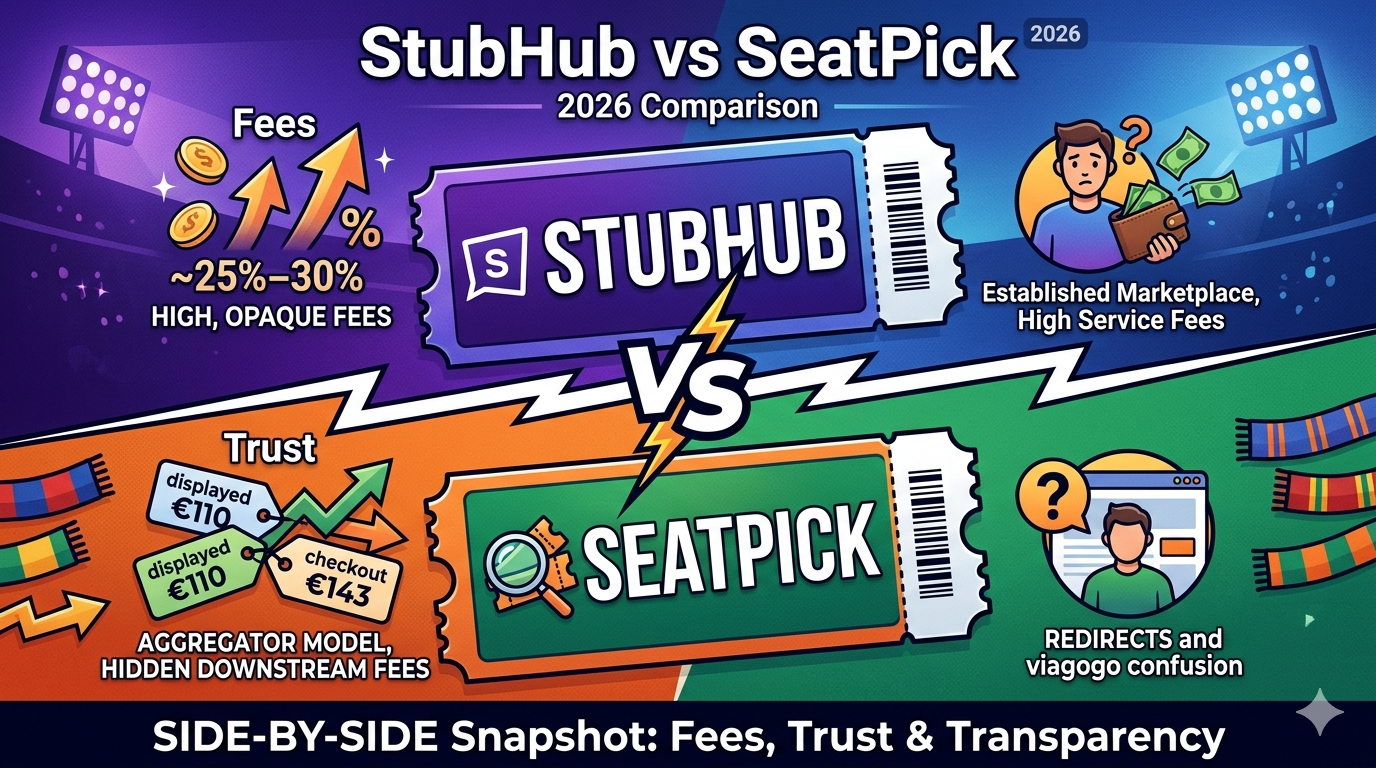
Here is a side-by-side snapshot of how StubHub, SeatPick, and TicketX Europe compare across the factors that matter most to European ticket buyers in 2026, before the detailed analysis that follows.
| Factor | StubHub | SeatPick | TicketX Europe |
| Business Model | Peer-to-peer resale marketplace | Aggregator / price-comparison engine (redirects to third-party sellers) | Direct ticket platform — 100% official & verified tickets |
| Buyer Fees | 25%–30% service fee added at checkout | Varies — downstream reseller adds 15%–35% after redirect | 0% buyer fees — listed price is checkout price |
| Price Transparency | Low — fees revealed late in checkout | Low — displayed price excludes fulfillment reseller fees | Full — all-in pricing from first click |
| Buyer Protection | FanProtect Guarantee (single entity) | Depends on whichever reseller fulfills the order | Direct buyer protection with secure checkout |
| Ticket Authenticity | Verified through marketplace; viagogo group association | No direct verification — relies on downstream seller | 100% official / verified tickets |
| European Event Coverage | Strong for PL, UCL, major tours | Broad aggregation but variable accuracy | Premier League, Champions League, La Liga, Serie A, Bundesliga, concerts, festivals |
| Trustpilot Rating (mid-2026) | ~4.4 / 5 (30,000+ reviews) | ~3.7 / 5 (73 reviews) | Growing — transparent pricing model drives positive sentiment |
| Biggest Drawback | High, opaque fees; viagogo ownership baggage | Not the actual seller; fragmented accountability | Newer brand — still building inventory breadth |
| Best For | Buyers who want a single-platform resale experience | Price-comparison shoppers comfortable with redirects | European buyers who refuse to pay hidden fees |
The sections below test every claim in the table above against real fee calculations, Trustpilot data, regulatory context, and a worked checkout comparison, so you can make a fully informed decision.
- StubHub is a well-known resale marketplace, but its 25%–30% buyer fees and late-reveal pricing model remain its most persistent criticism.
- SeatPick aggregates listings from multiple resellers and can surface lower starting prices, but the price you see is almost never the price you pay once the downstream seller adds its own charges.
- TicketX Europe eliminates both problems entirely: 0% buyer fees, transparent all-in pricing, and 100% official tickets for European events.
StubHub vs SeatPick Fees — What You Actually Pay at Checkout
Fees are the single most important variable in the StubHub-vs-SeatPick comparison. Not the number of listings. Not the seat map quality. Not the app design. Fees determine whether a £100 ticket costs you £100 or £135, and for European buyers spending €200–€500+ on premium football or concert tickets, the difference between platforms can easily exceed €50–€100 per order. This section quantifies exactly what each platform charges, with real numbers drawn from 2025–2026 pricing data.
StubHub Service Fees in Europe (Typically 25%–30% on Top)
StubHub’s fee structure for European buyers is percentage-based and applied to the buyer at checkout. The platform charges a service fee that varies by event but typically falls within the 25%–30% range for European market transactions. This fee is not displayed alongside the listing price during browsing — it appears only after the buyer selects a ticket and proceeds to the checkout screen.
Here is what that looks like in practice for a Premier League match:
| Line Item | Amount (GBP) |
| Listed ticket price (Cat 1 seat, Arsenal vs Chelsea) | £120.00 |
| StubHub service fee (~27%) | £32.40 |
| Delivery / e-ticket fee | £0.00–£5.95 |
| Total at checkout | £152.40–£158.35 |
For a pair of tickets, that is £64.80–£76.70 in fees alone — enough to buy a matchday meal, a program, and a scarf at the stadium. The fee percentage also does not decrease for higher-priced tickets; a €300 Champions League semi-final ticket generates a €75–€90 service fee at the same 25%–30% rate.
StubHub does not offer fee-free promotions in European markets as of mid-2026, despite users on Quora and Reddit frequently asking whether such promotions exist. The fee is a structural component of StubHub’s revenue model — the company earns from both the buyer fee and a separate seller fee (typically 15%) — and it is applied uniformly across European transactions.
- StubHub charges 25%–30% buyer service fees in European markets, applied at checkout.
- The fee is not visible during browsing or listing selection — it appears only at the payment screen.
- For a £120 Premier League ticket, expect to pay £152–£158 after fees.
- No fee-free promotions are currently available for European buyers.
SeatPick’s Hidden Markup Chain (15%–35% Above Face Value)
SeatPick’s fee situation is more complicated than StubHub’s — not because SeatPick charges higher fees per se, but because the fee structure is fragmented across two entities and the buyer cannot see the total cost until they have already left SeatPick’s website.
SeatPick itself does not publicly disclose a buyer fee percentage. Its revenue model is based on referral commissions and affiliate arrangements with downstream resellers. When a buyer clicks through from SeatPick to Viagogo, Viagogo applies its own fee structure — which, as a member of the same corporate group as StubHub, follows similar percentage-based pricing in the 20%–30% range.
The compounding effect works like this:
| Stage | Price (EUR) | What Happened |
| Face value of ticket | €100 | Original price set by the event organizer |
| Reseller listing price | €110 | Seller sets price above face value on Viagogo |
| Price displayed on SeatPick | €110 | SeatPick shows the base listing without fees |
| Viagogo service fee (~25%) | +€27.50 | Added after redirect to Viagogo checkout |
| Viagogo delivery fee | +€5.90 | Varies by delivery method |
| Total buyer pays | €143.40 | 43.4% above face value |
The buyer who started on SeatPick saw €110 and expected to pay approximately €110. They ended up paying €143.40. The gap — €33.40 — appeared only after they were redirected to a website they may not have intended to visit. This is the “hidden markup chain” that drives the most visceral negative feedback about SeatPick across Reddit, Trustpilot, and consumer forums.
To be clear, SeatPick is not the entity adding these fees. Viagogo (or whichever downstream reseller fulfills the order) is the fee-charging party. But SeatPick’s decision to display base prices without the fulfillment reseller’s fees creates a predictably misleading price signal. Prices shown are “estimates” that “may vary” on the seller’s site — a disclosure that is technically present but functionally invisible to most users who are focused on the seat map and listed price, not the fine print.
- SeatPick does not charge its own visible buyer fee, but its downstream resellers (primarily Viagogo) add 20%–30%+ in fees after redirect.
- The total markup from face value to final checkout through the SeatPick → Viagogo path is commonly 15%–35%, and can exceed 40% for high-demand events.
- SeatPick’s displayed price is a base estimate that excludes all fulfillment fees — making it structurally unreliable as a budgeting tool.
- The “hidden” aspect is not a deliberate scam but a structural consequence of the aggregator model that separates price discovery from price payment.
Side-by-Side Checkout Test — Champions League 2026 Ticket at €120 Face Value
To move beyond percentages and into concrete reality, here is what happens when you attempt to buy the same ticket — a Category 2 seat for a 2026 Champions League semi-final with a face value of €120 — through StubHub, through SeatPick (redirecting to Viagogo), and through TicketX Europe.
| Checkout Component | StubHub | SeatPick → Viagogo | TicketX Europe |
| Displayed listing price | €120.00 | €120.00 | €120.00 |
| Service / booking fee | +€33.00 (27.5%) | +€30.00 (25%, on Viagogo) | €0.00 |
| Delivery / fulfillment fee | +€5.95 | +€7.90 | €0.00 |
| VAT adjustment / surcharge | Included in service fee | +€2.10 | Included in listed price |
| Total checkout price | €158.95 | €160.00 | €120.00 |
| Markup over face value | 32.5% | 33.3% | 0% |
The €38.95–€40.00 difference between StubHub/SeatPick and TicketX Europe is not a rounding error. For a pair of tickets, you are paying nearly €80 in fees that contribute nothing to your matchday experience — no better seat, no closer view, no enhanced atmosphere. That €80 is pure platform extraction, and it is the reason the “StubHub vs SeatPick” comparison exists in the first place: buyers are searching for a way out of the fee trap.
- At €120 face value, StubHub charges €158.95 and SeatPick/Viagogo charges €160.00 at checkout.
- TicketX Europe charges €120.00 — the listed price is the final price, with 0% buyer fees and no hidden charges.
- The fee gap per ticket is €38.95–€40.00, or approximately €80 per pair of tickets.
- For premium events where face values are €200+, the savings with TicketX Europe scale proportionally.
Is StubHub Legit? Is SeatPick Legit? Trust & Safety Audit
Legitimacy is not a binary question — it exists on a spectrum that includes corporate structure, regulatory compliance, user experience reliability, and post-purchase accountability. Both StubHub and SeatPick are legally operating companies, not fly-by-night scam operations. But “legally operating” and “trustworthy for a €300 ticket purchase” are two very different standards, and European buyers are right to scrutinize both platforms before committing real money.
StubHub — Trustpilot Score, Top Complaints & Regulatory History
StubHub holds an approximate 4.4 out of 5 rating on Trustpilot based on more than 30,000 reviews as of mid-2026. That headline number is solid — but aggregate ratings obscure the distribution of complaints, and the 1-star reviews reveal recurring patterns that European buyers should understand.
The five most frequent complaint categories in StubHub’s negative reviews:
- Unexpected fees / final price higher than listed — the single most cited complaint, appearing in an estimated 35%+ of negative reviews. Buyers consistently express frustration that the checkout total was well above the browsing price with no advance warning.
- Refund difficulties for rescheduled events — buyers who cannot attend a rescheduled date report weeks-long disputes with customer service over whether they qualify for a refund under the FanProtect Guarantee.
- Customer service unresponsiveness during peak periods — Champions League final week, major tour on-sale dates, and festival season produce spikes in wait times and unresolved support tickets.
- Replacement ticket quality — when the original seller’s tickets fail, the replacement seats provided under FanProtect are sometimes in significantly different (worse) sections than what was originally purchased.
- Viagogo association confusion — some buyers report discovering mid-purchase or post-purchase that their transaction was processed through viagogo’s infrastructure, creating brand trust concerns.
Regulatory history: Viagogo (StubHub’s parent group since 2021) was ordered by the UK CMA in November 2018 to overhaul its pricing practices after an investigation found the platform was not adequately disclosing fees, seller identities, and ticket restrictions; in 2019 the CMA brought contempt-of-court proceedings after Viagogo failed to comply fully. While StubHub operates under separate branding, the shared corporate ownership means that any systemic issues within the viagogo group — from data handling to fee disclosure practices — are structurally relevant to StubHub buyers.
StubHub is a legitimate platform with a broadly positive review profile. But its fee transparency failures and inconsistent post-purchase support are not isolated incidents — they are structural features of the platform’s business model that European buyers encounter predictably and repeatedly.
SeatPick — Trustpilot Score, Redirect Confusion & Verification Gaps
SeatPick holds an approximate 3.7 out of 5 rating on Trustpilot based on roughly 73 reviews as of mid-2026. The far smaller review volume compared to StubHub reflects SeatPick’s more recent market entry and lower brand awareness, but the complaint patterns are distinct and instructive.
The four most frequent complaint categories in SeatPick’s negative reviews:
- Redirect confusion / “I didn’t know I was buying from Viagogo” — the defining complaint of SeatPick’s user experience. Buyers expect to purchase tickets on SeatPick and are surprised — sometimes alarmed — when they are redirected to Viagogo or another third-party reseller. Many users explicitly state they would not have continued if they had known Viagogo was the actual seller, given Viagogo’s own negative reputation in European markets.
- Price discrepancy between SeatPick’s displayed price and the reseller’s checkout price — directly related to the aggregator markup chain discussed above. Buyers feel baited by SeatPick’s price and then trapped on the reseller’s checkout page.
- No direct customer support for order issues — because SeatPick is not the seller, it cannot resolve delivery problems, invalid tickets, or refund disputes. Buyers who contact SeatPick are directed to the downstream reseller, creating a frustrating loop for users who do not understand the aggregator model.
- Ticket verification uncertainty — SeatPick does not verify the authenticity of the tickets listed on its platform. Verification responsibility falls entirely on the downstream reseller. For buyers who chose SeatPick because it looked like a trustworthy comparison tool, discovering that no one in the SeatPick layer verified the ticket’s legitimacy is a significant trust breach.
Key verification gap: Unlike a marketplace that processes the transaction (StubHub) or a direct platform that sources official tickets (TicketX Europe), SeatPick occupies a structural middle ground where it has visibility into pricing but no accountability for product quality. If a ticket purchased through the SeatPick → Viagogo pathway turns out to be invalid, the buyer’s recourse is with Viagogo — not SeatPick. SeatPick’s terms of service explicitly disclaim responsibility for the accuracy of listings and the conduct of third-party sellers. This is legally defensible but practically unhelpful for a buyer standing outside Camp Nou with a rejected ticket.
- StubHub’s 4.4/5 Trustpilot rating is strong, but the most common 1-star complaints are about hidden fees and refund difficulties.
- SeatPick’s 3.7/5 Trustpilot rating — drawn from a much smaller review base — is undermined by redirect confusion, price discrepancies, and zero direct accountability for order issues.
- Neither platform has been accused of systematic fraud, but both have structural trust gaps that European buyers should understand before purchasing.
- The safest approach is to buy from platforms that both sell and guarantee tickets directly — eliminating the accountability gaps inherent in aggregator and pure-marketplace models.
How to Verify Any Ticket Is Genuine Before You Buy
Regardless of which platform you choose, ticket authenticity verification is a non-negotiable step for European event purchases. Counterfeit tickets remain a real problem in secondary markets, and even platforms with buyer guarantees cannot always prevent invalid tickets from reaching buyers before the issue is discovered at the venue gate.
Here is a seven-point verification checklist you can apply to any ticket purchase:
- Confirm the platform’s ticket sourcing model. Is it a direct seller of official tickets, a peer-to-peer marketplace, or an aggregator? The closer the platform is to the original ticket source, the lower the counterfeit risk.
- Check the buyer guarantee terms in writing. Read the actual guarantee language — not the marketing headline. Look for specific coverage of: invalid tickets, non-delivery, event cancellation, and event rescheduling.
- Verify the delivery method. E-tickets with unique barcodes and mobile transfers are the most secure delivery methods. Be cautious of screenshots, PDFs without unique identifiers, or physical tickets shipped from unknown origins.
- Cross-reference seat details. If the listing specifies a section, row, and seat number, verify that those coordinates exist in the venue’s actual seating map. Fraudulent listings sometimes reference sections or rows that do not exist.
- Pay by credit card. Credit card purchases provide chargeback protection under consumer regulations in the UK (Section 75 of the Consumer Credit Act) and the EU. Debit cards and cryptocurrency offer significantly less recourse.
- Screenshot everything. Capture the listing page, the checkout confirmation, the buyer guarantee terms, and the payment receipt. If a dispute arises, this documentation is essential.
- Check the platform’s regulatory compliance. In the UK, legitimate ticket resellers must comply with the Consumer Rights Act 2015 requirements for secondary ticketing, including disclosing face value, seat location, and any restrictions on the ticket. Platforms that do not provide this information are non-compliant and should be avoided.
- Always confirm whether you are buying from a direct seller, a marketplace, or an aggregator — the accountability chain differs dramatically.
- Read the actual guarantee terms, not the marketing summary.
- Pay by credit card for chargeback protection and screenshot all transaction details.
- Platforms offering 100% official and verified tickets — like TicketX Europe — eliminate the verification burden entirely by sourcing only authenticated inventory.
Refund & Cancellation Policies — StubHub vs SeatPick Compared
No European buyer should spend €200+ on tickets without understanding exactly what happens to that money if the event does not go ahead. Cancellation and rescheduling scenarios are not rare in European live events — fixture congestion in football, weather disruptions, artist health issues in touring, and public health regulations have all caused event changes across the 2024–2026 period. The refund policies of StubHub and SeatPick differ structurally, and those differences have real financial consequences.
Event Canceled or Rescheduled — Who Refunds You?
StubHub’s cancellation refund policy is relatively straightforward for outright cancellations: if the event is officially canceled and no alternative date is scheduled, the buyer receives a full refund including the service fee, processed within 5–10 business days. This is a core component of the FanProtect Guarantee and is generally enforced reliably for canceled events.
For rescheduled events, StubHub’s policy becomes less favorable. The platform’s default position is that the original tickets remain valid for the rescheduled date, and no automatic refund is issued. If the buyer cannot attend the new date — a common scenario for international fans who booked travel around the original fixture — they must request a refund through customer service, where approval is discretionary and not guaranteed. During the 2024–2025 Premier League season, multiple fixture reschedulings due to European competition conflicts and weather postponements generated significant complaint volume from international buyers who could not use their rescheduled tickets and were denied refunds.
SeatPick’s refund situation is complicated by the aggregator model. SeatPick itself does not issue refunds because SeatPick did not receive the buyer’s payment. The buyer paid the downstream reseller (Viagogo, StubHub, or another platform), and the refund must be pursued through that entity. SeatPick’s customer support cannot initiate, expedite, or guarantee a refund from a third-party seller.
SeatPick Refund Complexity — The Downstream Liability Problem
The downstream liability problem is the most consequential practical risk of purchasing through SeatPick’s aggregator model. Here is the chain of events a buyer faces when seeking a refund for a canceled event:
- Buyer contacts SeatPick. SeatPick’s support team confirms that they cannot process a refund because they did not process the original payment.
- SeatPick directs the buyer to the downstream reseller. The buyer must identify which platform actually fulfilled their order (often Viagogo) and contact that platform’s customer support separately.
- Downstream reseller applies its own refund policy. Viagogo’s refund policy for canceled events is similar to StubHub’s (full refund for cancellations, discretionary for reschedulings), but the buyer must navigate Viagogo’s customer service process — which has its own Trustpilot complaint history regarding response times and refund delays.
- No single point of accountability. If the downstream reseller denies the refund or delays it beyond a reasonable timeframe, the buyer has no recourse through SeatPick. The buyer must pursue the matter directly with the reseller, potentially through credit card chargeback or consumer protection authorities.
This fragmented accountability chain is manageable for a buyer who understands the aggregator model and is comfortable navigating multiple customer service departments. For a first-time European ticket buyer who chose SeatPick because it appeared to be a straightforward purchase platform, the refund process can be genuinely kafkaesque — sent from one entity to another, neither of which considers the buyer to be fully “their” customer.
- StubHub refunds canceled events reliably but handles rescheduled events on a discretionary, case-by-case basis.
- SeatPick cannot process refunds at all — the buyer must pursue the downstream reseller directly, with no support or advocacy from SeatPick.
- The aggregator model creates a fragmented accountability chain where no single entity takes full ownership of the buyer’s refund claim.
- Platforms that sell tickets directly and guarantee refunds from a single entity — like TicketX Europe — eliminate this multi-party liability problem entirely.
コメント