Choosing between TicketSwap and StubHub for a European event in 2026 is not as straightforward as picking the platform with the bigger name. Both operate in the secondary ticketing space, both claim buyer protection, and both will happily take your money — but the amount of money they take, and the transparency with which they take it, diverges sharply.
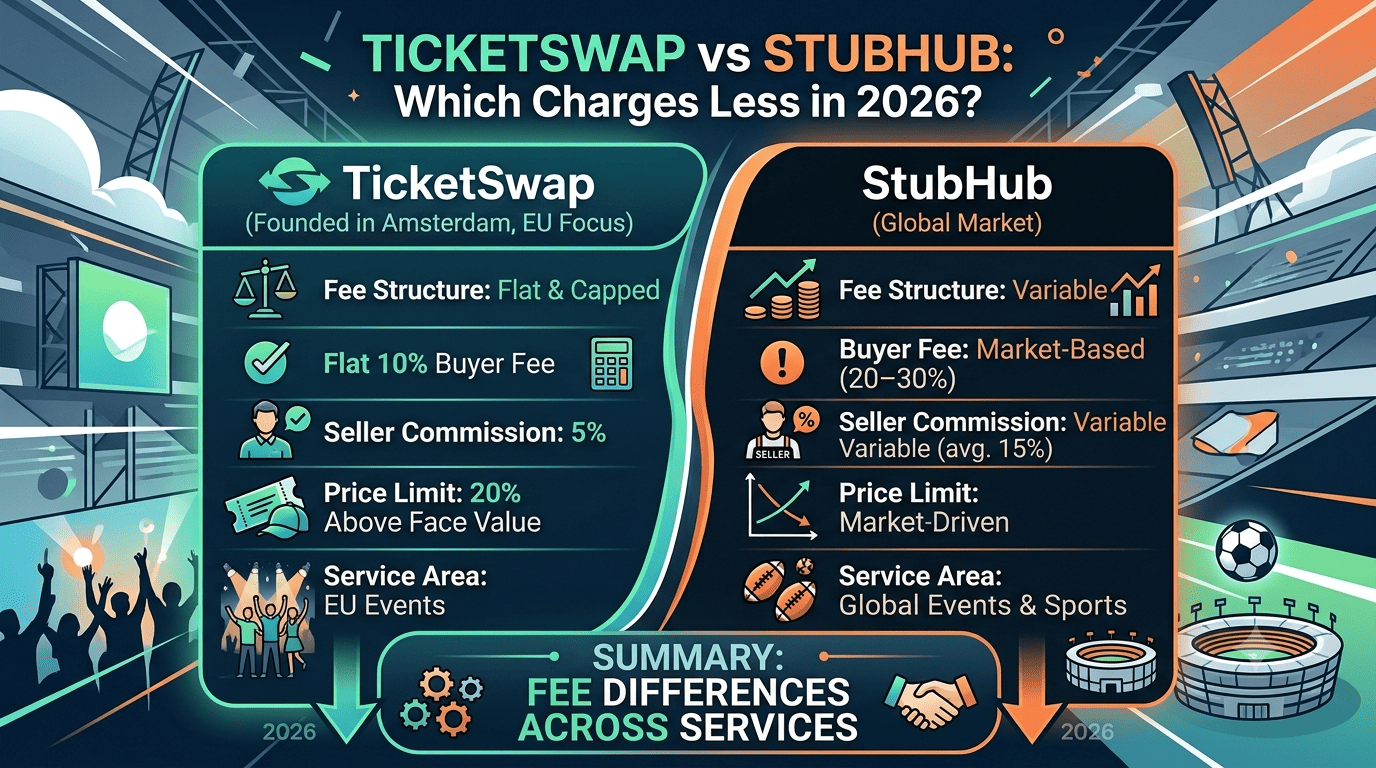
StubHub is the global heavyweight: founded in San Francisco in 2000, acquired by Viagogo in 2020, and now — together with its sister brand viagogo — serving customers in more than 200 countries and territories. Its inventory is vast, spanning NFL games to Premier League derbies, arena concerts to Broadway shows. But that global reach comes bundled with a fee model that European buyers have increasingly grown to resent — and that regulators on both sides of the Atlantic penalized in 2026. StubHub does not publish a fixed buyer-fee percentage — fees adjust based on ticket price, time to event, and supply and demand — but for high-demand European events, buyer-side charges frequently land in the 20–30% range, and they are rarely visible until the checkout screen. On a €300 Premier League ticket, your final cost can land anywhere between €365 and €400 once service charges and delivery fees are stacked on top.
TicketSwap takes a fundamentally different approach. Born in Amsterdam in 2012, the platform was built around peer-to-peer resale with a social conscience: price caps prevent sellers from listing tickets at more than 20% above face value in most markets, and the buyer fee is capped at 10%. That same €300 ticket costs approximately €330 at checkout. It is meaningfully cheaper than StubHub — but it is not free. Buyers still absorb a fee on every single transaction.
Both platforms verify tickets to varying degrees. StubHub offers its FanProtect Guarantee; TicketSwap uses barcode-scanning technology through its Secure Swap system. Neither is bulletproof, and neither fully eliminates the risk of gate denial at venues with strict non-transferable ticket policies.
Here is the quick-verdict comparison:
| Criteria | StubHub | TicketSwap |
| Buyer Fee Range | Variable — often 20–30% for high-demand events, plus delivery fee | Up to 10% |
| Price Transparency | Drip pricing — fined by the CMA (UK) and FTC (US) in 2026 | Better, but fee still added at checkout |
| Price Caps | No cap — market-driven pricing | Max 20% above face value (most markets) |
| Buyer Guarantee | FanProtect Guarantee | Secure Swap barcode verification |
| European Inventory Strength | Strong for Premier League, concerts, theatre | Strong for Dutch/Nordic events, EU festivals |
| Mobile Experience | Functional but US-centric design | Clean, EU-optimized app |
| Seller Fees | ~15% of sale price (variable) | 5% flat commission |
| 0% Buyer Fees | No | No |
The takeaway is blunt: TicketSwap is generally cheaper and more transparent than StubHub for European events, but neither platform offers a truly fee-free experience. If your priority is paying exactly what you see — with zero buyer fees and official, verified tickets — a third option exists, and we will break it down later in this article.
- StubHub dominates in global inventory breadth but carries some of the heaviest buyer-side fee totals in the resale market
- TicketSwap wins on pricing fairness within the peer-to-peer model but carries inventory limitations for major football and cross-border events
- Neither platform displays a fully transparent all-in price from the first click
- Regulators have moved from warnings to penalties: in June 2026, the UK Competition and Markets Authority fined StubHub UK £889,200 for illegal drip pricing and ordered refunds to 51,350 customers
- For fans who want the most honest checkout experience, 0% buyer-fee platforms are worth evaluating alongside both incumbents
TicketSwap Fees vs StubHub Fees — What You Actually Pay at Checkout
The single most important number when buying a ticket online is not the price displayed on the listing — it is the price that appears on your bank statement. And in 2026 — even after the UK Competition and Markets Authority fined StubHub UK for drip pricing under the Digital Markets, Competition and Consumers Act — neither StubHub nor TicketSwap shows you a fully loaded, all-in price the moment you first view a listing. Both platforms add fees at some point in the checkout flow. The question is how much, and how transparently.
This matters because the global online event ticketing market was valued at $55.4 billion in 2022 and is projected to reach $89.44 billion by 2030, growing at a 6.0% compound annual rate. With that volume of transactions, even small percentage-point differences in fees translate into billions of dollars flowing from fans’ wallets into platform margins. Understanding where your money goes is not pedantic — it is financially significant.
StubHub’s Fee Structure — Buyer Fees, Service Charges & FX Markups
StubHub’s fee model is the most aggressive in the mainstream resale market. The platform itself states that there is no set percentage for buyer fees — they adjust based on ticket price, time to event, and supply and demand. In practice, third-party analyses consistently find that buyer-side charges for in-demand events push totals 20–40% above the listed price. On top of the service fee, an electronic delivery fee — typically around $5–$10 per order — is added. For European buyers purchasing in euros or pounds, there is an additional layer: foreign-exchange conversion markups that are embedded in the displayed currency price but rarely itemized separately.
Consider a Champions League final ticket listed at $350. At the fee levels typical for high-demand events, the service fee alone can add $70 to $105, and the delivery fee pushes total added costs past $100 at the upper end. The final checkout price: roughly $425 to $465 for a ticket that was advertised at $350. This is not an edge case — this is the standard StubHub experience for high-demand European events.
Regulators have now confirmed what fans long suspected. In April 2026, the US Federal Trade Commission ordered StubHub to pay $10 million to consumers for advertising ticket prices without disclosing the all-in total, in violation of the FTC’s Fees Rule; StubHub disputed the FTC’s characterization, describing the case as covering a limited number of transactions over three days in May 2025. Two months later, the UK’s CMA fined StubHub UK £889,200 and ordered more than £590,000 in refunds to 51,350 customers after finding that mandatory delivery and service fees were only revealed at the final checkout stage between April and December 2025. StubHub UK admitted the breach, settled early for a reduced penalty, and says it has ended the practice. Either way, the pattern that generated years of complaints on forums like Reddit’s r/stubhub — users describing feeling “bait-and-switched” by drip pricing — is now a matter of regulatory record.
StubHub defends its fee structure by pointing to its FanProtect Guarantee, which is funded in part by these fees. The argument has merit: the guarantee does provide replacement tickets or refunds in certain scenarios. But the guarantee explains the size of the fees, not the timing of their disclosure — and it is the timing that regulators sanctioned.
Sellers on StubHub also absorb significant costs. The platform charges sellers a commission that typically lands around 15% of the final sale price — though, like buyer fees, the exact rate varies — which sellers tend to pass on to buyers by inflating the listing price. The result is a compounding effect: the buyer pays an inflated list price plus a hefty service fee on that already-inflated number.
- StubHub buyer service fee: variable — no fixed percentage, but commonly 20–30% of the listed price for high-demand events, and sometimes higher
- Electronic delivery fee: typically $5–$10 per order
- FX conversion markup: embedded, not itemized
- Seller commission: ~15% (variable), which inflates listing prices
- Drip pricing drew penalties in 2026: a $10M FTC settlement in the US and an £889,200 CMA fine in the UK
TicketSwap’s Fee Structure — Lower but Not Zero
TicketSwap’s positioning as a fairer alternative to StubHub is largely justified — but it is not the fee-free utopia that some first-time users expect. The platform caps its buyer service fee at 10% of the ticket price, and sellers pay a flat 5% commission. There are no delivery fees for mobile tickets, and the price-cap mechanism prevents sellers from listing above 120% of face value in most European markets.
This is materially better than StubHub. On a €300 ticket, TicketSwap adds approximately €30 in buyer fees, bringing the checkout total to around €330. There is no hidden FX markup for intra-EU transactions conducted in euros, and the fee percentage is displayed more prominently than on StubHub — though still not always visible on the initial listing card.
The 5% seller fee is also far lower than StubHub’s ~15%, which means sellers have less incentive to inflate their listing prices to recover platform costs. In theory, this produces more honest face-value-adjacent pricing throughout the marketplace.
However, a common misconception — frequently corrected on Reddit’s r/festivals — is that TicketSwap charges no fees at all. It does. Every buyer pays up to 10% on every transaction. For fans attending multiple events per year, those 10% additions compound into a meaningful annual expense. And while TicketSwap’s price cap is admirable, it does not apply universally: certain event categories and partner integrations may carry different terms.
- TicketSwap buyer fee: up to 10% of ticket price
- Seller commission: 5% flat
- No delivery fee for mobile tickets
- Price cap: max 20% above face value in most markets
- Fee is visible earlier in the flow than StubHub, but not shown on initial listing
- Still not a 0% buyer-fee platform
Side-by-Side Price Breakdown — A €300 Premier League Match Example
Abstract percentages are useful, but nothing clarifies a fee comparison like a concrete, euro-denominated example. Below is what a €300 face-value Premier League ticket can cost on each platform after all buyer-side fees are applied (StubHub figures are illustrative, based on the 20–30% fee levels typical for high-demand events; third-party analyses have documented totals running as high as 40% above the listed price):
| Cost Component | StubHub | TicketSwap | TicketX Europe |
| Listed Ticket Price | €300 | €300 | €300 |
| Buyer Service Fee | €60–€90 (variable, ~20–30%; can run higher) | €30 (10%) | €0 (0%) |
| Delivery / Processing Fee | €5–€10 | €0 | €0 |
| FX Markup (if applicable) | Embedded, unitemized | Minimal for EUR | None |
| Total Checkout Price | €365–€400 | €330 | €300 |
| Overpayment vs Face Value | €65–€100 (22–33%) | €30 (10%) | €0 (0%) |
The numbers speak with uncomfortable clarity. On StubHub, you can pay up to a third more than face value. On TicketSwap, you pay 10% more. On TicketX Europe, you pay exactly what you see — €300 in, €300 out — because the platform charges 0% buyer fees with no hidden checkout charges.
For a single ticket, the difference between StubHub and TicketX Europe is up to €100. For a couple attending four events over a season, that gap can approach €800 in cumulative fee savings. Over the life of a dedicated fan’s event calendar, the savings are substantial enough to fund additional experiences — another match, another concert, another weekend trip.
- StubHub can add €65–€100 in buyer-side fees to a €300 ticket
- TicketSwap adds €30 — better, but still not transparent from the first click
- TicketX Europe adds €0 — the listed price is the final price
- Over a season of four events for two people, the cumulative fee gap between StubHub and a 0% buyer-fee platform can approach €800
- Regulators and consumer groups across the UK and EU are converging on all-in pricing from the first click as the expected standard
Are TicketSwap & StubHub Tickets Legit? Safety & Buyer Protection Compared
Legitimacy is the bedrock question. No fee savings matter if the ticket gets you turned away at the turnstile. Both StubHub and TicketSwap have invested heavily in buyer-protection programs, but their approaches differ in architecture, coverage, and — critically — in the scenarios they fail to address. Understanding the mechanics of each guarantee is essential before committing money to either platform.
The scale involved is enormous: total attendance across the 2025–26 UEFA Champions League exceeded 8.3 million spectators, and knockout fixtures remain among the most oversubscribed tickets in European sport, with resale listings routinely priced at multiples of face value. At that scale, even a small percentage of fraudulent or non-transferable tickets represents tens of thousands of fans at risk. The stakes are not theoretical.
StubHub FanProtect Guarantee — What It Covers (and What It Doesn’t)
StubHub’s FanProtect Guarantee is the platform’s headline trust signal. In broad terms, it promises that buyers will receive valid tickets in time for the event, or StubHub will provide comparable replacement tickets or a full refund. If an event is cancelled and not rescheduled, buyers receive a refund. If tickets are not delivered by the event date, StubHub sources replacements.
This sounds comprehensive, and in many standard scenarios — a concert postponement, a delivery failure — it works. But the guarantee has documented limitations that are less prominently advertised:
Partial event changes: If an event changes venue or lineup but is not officially “cancelled,” FanProtect may not trigger a refund. Fans who bought tickets for a specific headliner at a festival, only to see that artist drop off the bill, have reported difficulty obtaining refunds under the guarantee.
Resold tickets that violate venue terms: FanProtect guarantees that the ticket is “valid,” but validity is defined by StubHub’s verification — not by the venue’s transfer policy. If a Premier League club uses non-transferable digital ticketing and the resold ticket is rejected at the gate, StubHub’s guarantee may not cover the scenario if the ticket was technically “valid” at the point of sale but invalidated by the club’s terms of service.
Refund timelines: Multiple Reddit threads on r/stubhub document refund processing times of 30–60 days for cancelled events, with some users reporting longer waits during peak cancellation periods.
Currency of refund: European buyers who paid in euros through a USD-denominated listing may receive refunds at the original exchange rate, which can result in a net loss if currency fluctuations have occurred.
- FanProtect covers: delivery failure, event cancellation, invalid tickets (as defined by StubHub)
- FanProtect gaps: venue-level transfer restrictions, partial lineup changes, currency-loss risk on refunds
- Refund processing: 30–60 days reported by users on Reddit’s r/stubhub
- The guarantee is funded in part by those buyer fees — you are paying for the safety net whether you need it or not
TicketSwap Secure Swap — How Barcode Verification Works
TicketSwap’s approach to fraud prevention is more technologically granular. The Secure Swap system requires sellers to upload their ticket’s barcode, which TicketSwap then validates against the event’s ticketing infrastructure. Once verified, the original barcode is invalidated and a new, unique barcode is generated for the buyer. This means the seller cannot use the original ticket after selling — a structural safeguard against the most common form of resale fraud (selling the same ticket to multiple buyers).
The system works well for events where TicketSwap has direct integration with the ticketing provider — and the platform’s official partner network is substantial, with primary tickets available from more than 6,000 partnered events. For those events, barcode verification is robust and gate denial is rare.
However, for events outside TicketSwap’s partnership network, the barcode-swap process depends on the ticket format. PDF tickets with standard barcodes can usually be verified and reissued. But mobile-only tickets tied to a specific account (increasingly common in the Premier League and across UEFA competitions) may not be compatible with the Secure Swap flow. In those cases, the buyer receives a transferred ticket that may or may not pass the venue’s digital verification at the gate.
Users on Reddit’s r/soccer have flagged cases where TicketSwap resale tickets for Premier League matches were rejected at the turnstile because the club’s ticketing system recognized the ticket as having been transferred through an unauthorized channel. TicketSwap’s buyer protection covers these scenarios with a refund, but the refund does not replace the experience of being denied entry on matchday.
- Secure Swap invalidates the seller’s barcode and issues a new one to the buyer
- Works reliably for the 6,000+ partnered events with direct integration
- Less reliable for mobile-only, account-linked tickets used by Premier League and UEFA events
- Gate denial cases have been documented on Reddit for non-partner events
- TicketSwap offers refunds for gate denial, but the lost experience is not recoverable
Why Resold Tickets Still Get Denied at the Gate
Neither FanProtect nor Secure Swap can override a venue’s own ticketing rules — and this is the gap that neither platform fully acknowledges in its marketing. An increasing number of European football clubs and concert venues have adopted non-transferable digital ticketing systems specifically to prevent resale. The ticket is bound to the original purchaser’s account, verified via the venue’s own app, and cannot be legitimately transferred to another person without the club’s or promoter’s involvement.
Premier League clubs including Chelsea, Manchester City, and Tottenham Hotspur have moved to account-linked digital tickets that can be voided upon unauthorized transfer. UEFA’s Champions League ticketing for knockout rounds uses a similar system, with tickets tied to the original buyer’s UEFA account. In these environments, a resold ticket — regardless of whether it was purchased on StubHub, TicketSwap, or any other secondary platform — carries an inherent risk of gate denial.
This is not a flaw specific to either platform. It is a structural limitation of the peer-to-peer resale model when confronted with venue-level digital rights management. The only way to fully eliminate this risk is to purchase through a channel that sources tickets from official or verified inventory with proper transfer authorization — not from individual resellers operating outside the venue’s ecosystem.
- Non-transferable digital tickets are increasingly standard at Premier League and UEFA events
- Neither FanProtect nor Secure Swap can override a venue’s transfer restrictions
- Gate denial risk exists on both platforms for events with account-linked ticketing
- The safest path is purchasing from platforms with official or verified ticket inventory and proper transfer authorization
- This structural limitation is a primary reason fans seek alternatives beyond peer-to-peer resale
Buying Tickets in Europe — TicketSwap vs StubHub Platform Experience
Beyond fees and fraud protection, the practical experience of using each platform matters — especially for European buyers navigating currency conversions, VAT implications, multilingual interfaces, and mobile ticket delivery. A platform can offer the lowest fees in the market, but if the checkout flow is confusing, the app crashes on matchday, or customer support is unreachable in your language, the savings are hollow.
StubHub in Europe — Global Inventory, US-Centric Design
StubHub’s greatest European strength is inventory depth. Because the platform operates globally and aggregates listings from sellers worldwide, its event coverage for major European events — Premier League fixtures, Champions League knockout rounds, Coldplay and Taylor Swift tours, West End theatre — is extensive. If a ticket exists on the secondary market, there is a reasonable chance it appears on StubHub.
The weakness is context. StubHub was designed for the US market, and its European experience often feels like a localized adaptation rather than a native product. Currency handling is a persistent pain point: listings may display in euros for a UK-based event, or in pounds for a buyer browsing from Germany, with the conversion rate embedded opaquely. VAT treatment is inconsistent — some listings include VAT, others do not, and the distinction is not always clear before checkout.
The mobile app is functional but optimized for US event types and navigation patterns. European football fans searching for, say, a La Liga fixture report that the search taxonomy prioritizes American sports categories, requiring extra taps to reach European leagues. Customer support is available in English and Spanish, with other European languages handled through translation layers that users describe as “adequate but not fluent.”
Delivery methods for European events include electronic delivery (e-ticket or mobile transfer), which works well for concerts and festivals, but can be problematic for football matches where venue-specific apps are required. StubHub provides instructions for ticket retrieval, but the process varies by event and is not always seamless.
- Inventory depth is StubHub’s strongest European asset — broadest selection across event types
- Currency display can be confusing; FX markups are embedded, not transparent
- VAT handling is inconsistent across listings
- App design prioritizes US event taxonomy; European navigation requires extra steps
- Customer support in non-English European languages relies on translation layers
- Mobile ticket delivery works for concerts but can be problematic for account-linked football tickets
TicketSwap in Europe — EU-Born but Limited by Its Peer-to-Peer Model
TicketSwap’s European credentials are genuine. The platform was built in Amsterdam, its interface is natively multilingual (Dutch, English, French, German, Spanish, and more), and its pricing displays in the local currency without opaque conversion markups. For intra-EU transactions, the experience is noticeably smoother than StubHub’s. The app is clean, fast, and designed with European festival and concert culture in mind — features like “friends nearby” and social-sharing integrations reflect the communal, peer-driven ethos of the European live-event scene.
The platform’s network of thousands of partnered events means that for many major Dutch and wider European festivals, TicketSwap functions almost as an official resale channel, with deep integration into the event’s ticketing infrastructure. For these events, the buying experience is excellent: barcode verification is seamless, ticket delivery is instant, and gate entry is virtually guaranteed.
The limitation emerges outside that partnership network. For Premier League football, Champions League fixtures, and large-scale arena concerts, TicketSwap’s peer-to-peer model means inventory depends entirely on individual sellers choosing to list there. Compared to StubHub’s aggregated global inventory, TicketSwap’s selection for high-demand football matches can be thin — and the tickets that are available carry the transfer-restriction risks discussed earlier.
Cross-border transactions within Europe work well on TicketSwap for festival tickets but can be complicated for football, where club-specific membership requirements, loyalty-point systems, and season-ticket holder restrictions create barriers that a peer-to-peer platform cannot navigate on the buyer’s behalf.
- Natively European interface, multilingual, local-currency pricing without FX markup
- Festival coverage is a standout strength — thousands of official event partnerships
- Football inventory is limited compared to StubHub, especially for Premier League and Champions League
- Cross-border football purchases are complicated by club-specific membership and transfer rules
- App is faster and cleaner than StubHub for European event types
- Customer support is available in multiple European languages natively
TicketSwap vs StubHub Event Coverage — Sports, Concerts & Festivals
The right platform depends heavily on what you are trying to see. A ticket marketplace can charge zero fees and offer ironclad buyer protection, but if it does not have the ticket you need, none of that matters. Here is how TicketSwap and StubHub stack up across the three major European event categories.
European Football — Premier League, Champions League, La Liga & Beyond
European football is the most complex category for secondary ticketing. Clubs operate their own primary ticket platforms, many enforce non-transferable digital tickets, and loyalty-point and membership systems gatekeep access to high-demand fixtures. The secondary market exists in tension with these controls.
StubHub has the deeper football inventory. Its global seller network ensures that tickets for virtually every Premier League match, Champions League fixture, and major La Liga or Serie A game are listed. For a North London derby or an El Clásico, StubHub will have options — though at a steep markup. The platform’s lack of a price cap means that in-demand matches can see listings at 300–500% of face value, with the buyer fee then applied on top of that inflated price.
TicketSwap has a growing but more limited football presence. Its club and organizer partnerships provide reliable inventory for those specific teams, but outside that network, selection is inconsistent. For a Champions League semi-final or a sold-out Premier League fixture, TicketSwap may have only a handful of listings — if any. The price cap prevents gouging, but it also discourages sellers with high-demand tickets from listing on the platform, since they can command higher prices elsewhere.
For football fans, the gap between both platforms’ promises and the reality of venue-specific restrictions is significant. Neither platform can guarantee gate entry for matches using non-transferable ticketing systems. The safest approach for European football is purchasing from platforms that source official or verified tickets with proper transfer authorization — rather than relying on peer-to-peer resale.
- StubHub: widest football inventory but the heaviest fees and no price cap — premium matches can cost 3–5x face value before buyer fees are added
- TicketSwap: price-capped, cheaper, but limited inventory outside its partner network
- Both platforms: cannot guarantee gate entry for matches with non-transferable digital ticketing
- The 2025–26 Champions League drew more than 8.3 million spectators, and knockout fixtures remain among the most oversubscribed tickets in Europe
- Fans seeking official, verified tickets with guaranteed entry should evaluate platforms beyond peer-to-peer resale
Concerts, European Tours & Music Festivals
The concert and festival landscape is where TicketSwap and StubHub diverge most clearly.
TicketSwap is the stronger platform for European music. Its thousands of event partnerships give it near-official status for many European festivals, and its barcode-verification system works reliably for most concert and festival ticket formats. The peer-to-peer model suits the festival ecosystem, where fans frequently buy tickets months in advance and later need to resell due to schedule changes. TicketSwap’s social features and community-oriented design align with the collaborative culture of European festival-going.
StubHub offers broader concert inventory, particularly for major arena tours and globally marketed acts. If you want floor seats for a Coldplay European tour date or premium tickets for an Ed Sheeran stadium show, StubHub is more likely to have the listing — albeit at a markedly higher total cost after fees. StubHub also covers West End theatre and major European performing arts events more comprehensively than TicketSwap.
Dynamic pricing has become a factor across both platforms. Algorithmic price adjustments are now widespread on major tours and increasingly common in top-flight football, pushing headline prices for high-demand events well above traditional face values before any resale markup is applied. On StubHub, that inflation stacks with the buyer fee at checkout. On TicketSwap, the price cap mitigates it — but does not eliminate the 10% buyer fee.
- TicketSwap excels for festivals and mid-tier concerts with verified peer-to-peer resale
- StubHub leads for major arena tours, stadium concerts, and West End theatre
- Dynamic pricing inflates headline prices for high-demand events before platform fees are even applied
- Neither platform offers 0% buyer fees for concert or festival tickets
- Fans seeking transparent concert ticket pricing should compare both platforms against 0% buyer-fee alternatives

コメント