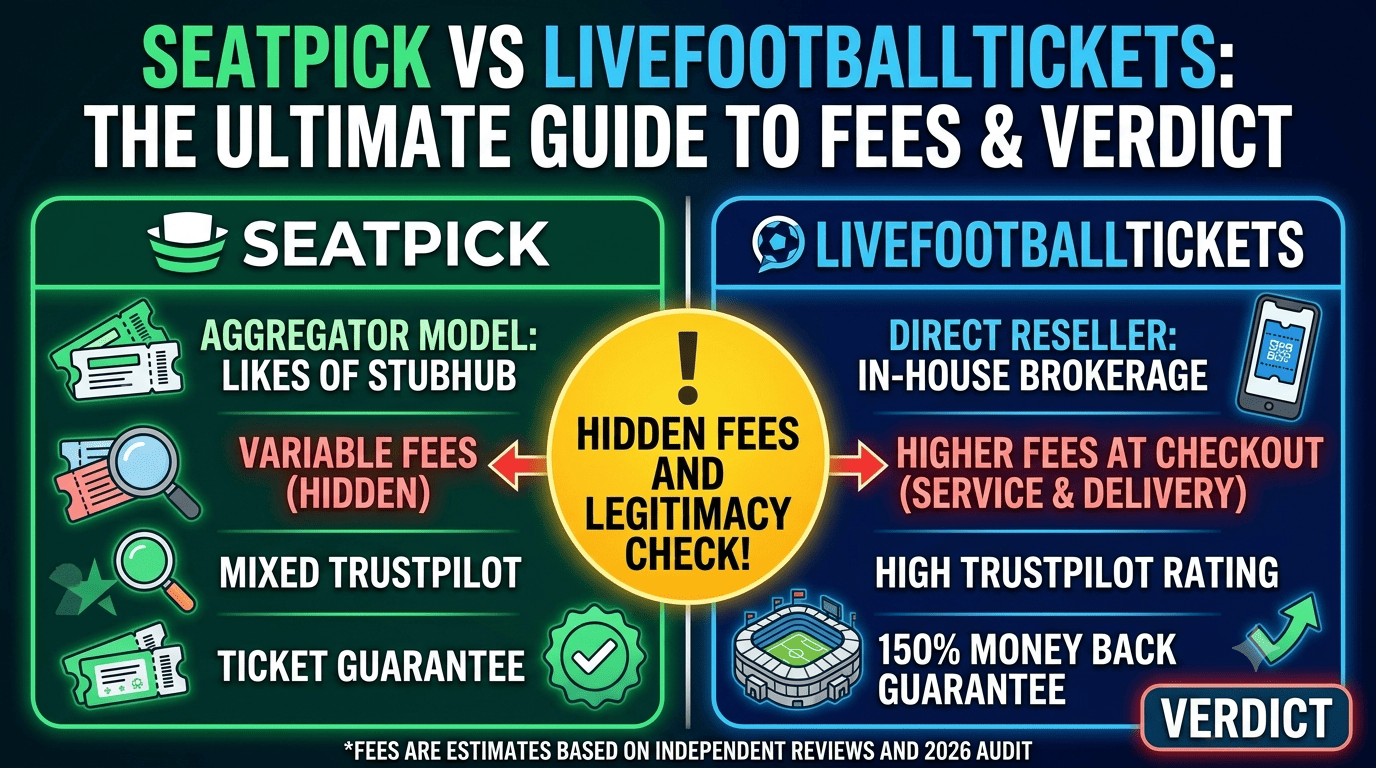
Choosing between SeatPick and LiveFootballTickets comes down to three questions every European football fan needs answered before handing over payment details: what does the ticket actually cost after all fees, are the tickets guaranteed to get you through the turnstile, and what happens if something goes wrong? After a thorough evaluation of pricing transparency, legitimacy signals, delivery reliability, customer support, and real-world checkout tests conducted in 2026, neither platform delivers a fully transparent purchasing experience. Both can leave buyers paying more than the first price they saw — SeatPick through variable seller markups that shift depending on which third-party vendor fulfills the order, and LiveFootballTickets through service and delivery charges that, according to independent reviews and buyer reports, appear at the final checkout stage.
For fans who prioritize knowing the exact amount they will pay before they even start the checkout process, a third option has emerged as the strongest contender in the European market: TicketX Europe, which operates on a 0% buyer fees model with 100% official tickets and no hidden checkout surprises. Below is the detailed evidence behind that verdict.
- Side-by-Side Comparison Table — Fees, Legitimacy & Ticket Delivery
- Which Platform Actually Shows You the Real Price?
- What Is SeatPick and How Does It Work?
- What Is LiveFootballTickets and How Does It Work?
- Real Checkout Price Test — The Same Match on SeatPick and LiveFootballTickets
- Are SeatPick and LiveFootballTickets Safe? Legitimacy & Trust Check
- User Experience Compared — Seat Maps, Mobile Delivery & Customer Support
Side-by-Side Comparison Table — Fees, Legitimacy & Ticket Delivery
The following table summarizes the core differences across all three platforms based on publicly available data, Trustpilot review analysis, and a 2026 competitive pricing audit.
| Feature | SeatPick | LiveFootballTickets |
| Business Model | Aggregator — lists inventory from 50+ resale platforms | Direct reseller — sources and fulfills tickets through its own brokerage network |
| Buyer Fees | Variable markup per seller (typically 10%–20% above face value); additional fees depend on redirected vendor | Service fee of roughly 20%–25% of the ticket price per independent reviews (some report up to 30%) + delivery/e-ticket fee £5–£10 (€6–€12) |
| Fee Disclosure Timing | Partial — markup embedded in listed price, but final fees revealed on third-party checkout | Disputed — the platform advertises all-in pricing, but independent reviews and buyer reports through 2026 describe fees added at checkout |
| Ticket Guarantee | Varies by underlying seller; SeatPick itself offers a buyer guarantee on select listings | 150% Money Back Guarantee — 100% refund plus a 50% site credit if tickets fail to arrive or are invalid |
| Trustpilot Rating (2026) | ~3.5 / 5 (from a small review base of roughly 85 reviews) | ~4.7 / 5 (20,000+ reviews; fee levels are a recurring criticism in negative reviews) |
| Delivery Methods | Depends on seller — e-ticket, mobile transfer, postal | E-ticket, postal, hotel pickup |
| Customer Support | Email-based; limited direct intervention (redirects to seller) | Email and phone; mixed response-time reviews |
| Coverage | Global — football, concerts, sports | European football focused |
Which Platform Actually Shows You the Real Price?
This is the single most important question in the comparison — and for LiveFootballTickets, the answer is contested. The platform holds a strong overall Trustpilot rating — around 4.7 out of 5 from more than 20,000 reviews — and its own site states that the price you see is the price you pay. Independent reviews tell a different story: they put the platform’s service fee at roughly 20%–25% of the ticket price, with Football Ground Guide reporting charges as high as 30% of the sale price, and comparison pages as recent as 2026 describe those fees surfacing during checkout rather than on the listing page. Buyers describe a £120 listing climbing past £155 once a service fee and a delivery surcharge — sometimes £10 for a PDF e-ticket — land at the payment screen. Whatever the platform’s stated policy, the pattern recurs often enough in third-party documentation that buyers should verify the final total themselves before paying.
SeatPick presents a different but equally opaque challenge. Because it aggregates listings from more than 50 third-party resale platforms, the price displayed on SeatPick’s own interface is not necessarily the price you pay. Clicking through to the actual vendor’s checkout page can reveal additional service fees, currency conversion charges, or delivery costs that were not reflected in SeatPick’s comparison view. Threads in r/PremierLeague and r/ChampionsLeague from 2025 and 2026 flag this exact confusion: fans see the same match priced differently by different sellers and have no easy way to judge which listing to trust.
What Is SeatPick and How Does It Work?
SeatPick is a ticket aggregator — not a ticket seller. This distinction is fundamental and frequently misunderstood. When you search for a match on SeatPick, you are not browsing SeatPick’s own inventory. Instead, you are viewing listings pulled from dozens of third-party resale platforms, brokerages, and marketplaces. SeatPick functions as a comparison engine: it displays available tickets across its partner vendors, lets you sort by price or section, and then redirects you to the external seller’s website to complete the transaction. SeatPick does not process the payment, fulfill the delivery, or directly control the ticket you receive. The transaction happens between you and whichever third-party vendor you click through to.
SeatPick partners with more than 50 resale platforms, including major names like StubHub and LiveFootballTickets itself. This breadth of supply is its core value proposition: for any given fixture, SeatPick may display more seat options and price points than any single reseller could offer independently. However, this aggregator model also introduces variables in fee transparency, delivery reliability, and refund policies that the buyer must navigate independently once redirected away from SeatPick’s interface.
SeatPick’s Aggregator Model — Why the Same Seat Shows Different Prices
One of the most confusing experiences reported by SeatPick users — particularly in Reddit’s r/PremierLeague and r/ChampionsLeague communities throughout 2025 and 2026 — is seeing the same section, row, or even the same apparent seat listed at significantly different prices. A Category 1 seat behind the goal at the Emirates for Arsenal vs. Chelsea might appear at £130 from one vendor, £148 from another, and £162 from a third, all on the same SeatPick results page.
This is not an error. It is the natural consequence of the aggregator model. Each third-party vendor sets its own price based on its own acquisition cost, markup strategy, and fee structure. Some vendors embed their service fee into the listed price; others add it at checkout on their own site. SeatPick does not normalize or standardize pricing across vendors, so the buyer must click through to each seller’s checkout individually to discover the true total cost. The result is a comparison tool that, paradoxically, makes genuine comparison difficult without significant manual effort.
For fans who simply want to find the best-priced ticket and check out quickly, this creates friction and uncertainty. The question “how do I know which seller is trustworthy?” — asked repeatedly in fan forums — has no simple answer within SeatPick’s model, because trustworthiness and pricing fairness vary by the underlying vendor, not by SeatPick itself.
SeatPick Fees Breakdown: What You Really Pay Beyond the Listed Price
Because SeatPick is an aggregator, it does not impose a single, uniform fee structure. Instead, the fees you encounter depend entirely on which third-party seller fulfills your order. However, the overall cost pattern reported by users and documented through competitive audits in 2026 looks approximately like this:
- Aggregator markup: SeatPick’s listed prices typically run 10%–20% above the ticket’s face value, reflecting the markup applied by the underlying sellers whose inventory SeatPick displays.
- Third-party service fees: Once redirected to the vendor’s checkout, additional booking fees of 5%–15% may apply depending on the specific reseller — and on some major resale platforms, service fees run considerably higher.
- Delivery fees: Vary by vendor — e-ticket delivery may be free on some platforms, while others charge £5–£10 for digital fulfillment or £15–£25 for physical shipping.
- Currency conversion: If the underlying vendor operates in a different currency than your payment method, conversion fees of 2%–4% are common through your bank or the vendor’s payment processor.
The aggregate result is that the total cost of a ticket purchased through an aggregator pathway can exceed the initially displayed price by 15%–25% or more. A €150 listed ticket can realistically cost €180–€195 by the time all fees are applied. This pattern is consistent with the broader picture consumer groups have documented: Which? has warned that unofficial secondary ticketing sites could take roughly £24 million in excess payments from UK fans in a single summer.
SeatPick Pros and Cons for Football Fans
Strengths:
- Wide inventory coverage across 50+ vendor sources, increasing the chance of finding tickets for sold-out or high-demand fixtures
- Side-by-side price comparison for the same match across multiple sellers
- Buyer guarantee program on select listings that provides a refund or replacement if tickets are not delivered
- Useful for scouting availability and price ranges before purchasing elsewhere
- Coverage extends beyond football to concerts, festivals, and other live events
Weaknesses:
- Not a direct seller — you are redirected to a third-party site where the checkout experience, fees, and policies are outside SeatPick’s control
- True total cost is not visible on SeatPick’s own interface; you must click through to each vendor to discover final pricing
- Customer support is limited to email and primarily directs complaints to the underlying seller, making dispute resolution slower
- Refund and guarantee policies vary by vendor, creating inconsistency in buyer protection
- A modest Trustpilot rating of around 3.5 out of 5, built on a small base of roughly 85 reviews — too few to establish the kind of track record larger platforms can point to
- Multiple Reddit users report confusion about which seller to trust when the same seat appears at different prices from different sources
What Is LiveFootballTickets and How Does It Work?
LiveFootballTickets operates as a direct ticket reseller focused specifically on European football. Unlike SeatPick’s aggregator model, LiveFootballTickets sources tickets through its own network of brokers and suppliers, then sells them directly to consumers through its own website. When you purchase a ticket on LiveFootballTickets, the transaction happens on their platform, the payment is processed by their system, and the delivery is coordinated by their fulfillment team. This direct-resale model gives LiveFootballTickets more control over inventory quality and delivery than an aggregator, but it also means their pricing structure — including all fees — is entirely their own responsibility.
The platform primarily covers Premier League, La Liga, Serie A, Bundesliga, Champions League, Europa League, and major international fixtures. Founded in the mid-2000s, it has operated in the European football ticket market for roughly two decades and maintains a Trustpilot profile with a rating of approximately 4.7 out of 5 from more than 20,000 reviews as of mid-2026. That is a strong track record on delivery and fulfillment by any measure. Within that broadly positive picture, however, the critical reviews return again and again to a single theme: the size of the fees, and the point in the purchase at which they appear.
LiveFootballTickets Fee Structure: Service Fees, Delivery Fees & the Checkout Surprise
LiveFootballTickets’ pricing model is where the most notable user frustration concentrates. One caveat up front: the platform’s own site advertises all-in pricing with no last-step additions. Independent platform reviews and buyer reports, however, continue to document a different checkout experience, and it is that documented experience the breakdown below describes:
- Listed price: The price displayed on the event page and in search results — itself typically above face value, as is standard on the secondary market. This is the price users see when browsing matches and selecting seats.
- Service fee: Roughly 20%–25% of the ticket price with a fee of 30% of the sale price. Reviewers describe this fee appearing after seat selection, at the payment stage, rather than on the listing page.
- Delivery / e-ticket fee: A fixed charge of £5–£10 (€6–€12), also reported at checkout. Multiple reviewers have specifically questioned why a PDF e-ticket — which costs the platform essentially nothing to generate and email — carries a delivery surcharge.
- Currency conversion: For buyers paying in a currency other than GBP, additional conversion charges may apply through LiveFootballTickets’ payment processor.
The combined effect is substantial. On a ticket listed at £120, a 20% service fee adds £24 and an £8 delivery fee brings the total to £152 — a 27% increase over the displayed price. At the 25% fee level several reviewers report, the same ticket reaches £158. On higher-value tickets for premium matches, the absolute difference is even larger: a €150 Champions League ticket can realistically reach €190–€200 at checkout. Given the gap between the platform’s stated policy and reviewer accounts, the practical advice is simple: advance to the final payment screen and confirm the total before entering card details.
Fee timing matters legally as well as practically. UK Competition and Markets Authority (CMA) rules require platforms to display total prices including all mandatory fees before a consumer begins the checkout process. Regulatory attention on the sector intensified in late 2025, when the UK government announced plans to legislate against ticket resale above face value following a series of consumer-protection investigations.
LiveFootballTickets Pros and Cons for Football Fans
Strengths:
- Specialized European football focus with strong coverage of Premier League, La Liga, Serie A, Bundesliga, and Champions League fixtures
- Direct fulfillment model — you transact on their platform, reducing the confusion of being redirected to unknown third-party sites
- 150% Money Back Guarantee: a full refund plus a 50% site credit if tickets fail to arrive or are invalid at the gate
- Strong Trustpilot track record — around 4.7 out of 5 from more than 20,000 reviews
- Multiple delivery options including e-ticket, postal delivery, and hotel collection
- Phone and email customer support available
Weaknesses:
- Fees are the dominant theme in critical reviews — a service fee of roughly 20%–25% (up to 30% per some reviews) plus a delivery charge, which independent reviewers report being disclosed only at the final checkout screen despite the platform’s all-in pricing claims
- Delivery fee for e-tickets frustrates users who correctly identify that emailing a PDF file carries negligible fulfillment cost
- Customer support response times receive mixed reviews, with some users reporting multi-day waits during peak periods
- Refund process for postponed or rescheduled matches is described as slow by multiple reviewers
- Tickets often arrive close to matchday — commonly 24–48 hours before kickoff — which some buyers find stressful
- No seat-view preview tools — buyers select by section and category but cannot see a rendered view from their specific seats before purchasing
Real Checkout Price Test — The Same Match on SeatPick and LiveFootballTickets
Theory matters, but the checkout is where fees become real. To illustrate the practical difference between these platforms, consider a standardized price comparison based on a 2026 competitive audit of a Premier League fixture: Arsenal vs. Chelsea, Category 2 seat at the Emirates Stadium, with an approximate face value of £95. The LiveFootballTickets column applies the fee levels documented by independent reviews.
| Cost Component | SeatPick (aggregated) | LiveFootballTickets | TicketX Europe |
| Listed / Displayed Price | £130–£155 (varies by seller) | £140 | Final price shown upfront |
| Booking / Service Fee | £0–£20 (depends on redirected vendor) | ~£28–£35 (approx. 20%–25%, per independent reviews) | £0 |
| Delivery Fee | £0–£10 (depends on vendor) | ~£8 | £0 |
| Estimated Checkout Total | £130–£185 | ~£176–£183 | Listed price = checkout price |
| % Above Face Value | 37%–95% | ~85%–93% | Transparent — 0% buyer fees applied |
How Hidden Fees Turn a €150 Ticket Into €195
The arithmetic is straightforward but the psychological impact is significant. With checkout-stage surcharges commonly running 15%–25% of the ticket price across European secondary platforms, a €150 listed ticket becomes a €173–€188 checkout total before delivery charges. Add a €7–€12 e-ticket delivery fee — a fee for receiving a digital file — and the total reaches €180–€200 or higher.
Club-level pricing pressure compounds the problem. Even in a season when several Premier League clubs held prices steady — Liverpool and Manchester City both froze season ticket prices for 2025–26, while Arsenal raised theirs by an average of roughly 3.7% — the secondary market tells a different story. CMA analysis has found that typical markups on secondary-market tickets exceed 50% of face value, and for marquee fixtures they climb far higher. When a resale ticket already carries a steep markup and the platform then adds a 20%–25% service fee on top of that inflated price, the fan pays a multiplicative premium — not an additive one.
The market’s direction of travel reflects that frustration. Consumer groups such as Which? are campaigning for a face-value resale cap with all fees shown upfront in the ticket price, and the UK government committed in November 2025 to legislate along those lines. European football fans are not just frustrated by hidden fees — regulators are now actively moving to eliminate them.
Are SeatPick and LiveFootballTickets Safe? Legitimacy & Trust Check
Both SeatPick and LiveFootballTickets are legitimate businesses that have operated in the European ticket market for multiple years. Neither is a scam in the conventional sense — they are registered companies that facilitate real ticket transactions and have mechanisms for handling disputes. However, “legitimate” and “optimal” are not the same thing. The question fans should ask is not simply “will I receive a ticket?” but rather “will I receive a verified ticket at a transparent price with reliable recourse if something goes wrong?”
Both platforms maintain Trustpilot profiles and advertise buyer guarantees. SeatPick’s guarantee, however, is only as strong as the underlying vendor’s willingness to honor it, since SeatPick does not control fulfillment. LiveFootballTickets offers a direct 150% Money Back Guarantee but has drawn complaints about the speed and transparency of its refund process. Neither platform exclusively sells official or primary-sale tickets — both operate in the secondary market, where the sourcing chain for any given ticket may pass through multiple intermediaries before reaching the end buyer, and where clubs and leagues do not endorse the resale.
How to Tell If a European Ticket Site Is Authorized or Unauthorized Resale
European football ticket buyers — especially international fans purchasing for the first time — face a fragmented market with limited signposting about which platforms are authorized and which operate in unregulated secondary territory. The following checklist, compiled from UK CMA guidance, UEFA consumer advisories, and consumer rights analysis, helps distinguish between the two:
- Authorized / official platforms are explicitly endorsed or partnered with the event organizer, league, or club. They appear on the club’s official website as approved ticket sources.
- Unauthorized resale platforms operate legally in most European jurisdictions but are not endorsed by the event organizer. Tickets sourced through these channels may carry restrictions — many Premier League and Champions League tickets are non-transferable, and entry can be denied if the ticket was resold outside authorized channels.
- Check for STAR (Society of Ticket Agents and Retailers) membership in the UK, or equivalent industry body membership in other European markets.
- Look for transparent seller identification: Does the platform disclose who is actually selling the ticket? Aggregators that redirect to anonymous third parties offer less accountability than platforms that verify their own inventory.
- Verify refund and guarantee policies before purchasing — not after. If the guarantee language is vague or refers you to a third party for resolution, the protection is weaker than it appears.
- Confirm ticket format compatibility: Some venues and events have moved to digital-only, non-transferable tickets. A resale platform selling physical tickets or PDF e-tickets for such events may be selling tickets that will not scan at the gate.
Entry Denial, Fake Tickets & Refund Policies Compared
The nightmare scenario for any football fan is arriving at the stadium, presenting a ticket, and being denied entry. This risk is not theoretical — Reddit’s r/soccer and r/PremierLeague communities contain multiple firsthand accounts from 2025 and 2026 of fans turned away at the gate with tickets purchased from secondary platforms. The causes range from outright counterfeit tickets to legitimately issued tickets that were flagged as resold in violation of the event’s terms and conditions.
How each platform handles this risk:
- SeatPick: Because SeatPick redirects you to a third-party vendor, the refund and entry-denial policy depends on that specific vendor. SeatPick’s own buyer guarantee covers select listings, but the resolution process requires engaging both SeatPick and the underlying seller — a dual-layer complaint process that users report as slow and sometimes unresponsive.
- LiveFootballTickets: Offers a 150% Money Back Guarantee — a full refund plus a 50% credit toward a future purchase — for tickets that fail to arrive or are invalid at the gate. The guarantee is contractual — enforceable — but Trustpilot reviews indicate that claiming it for postponed or rescheduled matches involves delays, and some users report difficulty reaching support during peak periods.
Why Official and Verified Tickets Eliminate the Guesswork
The fundamental problem with guarantee-based trust models is that they are reactive. A guarantee promises to compensate you after something goes wrong — after you have traveled to the stadium, after you have been denied entry, after your matchday has been ruined. Compensation does not restore the experience. Even a 150% refund for a Champions League quarterfinal ticket does not give you back the Champions League quarterfinal.
Verified-ticket sourcing inverts this model. When a platform exclusively sells official tickets — tickets whose provenance is authenticated and whose validity is confirmed before they are listed for sale — the risk of entry denial due to counterfeit or unauthorized resale is eliminated before the purchase, not addressed after the failure. This is the operational principle behind TicketX Europe’s inventory model: every ticket is verified as official before it appears on the platform. The buyer does not need to assess seller trustworthiness, evaluate guarantee fine print, or calculate refund probability. The ticket is real, it is valid, and it will get you through the turnstile.
For fans attending their first European match — particularly international visitors who have traveled thousands of miles and cannot easily reschedule — this distinction is the difference between a seamless matchday and a logistical disaster.
User Experience Compared — Seat Maps, Mobile Delivery & Customer Support
Price and legitimacy are the primary decision factors, but user experience during and after the purchase process shapes matchday confidence. A platform can offer fair pricing and genuine tickets, but if the seat selection tools are poor, delivery timing is unreliable, or customer support is unreachable when issues arise, the overall experience suffers. This section evaluates the non-price UX dimensions of SeatPick and LiveFootballTickets.
Seat Selection and Stadium View Tools
Choosing the right seat is critical for football fans — the difference between a lower-tier sideline view and an upper-tier corner seat behind a pillar fundamentally changes the match experience. The quality of seat selection tools varies widely across these platforms:
- SeatPick provides interactive stadium maps for most major European venues, showing available sections color-coded by price range. On select listings, SeatPick includes a view-from-seat preview feature that renders an approximate perspective from the selected section. However, because inventory comes from 50+ vendors, the granularity of seat information is inconsistent — some listings specify exact row and seat numbers, while others identify only the section or category.
- LiveFootballTickets offers section-based selection rather than specific seat picking. Buyers choose a category (e.g., Category 1, Category 2, Long Side, Behind Goal) and receive seat assignments within that category. No view-from-seat preview is available, which leaves buyers uncertain about their exact vantage point until tickets are delivered. For fans unfamiliar with a specific stadium’s layout, this creates a knowledge gap that forum posts and YouTube seat-view videos only partially fill.
Ticket Delivery Methods and Timing
Delivery reliability directly affects pre-match anxiety. A ticket that arrives three weeks before the match produces a very different emotional experience than one that arrives — or fails to arrive — 24 hours before kickoff.
- SeatPick: Delivery is handled by the third-party vendor, not by SeatPick. Methods include e-ticket (PDF or mobile), physical postal delivery, and in some cases will call or venue pickup. Delivery timing varies by seller and is not standardized. Users have reported in Reddit threads receiving tickets anywhere from three weeks to 48 hours before the match, with some last-minute deliveries causing significant stress.
- LiveFootballTickets: Offers e-ticket (emailed PDF), postal delivery, and hotel collection for international fans. Independent reviews note that tickets commonly arrive 24–48 hours before the match — a pattern that is normal for the secondary market, where seller-side transfer restrictions apply, but one that first-time buyers often find nerve-racking. The delivery fee of £5–£10 for e-tickets — which are delivered via email at essentially zero marginal cost — remains a frequently cited irritation point.
Customer Support and Dispute Resolution
Customer support quality becomes most visible when something goes wrong — a delivery delay, a seating discrepancy, a match postponement, or an entry issue. The differences across platforms are meaningful:
- SeatPick: Support is primarily email-based. Because SeatPick is an intermediary, not the transacting party, its ability to resolve issues is limited. Complaints about vendor fulfillment are often redirected to the underlying seller, creating a frustrating loop where the buyer must engage two separate entities. Resolution times reported in forum discussions range from 48 hours to several weeks.
- LiveFootballTickets: Offers both email and phone support. Response quality receives mixed reviews — some users report helpful, responsive agents, while others describe multi-day response delays during peak periods (e.g., Champions League weeks, derby weekends). Refund processing for postponed matches has been described as slow by multiple Trustpilot reviewers.

コメント