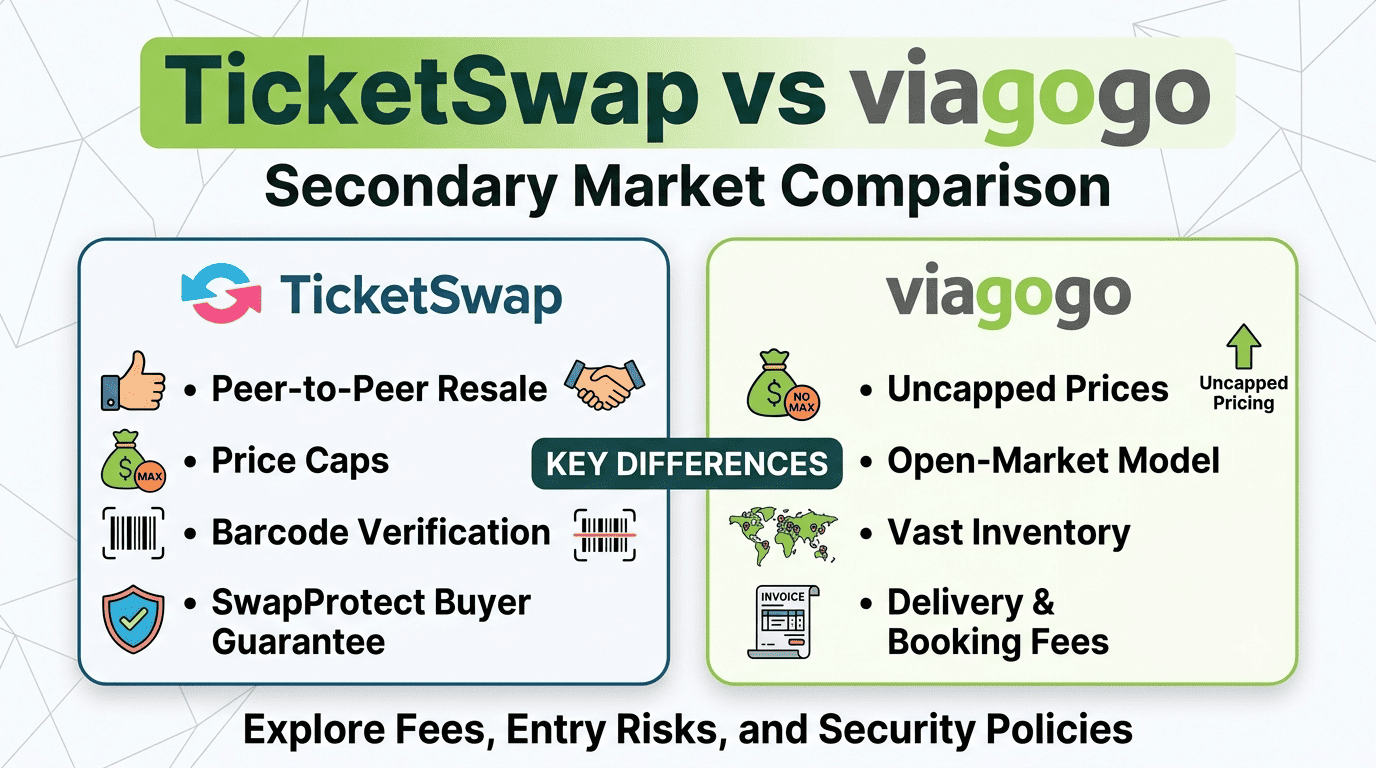
Here is the comparison snapshot that most readers searching “TicketSwap vs viagogo” actually need. The table below distills checkout simulations, current Trustpilot data, regulatory filings, and real-world gate-entry reports into one scannable resource.
| Criteria | viagogo | TicketSwap |
| Buyer Fees | 20–28% + delivery + FX markup | ~10% (7% service + 3% transaction) |
| Final Cost on a €100 Ticket | €125–€132 | ~€110 |
| Price Cap on Resale | None — open-market speculation | Max 20% above face value |
| Ticket Source | Third-party sellers (unverified origin) | Fan-to-fan (peer-to-peer) |
| Trustpilot Rating (Mid-2026) | 4 / 5 (~22,000 reviews on .com; ~50,000 on .co.uk) | ~4.5 / 5 (40,000+ reviews) |
| Non-Transferable Digital Ticket Risk | High — no control over transfer restrictions | Medium — barcode swap works only if venue allows |
| Refund on Entry Refusal | Frequently disputed — “valid ticket” arguments complicate claims | SwapProtect: replacement or refund (conditions apply) |
| Hidden Fees at Checkout | Yes — service and delivery fees appear late in checkout | Minimal, but currency conversion can add cost |
The one-paragraph verdict: viagogo offers vast global inventory but combines it with layered fees, uncapped speculative pricing, and a regulatory record that includes a UK court order over pricing transparency. TicketSwap is a safer peer-to-peer alternative with lower fees and a price cap, yet its model still cannot guarantee gate entry when venues enforce non-transferable, mobile-ID ticketing — a policy now standard across the Premier League, Bundesliga, and UEFA competitions. If your priority is paying exactly the listed price, avoiding hidden fees entirely, and holding a ticket that will actually scan at the turnstile, TicketX Europe’s 0% buyer-fee model with official, verified tickets eliminates the core risks of both resale platforms.
What Is viagogo and How Does It Work?
viagogo is a secondary ticket marketplace founded in London in 2006. It connects third-party sellers — including professional brokers, season-ticket holders, and speculative resellers — with buyers seeking tickets to sold-out events worldwide. In November 2019, viagogo announced an agreement to acquire StubHub from eBay for $4.05 billion; the deal closed in February 2020, creating one of the largest resale ticket operations on the planet. The UK’s Competition and Markets Authority later ordered the divestment of StubHub’s business outside North America, but the scale remains enormous: StubHub Holdings — the parent of both the StubHub and viagogo brands — reported $8.7 billion in gross merchandise sales for 2024 in its IPO filing.
The mechanics are straightforward on the surface: a seller lists a ticket, sets any price they choose, and a buyer purchases it through viagogo’s checkout system. viagogo acts as an intermediary, holding payment until the buyer receives the ticket. Crucially, viagogo imposes no price ceiling. A €50 face-value ticket for a Champions League quarter-final can be listed at €400, €800, or higher — the market decides, and viagogo takes a percentage of whatever clears.
This open-market model is precisely what makes viagogo both powerful and problematic. It provides access to tickets that are genuinely unavailable elsewhere, but it also incentivizes speculative buying — professional resellers purchasing tickets at face value specifically to flip them at multiples on viagogo’s marketplace. The result is an ecosystem where the buyer bears the full cost of speculation and layered fees..
viagogo Fee Structure — What a €100 Ticket Really Costs
The most persistent complaint about viagogo across consumer forums, Trustpilot, and regulatory bodies is not the ticket prices themselves — it is the fees that materialize between the listing page and the payment confirmation screen.
Here is a realistic euro-by-euro breakdown of what a ticket listed at €100 on viagogo actually costs the buyer in 2026, based on checkout simulations and the pricing-disclosure issues documented in the CMA’s secondary ticketing case:
| Fee Component | Typical Amount | % of Face Value |
| Listed Ticket Price | €100.00 | 100% |
| Service / Booking Fee | €15.00–€20.00 | 15–20% |
| Delivery / Handling Fee | €5.00–€7.00 | 5–7% |
| Currency Conversion Markup (if applicable) | €3.00–€5.00 | 3–5% |
| Total Checkout Price | €125–€132 | 25–32% |
That €100 ticket quietly becomes €125 to €132 by the time the “Confirm Purchase” button appears. Drip pricing — advertising one price and charging another after fees appear late in the checkout flow — is exactly the practice the European Commission continues to target in its consumer-protection work; its 2025 Consumer Conditions Scoreboard found unfair commercial practices to be widespread online, including misleading discounting experienced by 61% of online consumers — that is, discounts that appeared too large to be genuine.
In consumer forums, buyers regularly ask whether it is normal for viagogo’s final price to land 25–30% above the listed price. Based on our July 2026 checkout simulations, that range is typical.
Is viagogo Legit? Trustpilot Scores, CMA Orders & Consumer Complaints
viagogo is a legitimate, registered marketplace that facilitates real ticket transactions. The more useful question is not whether it is legitimate — it is — but what buying there actually costs, in both fees and event-day risk.
Trustpilot data as of mid-2026: viagogo holds a 4 out of 5 rating — roughly 22,000 reviews on its .com domain and 50,000 on .co.uk. The aggregate score looks respectable, but the critical reviews cluster around familiar themes: fees revealed late in checkout, prices far above face value, and slow or disputed refunds. A decent star rating and a documented regulatory history can coexist — and in viagogo’s case, they do.
Regulatory actions: The UK Competition and Markets Authority secured a court order against viagogo in November 2018, requiring clearer pricing disclosure and better information about ticket restrictions, with a compliance deadline of mid-January 2019. By September 2019, the CMA confirmed viagogo had addressed its outstanding concerns and suspended preparations for further court action; in 2021 it followed up with policy recommendations to government on the secondary ticketing market as a whole. European consumer organisations, including BEUC, continue to push for tighter EU-wide rules on drip pricing and dark patterns across online platforms under the proposed Digital Fairness Act.
The pattern: viagogo operates within the law — under recurring regulatory scrutiny. Its open-market model gives sellers full pricing freedom, and the costs of that freedom — service fees, delivery fees, uncapped markups — fall on the buyer. All of it is legal. Whether it represents good value for buyers is a separate question, and the fee simulation above answers it.
Entry Refusals — Why viagogo Tickets Get Rejected at the Gate
This is the risk that fee comparisons alone do not capture. A viagogo ticket can be “real” — issued by the original vendor, bearing a valid barcode — and still result in entry refusal at the stadium or venue gate.
The mechanism is straightforward: major European competitions and venues have moved aggressively toward non-transferable digital tickets tied to the original purchaser’s identity. When a fan buys a ticket on viagogo, they receive a ticket that was originally issued to someone else. If the venue scans the barcode and cross-references it against the registered buyer’s ID, the ticket fails — not because it is fake, but because it belongs to a different person.
This is not a theoretical risk. In 2025–2026, the Premier League, Bundesliga, and UEFA Champions League have all accelerated adoption of mobile-ID entry and closed-loop ticketing systems. Reddit threads in r/PremierLeague and r/ChampionsLeague are full of firsthand accounts of viagogo tickets being rejected at stadium gates — and the explanation is almost always the same: the venue’s system flagged a name mismatch or a non-transferable restriction.
- viagogo cannot override venue-level transfer restrictions
- Entry refusal is increasingly common at Premier League, Bundesliga, and Champions League events
- A “valid” ticket on viagogo does not equal guaranteed admission in 2026
- Refund claims after entry denial are frequently disputed, because the platform can argue the ticket itself was genuine
What Is TicketSwap and How Does It Work?
TicketSwap is a Netherlands-founded fan-to-fan ticket resale platform launched in 2012. Its core promise is simple: fans who can no longer attend an event sell their tickets directly to other fans, at or below face value. TicketSwap enforces a price cap — typically a maximum of 20% above the original face value — to prevent the speculative pricing that defines viagogo’s marketplace.
The model is philosophically different from viagogo. Where viagogo is an open marketplace with uncapped pricing and professional brokers, TicketSwap positions itself as a community-driven exchange between real fans. The platform has established partnerships with European festivals, clubs, and venues, and it has built a genuine reputation for being the “fairer” resale option in the European market.
TicketSwap’s Trustpilot profile — a TrustScore of around 4.5 out of 5 from more than 40,000 reviews — reflects this positioning, placing it among the better-reviewed resale platforms in Europe and slightly ahead of viagogo’s aggregate score. However, trust and infallibility are not synonyms, and TicketSwap has limitations that its most enthusiastic advocates tend to overlook.
TicketSwap Fees, Barcode Verification & Buyer Protection
TicketSwap charges buyers a 7% service fee plus a 3% transaction fee — roughly 10% in total — while sellers pay approximately 5%. On a €100 face-value ticket, the buyer pays roughly €110 — far less than viagogo’s €125–€132 range, but still a €10 premium over the original price.
The platform’s barcode-verification technology is its primary anti-fraud mechanism. When a seller lists a ticket, TicketSwap scans and validates the barcode, then generates a new, unique barcode for the buyer. This process is designed to prevent the same ticket from being sold multiple times — a genuine and significant improvement over platforms that perform no verification at all.
TicketSwap also offers SwapProtect, its buyer-protection guarantee. If a ticket purchased through TicketSwap turns out to be invalid, SwapProtect promises either a replacement ticket or a full refund. This guarantee provides a meaningful safety net and is one of the primary reasons European festival-goers and concert fans gravitate toward TicketSwap over viagogo.
However — and this is the critical caveat — SwapProtect and barcode verification operate within the boundaries of what TicketSwap can control. They cannot override decisions made at the venue level, which brings us to TicketSwap’s most underappreciated limitation.
Is TicketSwap Safe? Peer-to-Peer Limitations Fans Overlook
TicketSwap is safer than viagogo by nearly every measurable metric: lower fees, price caps, barcode verification, a functional buyer-protection guarantee, and a stronger consumer reputation. None of that is in dispute.
What is in dispute — or rather, what is underappreciated — is that TicketSwap’s safety guarantees have a structural ceiling. As a peer-to-peer resale platform, TicketSwap facilitates the transfer of tickets that were originally issued to someone else. When a venue or competition enforces non-transferable digital ticketing, TicketSwap’s barcode swap may be technically valid yet still unable to secure entry — the venue’s system rejects the ticket on identity mismatch, not barcode validity.
This is not a hypothetical scenario. A recurring theme in TicketSwap’s negative reviews is event-day entry refusal — particularly at Premier League matches, Bundesliga fixtures, and UEFA-sanctioned events where mobile-ID and closed-loop systems are now the standard.
A common misconception surfaces repeatedly in Reddit threads (r/festivals, r/soccer): “TicketSwap’s 10% fee cap means it’s basically fee-free.” This conflates two separate issues. The 10% fee is indeed low relative to viagogo — but the more consequential risk is not the fee, it is whether the ticket will work at the gate. For events with strict digital-ticket policies, a €110 TicketSwap purchase that results in entry refusal is a worse outcome than a €132 viagogo purchase that also results in entry refusal. Both leave you outside the venue. The fee difference is irrelevant if the ticket does not scan.
- TicketSwap’s barcode verification prevents duplicate sales but cannot override venue-level ID enforcement
- SwapProtect covers invalid tickets but does not guarantee entry at venues with non-transferable policies
- For festivals and smaller events, TicketSwap remains a strong and relatively safe option
- For Premier League, Champions League, and Bundesliga matches, the peer-to-peer model carries structural risk that no verification technology can eliminate
Side-by-Side Fee Simulation — €100 Ticket on viagogo & TicketSwap
Numbers do not lie, and a fee comparison for the same hypothetical €100 face-value ticket across platforms makes the landscape unambiguous. The simulation below is based on checkout data from July 2026.
| Cost Component | viagogo | TicketSwap |
| Ticket Price (Listed) | €100.00 | €100.00 |
| Service / Booking Fee | €15.00–€20.00 | €10.00 (7% service + 3% transaction) |
| Delivery / Handling Fee | €5.00–€7.00 | €0.00 |
| Currency Conversion Markup | €3.00–€5.00 | Varies |
| Total You Pay | €125–€132 | ~€110 |
| Savings vs. viagogo | — | €15–€22 |
Estimates of the global secondary ticketing market vary widely by methodology — from roughly $10.6 billion to $20.5 billion in 2025 — but every credible estimate describes a market measured in the billions, built partly on fees buyers never saw coming. On an individual level, that means €25–€32 of unnecessary cost per ticket — money that could buy a matchday scarf, a pre-show meal, or simply stay in the buyer’s pocket.
TicketX Europe’s 0% buyer-fee model does not merely undercut the competition on price. It eliminates the entire fee category. What you see on the listing page is what you pay at checkout. No booking fee. No service charge. No delivery fee. No currency-conversion surprise. The price is the price.
Non-Transferable Digital Tickets in 2026 — Why Resale Is Failing Fans
The European live-events industry underwent a quiet but seismic shift between 2023 and 2026. What was once a slow migration toward digital ticketing has become a hard policy line: the majority of high-profile European sports and entertainment events now issue non-transferable digital tickets tied to the original purchaser’s identity. This single change has fundamentally undermined the operational model of every peer-to-peer and secondary resale platform — including both viagogo and TicketSwap.
The motivation behind the shift is straightforward from the perspective of clubs, leagues, and venue operators. Non-transferable digital tickets accomplish three objectives simultaneously: they eliminate counterfeit tickets, they kill speculative resale, and they give organizers complete control over who enters the venue. For fans who purchase through official channels, the system works flawlessly. For fans who purchase through resale platforms, the risk falls entirely on the buyer — because the ticket’s embedded identity cannot be changed, regardless of which platform facilitated the sale.
Mobile-ID Entry, Closed-Loop Systems & What They Mean for Ticket Buyers
Mobile-ID entry requires the ticket holder to present government-issued identification that matches the name embedded in the digital ticket at the point of gate entry. Closed-loop systems go further: the ticket exists only within the event organizer’s proprietary app, cannot be exported as a PDF or screenshot, and is tied to a verified account that the original buyer created during purchase.
In 2025–2026, the following leagues and competitions enforce some form of non-transferable digital ticketing or mobile-ID entry:
- Premier League: Most clubs now issue digital-only tickets through official club apps with name-linked entry
- Bundesliga: Stadium access increasingly tied to personalized membership cards and mobile tickets
- UEFA Champions League: Digital-only ticketing with identity verification at knockout-stage and final matches
- Major European festivals: Increasing adoption of wristband-linked digital passes that cannot be resold after activation
The implications for TicketSwap and viagogo are severe. TicketSwap’s barcode-verification technology was designed for an era when a valid barcode equaled valid entry. In 2026, a valid barcode paired with the wrong name equals a denied scan at the turnstile. viagogo faces the same constraint with even less visibility — it has never controlled or verified the identity chain in the first place.
As closed-loop systems proliferate, event-day problems will increasingly stem not from counterfeit tickets, but from tickets that are structurally untransferable — genuine barcodes locked to someone else’s identity. The category of “fake ticket” is shrinking; the category of “real ticket that will not scan for you” is growing in its place.
Why Official-Source Tickets Are the Only Reliable Path in 2026
The logic is simple and increasingly inescapable. If the venue will only admit the person whose name is on the ticket, then the only reliable way to attend is to be the person whose name is on the ticket from the moment of purchase. That means buying from an official source — the club, the promoter, an authorized primary vendor, or a verified platform that sources inventory directly from official allocations.
This is not a philosophical preference. It is a mechanical reality of how digital ticketing infrastructure now works: the fewer hands a ticket passes through between the official allocation and your phone, the lower the odds that an identity check fails at the gate.
TicketX Europe operates within this paradigm. Its inventory consists of official and verified tickets — not resale listings from anonymous third parties or peer-to-peer transfers from strangers. When you purchase a ticket through TicketX Europe, the ticket is issued in alignment with the venue’s admission requirements. Combined with 0% buyer fees and secure checkout, this model addresses the two primary anxieties European ticket buyers face in 2026: “Will I overpay?” and “Will I actually get in?”
- Peer-to-peer resale is structurally incompatible with non-transferable digital ticketing
- Barcode verification alone is insufficient when venues enforce identity-linked entry
- Official-source platforms eliminate the identity-mismatch risk entirely
- The safest ticket in 2026 is one that was never resold
EU Consumer Protection for Ticket Buyers — What the Law Covers and What It Does Not
European Union consumer protection law is among the strongest in the world, but its application to secondary ticket purchases contains gaps that many buyers do not discover until something goes wrong.
What the law does cover:
The EU Consumer Rights Directive guarantees a 14-day right of withdrawal for most online purchases — but event tickets are one of the explicit exceptions. The cooling-off period does not apply to concert tickets, plane and train tickets, hotel bookings, or other date-specific services. In other words, once you have bought a ticket, you generally cannot simply change your mind and demand your money back — which makes getting the purchase right the first time all the more important. The EU Digital Services Act (DSA), fully enforced since February 2024, does require large online platforms to provide greater pricing transparency, clearer terms, and faster dispute resolution, and consumer advocates have argued that major ticketing marketplaces should face stricter transparency obligations under that framework, including fee disclosure before the “Add to Cart” step.
What the law does not reliably cover:
- Entry refusal due to non-transferable ticket policies. If a venue refuses entry because the ticket holder’s name does not match the ticket, the buyer’s legal recourse against the resale platform is limited — the platform delivered a “valid” ticket; the venue’s admission policy is outside the platform’s control.
- Cross-border enforcement. viagogo is domiciled in Switzerland. TicketSwap is based in the Netherlands. A French or German buyer who encounters a problem may face jurisdictional complexity when seeking redress.
- Speculative pricing. EU law does not cap resale ticket prices at the EU level (some member states have national-level caps, but enforcement is inconsistent). viagogo’s uncapped pricing model is legal even when it results in 300–500% markups.
European consumer organisations, led by BEUC, are pushing for a Digital Fairness Act that would tighten EU-wide rules on drip pricing and manipulative design across online platforms — ticket resale included. Until that regulation materializes, the most effective consumer protection is not legal — it is behavioral: buy from official or verified sources where the fee structure is transparent and the ticket is issued to clear venue admission requirements.
- EU consumer law provides a strong baseline but explicitly excludes event tickets from the 14-day withdrawal right
- The Digital Services Act is improving transparency requirements for platforms
- Entry refusal and speculative pricing remain poorly addressed by current regulation
- Buying from verified, official-source platforms remains the buyer’s strongest protection
コメント