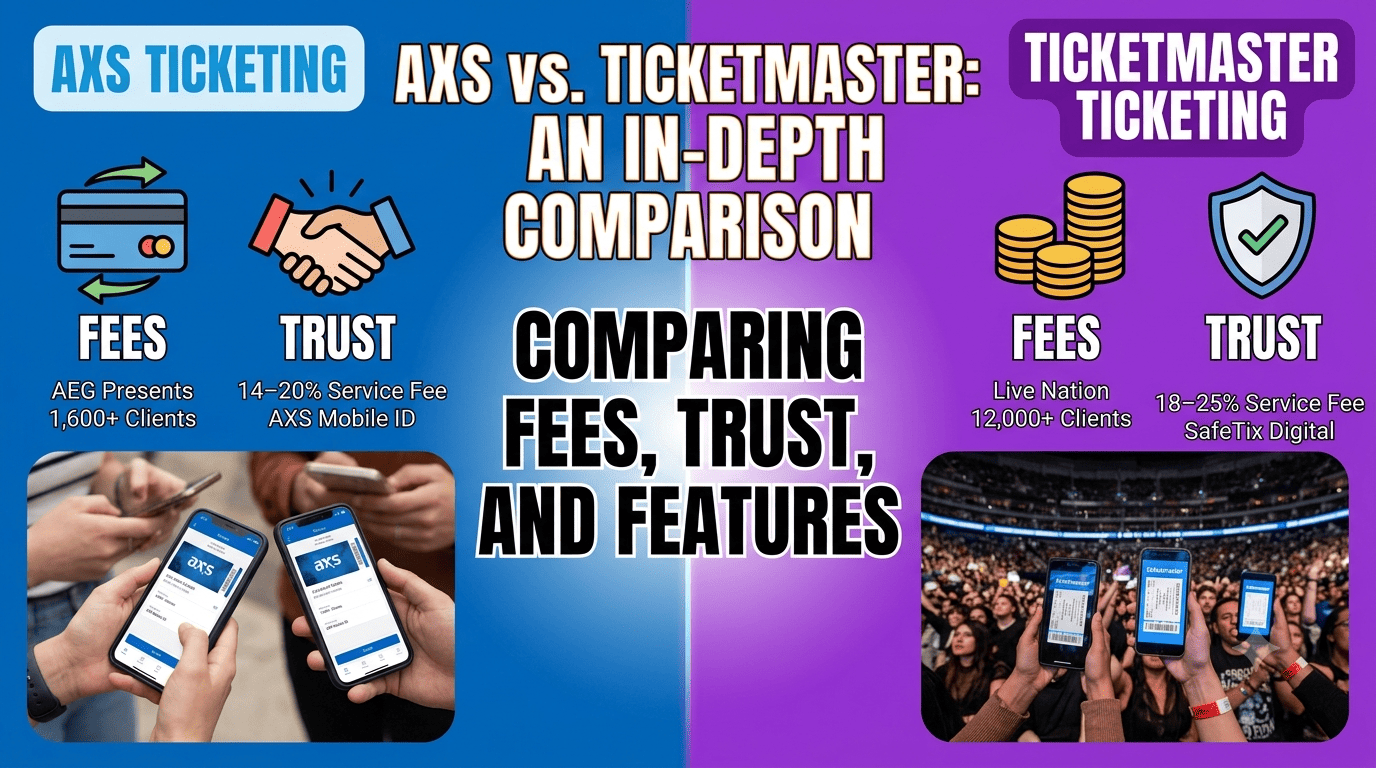
Before diving into the granular details, here is a high-level snapshot of how AXS and Ticketmaster stack up across the metrics that matter most to ticket buyers in 2026. This table distills hundreds of data points into a single reference you can return to at any stage of your purchasing decision.
| Category | Ticketmaster | AXS |
| Parent Company | Live Nation Entertainment | AEG (Anschutz Entertainment Group) |
| Global Client Network | 12,000+ clients | 1,600+ clients |
| Typical Service Fee Range | 18–25% of face value | 14–20% of face value |
| Total Fee Impact (incl. order + facility fees) | 25–39% of face value | 18–27% of face value |
| Dynamic Pricing | Yes — Platinum / Official Platinum | Yes — venue-dependent |
| All-In Pricing Available | Mandatory in the US since May 12, 2025 (FTC rule); adoption varies by venue in Europe | Mandatory in the US since May 12, 2025 (FTC rule); adoption varies by venue in Europe |
| Built-In Resale Marketplace | Yes — Verified Resale | Yes — AXS Official Resale |
| Resale Price Caps | No universal cap | Some venues enforce caps |
| Mobile-Only / Digital Tickets | Yes — SafeTix | Yes — AXS Mobile ID |
| European Market Strength | Dominant across most leagues and arenas | Strong in AEG-owned venues (The O2, AO Arena) |
| Customer Support Reputation | Mixed — long wait times widely reported | Mixed — smaller scale, sometimes faster response |
The takeaway from this overview is clear: both platforms charge significant buyer fees, neither consistently offers fee-free purchasing, and your platform choice is often dictated by venue contracts rather than personal preference. For fans who want to escape that fee trap entirely — particularly for European events — a third option exists, which we cover in detail further below.
- Is AXS Owned by Ticketmaster? Who Runs Each Platform
- AXS Fees vs Ticketmaster Fees — A Line-by-Line Breakdown
- Why Are Ticketmaster Fees So High — and How to Avoid Them
- Dynamic Pricing Explained — Why Your Ticket Price Jumps Mid-Checkout
- Is AXS Legit? Is Ticketmaster Safe? Trust and Safety Compared
- Resale Tickets — Which Platform Is Safer for Secondhand Purchases?
Is AXS Owned by Ticketmaster? Who Runs Each Platform
One of the most common points of confusion among ticket buyers is whether AXS and Ticketmaster are somehow related — perhaps sister companies or different interfaces for the same backend. They are not. AXS and Ticketmaster are operated by separate, competing entertainment conglomerates with distinct venue portfolios, technology stacks, and business strategies. Understanding who owns each platform is foundational to understanding why the ticketing landscape is structured the way it is — and why consumers so often feel they have no real choice.
Ticketmaster and Live Nation — Market Dominance in 2026
Ticketmaster is the primary ticketing arm of Live Nation Entertainment, the world’s largest live-entertainment company. The merger between Live Nation (a concert promoter) and Ticketmaster (a ticketing platform) was completed in 2010 and created a vertically integrated powerhouse that controls promotion, venue operation, artist management, and ticket distribution under a single corporate umbrella. That vertical integration is precisely what gives Ticketmaster its extraordinary market leverage.
As of 2025, Ticketmaster processes over 620 million tickets annually worldwide and serves more than 12,000 clients globally. In North America, it commands an estimated 70–80% of the primary ticketing market. Across Europe, its dominance is equally pronounced: it is the default ticketing provider for the majority of Premier League clubs, numerous Champions League venues, and virtually all arena-scale concert tours.
This scale creates a self-reinforcing cycle. Artists and promoters route through Live Nation because it controls the biggest venues; venues partner with Ticketmaster because it delivers the biggest artists. The result is a highly concentrated market that regulators on both sides of the Atlantic have scrutinized for years — a topic we address in the venue-exclusivity section below.
AXS and AEG Presents — The Challenger Network
AXS is the ticketing platform owned and operated by Anschutz Entertainment Group (AEG), the second-largest live-entertainment company in the world. AEG’s portfolio includes AEG Presents (a major global concert promoter), Crypto.com Arena (formerly Staples Center), The O2 in London, AO Arena in Manchester, and the Uber Arena (formerly Mercedes-Benz Arena) in Berlin, among other marquee properties.
AXS partners with over 1,600 of the most recognized brands in sports and entertainment globally. While that figure is significantly smaller than Ticketmaster’s 12,000-client network, AXS holds strategic positions in some of Europe’s most high-profile arenas. If you are buying tickets for an event at The O2 or AO Arena, you will typically be directed to AXS, since AEG owns the venue and uses its own ticketing platform there.
The key distinction: Ticketmaster’s dominance comes from the sheer breadth of its venue and promoter network. AXS’s relevance comes from the depth of its parent company’s venue ownership. Both platforms are part of larger entertainment conglomerates, and their fee structures reflect that broader business model.
AXS Fees vs Ticketmaster Fees — A Line-by-Line Breakdown
Fees are one of the most common concerns behind the “AXS vs Ticketmaster” comparison. A U.S. Government Accountability Office report determined that fees averaged 27% of face value across major ticketing platforms. Here’s exactly what each platform charges, broken down line by line, so you can calculate your true cost before you ever reach the checkout screen.
How Ticketmaster Fees Are Structured (Service Fee, Order Fee, Facility Charge)
Ticketmaster’s fee structure is layered, with each layer covering a different part of the transaction. Here is the standard anatomy of a Ticketmaster transaction:
- Service Fee — The largest single add-on, typically 18–25% of the ticket’s face value. Ticketmaster describes this as covering “the cost of providing the ticketing service,” and a considerable share is contractually shared with venues and promoters. On a €100 face-value ticket, expect a service fee of €18–€25 or higher.
- Order Processing Fee — A flat per-order charge, generally €4–€6, applied once per transaction regardless of how many tickets you buy. This covers “fulfillment and delivery,” even when delivery is a digital QR code sent to your phone.
- Facility Charge — A per-ticket fee set by the venue, not Ticketmaster, ranging from €1 to €10+. This funds venue operations, maintenance, or capital improvements. It appears on your receipt as a Ticketmaster charge, but the money flows directly to the venue.
- Delivery Fee — If you select a non-digital delivery method (e.g., mail), expect an additional €2–€8. Digital delivery is often free but not always.
Combined, these fees push the total cost of a Ticketmaster purchase to 25–39% above the listed face value. The “drip pricing” model — where fees appear incrementally as you progress through checkout — has been a frequent point of feedback from consumers and a focal point for regulators.
How AXS Fees Are Structured (Service Fee, Processing Fee, Add-Ons)
AXS uses a similar multi-layer fee model, though the individual charges tend to be marginally lower than Ticketmaster’s in most markets:
- Service Fee — Typically 14–20% of face value, positioning AXS slightly below Ticketmaster’s range. On a €100 face-value ticket, the service fee generally lands between €14 and €20.
- Order Processing Fee — A flat per-order charge, usually €3–€5, comparable to Ticketmaster’s but at the lower end of the range.
- Delivery / Fulfillment Fee — Varies by event and delivery method. Mobile delivery is frequently free; physical or expedited delivery incurs additional charges.
- Optional Add-Ons — AXS also offers ticket insurance, premium packaging, and other upsells during checkout that can incrementally increase your total if you are not paying close attention.
AXS’s total fee load typically falls in the 18–27% range above face value, based on the checkout math below. That is lower than Ticketmaster’s ceiling but still represents a substantial markup over what the fan expected to pay when they first saw the advertised ticket price.
Real-Price Math — What a €100 Ticket Actually Costs on Each Platform
Theory matters less than arithmetic. Here is what a single €100 face-value concert ticket actually costs at checkout on each platform, based on median fee ranges observed across European events:
| Fee Component | Ticketmaster | AXS |
| Face Value | €100 | €100 |
| Service Fee | €18–€25 | €14–€20 |
| Order Processing Fee | €5 | €4 |
| Facility Charge | €2–€9 | €0–€3 |
| Total at Checkout | €125–€139 | €118–€127 |
| Savings vs Ticketmaster | — | €5–€12 |
Why Are Ticketmaster Fees So High — and How to Avoid Them
“Why are Ticketmaster fees so high?” is not just a search query — it reflects a common concern among fans who feel they’re paying more than expected every time they attend a live event. Understanding the mechanics behind those fees is the first step toward minimizing them.
The Real Reasons Behind the Fee Stack
Ticketmaster’s fees are not arbitrary. They are the financial output of a specific business architecture:
- Revenue-sharing with venues and promoters. A significant portion of the “service fee” does not stay with Ticketmaster — it is contractually shared with the venue, the promoter, and sometimes the artist. In many deals, venues receive 50% or more of the service fee. This arrangement incentivizes venues to sign exclusive Ticketmaster contracts, because the fee revenue supplements (or replaces) other income streams.
- Vertical integration economics. Because Live Nation owns or operates hundreds of venues and promotes thousands of tours, it can set fee levels that benefit the entire corporate ecosystem — even if individual consumers bear the cost. The fee is not just paying for a “ticketing service”; it is subsidizing an entire vertically integrated entertainment pipeline.
- Facility charges as venue revenue. The facility charge is set by the venue, not Ticketmaster, but it appears on the Ticketmaster receipt. This creates a perception that Ticketmaster is charging more than it actually retains — though from the consumer’s perspective, the distinction is academic. You pay the charge regardless of where the money goes.
- Market power and lack of competitive pressure. With 70–80% market share in North America and dominant positions across Europe, Ticketmaster faces limited price competition. When consumers have no alternative platform for a given event, fee sensitivity has minimal impact on transaction volume.
Dean Budnick and Josh Baron, co-authors of Ticket Masters: The Rise of the Concert Industry and How the Public Got Scalped, have documented how ticketing fee structures have evolved over recent decades — and consumer surveys have repeatedly found hidden fees to be one of the biggest frustrations fans report when buying tickets online, often ranking above the price of the ticket itself.
Does “All-In Pricing” Actually Remove Ticketmaster Fees?
On May 12, 2025, all-in pricing became mandatory in the US for both Ticketmaster and AXS under the FTC’s Rule on Unfair or Deceptive Fees, following years of regulatory pressure and state-level legislation in New York, California, Minnesota, and Connecticut. However, a critical distinction must be understood:
All-in pricing changes when fees are displayed, not whether they are charged.
Under all-in pricing, the service fee and order processing fee are folded into the displayed ticket price from the first search result. A ticket that was listed at €100 + €25 in fees under the old model is now listed at €125 from the start. You pay the same total — you simply see it earlier. This is a transparency improvement, not a cost reduction. In the US, this display format is now a federal requirement rather than optional; in European markets, where an equivalent mandate does not yet exist (see the regulatory section below), some events still use drip pricing that reveals fees only at the final checkout step.
A common misconception flagged repeatedly on Reddit’s r/TicketMaster: users assume “all-in pricing” means “no fees.” It does not. It means “fees are included in the displayed price.” The total out-of-pocket cost is identical.
Practical Ways to Reduce or Avoid Ticket Fees in 2026
While no strategy eliminates Ticketmaster or AXS fees entirely within those platforms, several approaches can meaningfully reduce what you pay:
- Buy at the physical box office. Many venues waive service fees and order processing fees for in-person purchases. This requires proximity and patience, but it is the most reliable fee-reduction method within the traditional ticketing ecosystem.
- Use presale access strategically. Some presale windows offer exclusive pricing or reduced fees. Ticketmaster’s Verified Fan presales and AXS presale codes occasionally unlock fee-discounted inventory — though this is event-specific, not guaranteed.
- Buy multiple tickets in one transaction. Order processing fees are typically flat per order, not per ticket. Buying four tickets in a single transaction means you split that €4–€6 charge across four seats instead of paying it four times.
- Avoid optional add-ons. Ticket insurance, express delivery, and premium packaging are upsells that inflate your total. Decline them unless you have a specific need.
- Use a platform that charges 0% buyer fees. This is the only approach that structurally eliminates fees rather than merely reducing them. Platforms like TicketX Europe operate on a model where the buyer pays the displayed price with no service fee, no order fee, and no hidden charges at checkout. If the event you want is available on a fee-free platform, the math is unambiguous — you save €25–€39 per ticket compared to Ticketmaster.
Dynamic Pricing Explained — Why Your Ticket Price Jumps Mid-Checkout
Few experiences are more surprising than selecting a €90 ticket, adding it to your cart, and watching the price climb to €160 by the time you reach the payment screen. This is not a glitch. It is dynamic pricing — and both major platforms use it.
How Ticketmaster Platinum and Dynamic Pricing Work
Ticketmaster’s dynamic pricing system, most visibly implemented through its “Platinum” and “Official Platinum” ticket tiers, adjusts prices in real time based on demand signals. When more users search for, click on, or attempt to purchase a specific event, the algorithm raises the price of remaining inventory — particularly for premium seats.
Key mechanics to understand:
- Platinum tickets are primary-market tickets, not resale. They are sold by the artist or promoter at market-driven prices. The artist or their team typically receives the upside from Platinum pricing, not scalpers.
- Prices can change multiple times per hour. During an on-sale event for a high-demand act, a seat in the same section can jump from €100 to €250 within minutes.
- Standard service fees are applied on top of the dynamic price. If a ticket’s dynamically adjusted price is €200, the service fee is calculated as a percentage of €200 — not the original face value. This means dynamic pricing and percentage-based fees compound each other.
Dynamic pricing is explicitly modeled on airline and hotel revenue management. The ethical debate centers on whether a concert ticket — often tied to a one-time, emotionally significant experience — should be priced like a commodity.
Does AXS Use Dynamic Pricing Too?
Yes. AXS supports dynamic pricing, though its implementation is less uniform than Ticketmaster’s Platinum system. Whether dynamic pricing appears on an AXS-ticketed event depends on the venue operator and promoter’s decision to activate it. At AEG-owned venues, dynamic pricing has been observed on high-demand concerts, sporting events, and residency shows.
The practical implication for consumers: switching from Ticketmaster to AXS does not inherently protect you from demand-based price surges. The pricing model is a function of the event and promoter, not the platform. If you want to avoid dynamic pricing, look for events where the promoter has committed to fixed-price tiers — or purchase through platforms that do not employ surge-pricing algorithms.
Is AXS Legit? Is Ticketmaster Safe? Trust and Safety Compared
Trust is non-negotiable when you are entering payment details and hoping that a QR code on your phone will actually open a turnstile weeks or months later. Both AXS and Ticketmaster are legitimate, established ticketing companies — but “legitimate” does not mean “flawless.” Each platform carries distinct trust signals and documented pain points that every buyer should evaluate.
AXS Legitimacy, Reviews, and Known Issues
AXS is a legitimate ticketing platform backed by AEG, one of the world’s largest entertainment companies. It is not a scam, and tickets purchased through AXS for events at AXS-partnered venues are genuine. That said, user reviews across platforms like Trustpilot, Reddit, and the App Store reveal recurring friction points:
- App reliability concerns. Users report occasional QR code loading failures at venue gates, particularly during high-traffic events. AXS’s mobile-only ticket delivery means a dead phone battery or app crash can leave you locked out.
- Customer support delays. While AXS’s smaller scale sometimes translates to faster support compared to Ticketmaster, response times remain inconsistent — especially during on-sale spikes when inquiry volume surges.
- Refund policy variation. AXS’s refund policy is event-specific. Some events allow full refunds; others offer credit only; still others are entirely non-refundable. The policy is disclosed at purchase but not always prominently displayed.
- Resale marketplace edge cases. AXS’s built-in resale marketplace is generally well-regarded, but users on r/Scams have raised questions about specific scenarios — particularly for events where resale is restricted or where transferred tickets fail to activate for the new holder.
Ticketmaster Legitimacy, Reviews, and Known Issues
Ticketmaster is unquestionably a legitimate platform and the largest primary ticketing company in the world. Its “Fan Guarantee” promises that tickets purchased through Ticketmaster are authentic and will be valid for entry. However, Ticketmaster’s scale brings its own category of challenges:
- Checkout crashes during high-demand on-sales. The Taylor Swift Eras Tour on-sale in 2022 — when the platform experienced major outages under high demand, leaving many fans unable to complete purchases — remains a widely cited example of the reliability challenges large-scale on-sales can create. Similar issues have recurred on a smaller scale for subsequent major on-sales.
- Queue system experience. Ticketmaster’s virtual queue can place users in line for 30–90+ minutes, only to present them with limited or dynamically repriced inventory upon entry.
- Customer support volume. Ticketmaster’s support infrastructure processes millions of inquiries annually. Individual users frequently report multi-day wait times for email responses and limited resolution authority among frontline agents.
- Antitrust scrutiny. Beyond individual transaction friction, Ticketmaster has faced antitrust scrutiny over its market position and its use of exclusive venue contracts. The DOJ and dozens of states sued Live Nation and Ticketmaster on antitrust grounds in 2024; the DOJ settled in March 2026 for a $280 million fund plus structural changes, including the end of exclusive booking arrangements at 13 amphitheaters and a 15% service-fee cap specifically at amphitheaters Live Nation owns, operates, or controls — not a blanket cap across all its venues. A coalition of state attorneys general rejected that deal and took the case to trial; on April 15, 2026, a federal jury found Live Nation and Ticketmaster liable on every antitrust count, including a finding that Ticketmaster had overcharged consumers by $1.72 per ticket (NBC News). As of mid-2026, remedies — potentially including a structural breakup — are still being litigated, with the plaintiff states continuing to push for a breakup (Sports Business Journal).
How to Spot a Fake Ticket on Any Platform
Regardless of which platform you use, verifying ticket authenticity is a skill every live-event attendee should develop. Use this checklist:
- Buy only from official or verified sources. Ticketmaster, AXS, and platforms like TicketX Europe that supply 100% official, verified tickets are your safest starting points. Avoid screenshots, PDFs from strangers, or social-media sellers with no verifiable track record.
- Check for dynamic barcodes. Both Ticketmaster (SafeTix) and AXS (Mobile ID) use rotating barcodes that refresh every few seconds. A static screenshot of a barcode is likely invalid.
- Verify the event details. Confirm that the date, venue, section, row, and seat number on your ticket match the event listing exactly. Scammers sometimes repurpose tickets from canceled or different events.
- Cross-reference your account. Legitimate digital tickets should appear in your Ticketmaster, AXS, or TicketX Europe account — not just in an email attachment. If a ticket was “transferred” to you but does not show in your app, contact the platform immediately.
- Beware of prices that seem too low. If a sold-out Champions League final ticket is listed at 40% below market value on an unverified site, it is almost certainly fraudulent.
Resale Tickets — Which Platform Is Safer for Secondhand Purchases?
The resale market is where the highest concentration of fraud, inflated pricing, and buyer remorse exists. Both AXS and Ticketmaster operate official resale marketplaces, but their policies, protections, and fee structures differ meaningfully.
Ticketmaster Verified Resale — How It Works and What It Guarantees
Ticketmaster’s Verified Resale program allows fans to list and purchase secondhand tickets directly within the Ticketmaster ecosystem. Key features include:
- Ticket authenticity guarantee. Verified Resale tickets are backed by Ticketmaster’s Fan Guarantee, meaning if a ticket turns out to be invalid, Ticketmaster will provide a replacement or refund.
- No price caps. Sellers can list tickets at any price, including well above face value, since there is no platform-wide cap on resale prices.
- Automatic transfer. When a resale purchase is completed, the ticket is digitally transferred to the buyer’s account. There is no physical ticket exchange, reducing (but not eliminating) fraud risk.
- Resale edge cases. In rare cases, a seller may report a resold ticket as lost in order to request a replacement from the venue after already being paid for the resale. Ticketmaster’s guarantee is designed to protect the buyer in these situations, though resolving a replacement can take time.
AXS Resale Marketplace — Built-In Resale and Price Caps
AXS’s official resale marketplace is integrated directly into its app and website. It differs from Ticketmaster’s resale program in several notable ways:
- Price caps on some events. Certain venues and promoters using AXS enforce resale price caps — for example, capping resale at 10–20% above face value. This prevents extreme scalping on those events, though cap enforcement varies by event and venue.
- Seller identity verification. AXS requires sellers to have a verified AXS account, and tickets are transferred digitally within the platform. This reduces the risk of counterfeit or duplicate tickets entering the marketplace.
- Smaller resale inventory. Because AXS covers fewer venues than Ticketmaster, its resale marketplace has less overall inventory. For highly in-demand events at non-AEG venues, you may find more resale options on Ticketmaster or third-party platforms.
Resale Fees Side by Side — AXS vs Ticketmaster
Resale transactions carry their own layer of fees, separate from primary-market purchases. Here is how they compare:
| Resale Fee Component | Ticketmaster Verified Resale | AXS Official Resale |
| Buyer Service Fee | 15–25% of resale price | 10–20% of resale price |
| Seller Fee | 5–15% of sale price | 5–10% of sale price |
| Order Processing Fee | €4–€6 per order | €3–€5 per order |
| Price Caps | No universal cap | Venue/event-dependent caps |
| Buyer Protection Guarantee | Yes — Fan Guarantee | Yes — AXS Guarantee |
Both platforms offer buyer protection on resale transactions, which is a significant advantage over unregulated third-party resale sites. However, both platforms also take a cut from both sides of the transaction — buyer and seller — which means resale tickets carry even higher total fee burdens than primary-market purchases.
コメント