If you are comparing StubHub and LiveFootballTickets for European football tickets in 2026, the short answer is that both platforms will get you into the stadium — but neither will get you there without adding significant fees to the price you initially see. StubHub operates as a peer-to-peer resale marketplace with a well-known brand and a FanProtect Guarantee, but its buyer fees in European markets typically land between 20% and 27.6% of the listed ticket price, applied at checkout after you have already committed psychologically to the purchase. LiveFootballTickets functions as a broker-aggregator, sourcing inventory from third-party ticket suppliers, with markups and service charges that are often baked into the displayed price but remain opaque in terms of what portion constitutes the actual face value versus the platform’s margin. Both platforms are legitimate businesses, but neither offers full pricing transparency from the first click. The critical question for any fan planning a European football trip in 2026 is not simply “which of these two is better?” but rather “is there a platform that eliminates the exact frustrations both of these create?” That question has a clear answer, and it reshapes the entire comparison.
- Side-by-Side Comparison Table (Fees, Ticket Source, Guarantees, Refund Policy)
- How European Football Ticket Pricing Works in 2026
- StubHub Fees in Europe — What the 25%+ Markup Actually Covers
- LiveFootballTickets Fees and Pricing Model Explained
- Fee Showdown — StubHub vs LiveFootballTickets vs a 0% Fee Platform
- Refund and Cancellation Policies — StubHub vs LiveFootballTickets Compared
- Best Platform for Your Specific Match — StubHub vs LiveFootballTickets Recommendations
Side-by-Side Comparison Table (Fees, Ticket Source, Guarantees, Refund Policy)
Before diving into the details, here is a direct feature-by-feature comparison across StubHub, LiveFootballTickets, and TicketX Europe — the 0% buyer fee alternative that an increasing number of European football fans are switching to in 2026.
| Criteria | StubHub | LiveFootballTickets | TicketX Europe |
| Platform Type | Peer-to-Peer Resale Marketplace | Broker / Aggregator | Official & Verified Ticket Marketplace |
| Buyer Fees | typically 20–28% (variable) | Markup embedded + service fees | 0% Buyer Fees |
| Pricing Transparency | Drip pricing — fees appear late in checkout | All-in price shown, but breakdown unclear | What you see is what you pay |
| Ticket Source | Individual resellers (unverified origin) | Third-party broker network | 100% official / verified inventory |
| Buyer Guarantee | FanProtect (replacement or refund) | 100% Guarantee (terms vary) | Full guarantee — verified tickets only |
| Seat Specificity Pre-Purchase | Section + row shown (seat may vary) | Often section-only until after payment | Exact seat details provided pre-purchase |
| Refund on Cancellation | 120% credit or full cash refund | Refund or credit (complaints about delays) | Full refund on cancellations and date changes |
| Trustpilot Rating (2026) | ~4.2–4.4/5.0 (variable) | ~4.8/5.0 | Verified positive — growing rapidly |
| European League Coverage | Premier League, La Liga, Serie A, Bundesliga, UCL | Premier League, La Liga, Serie A, Bundesliga, UCL | Premier League, La Liga, Serie A, Bundesliga, UCL |
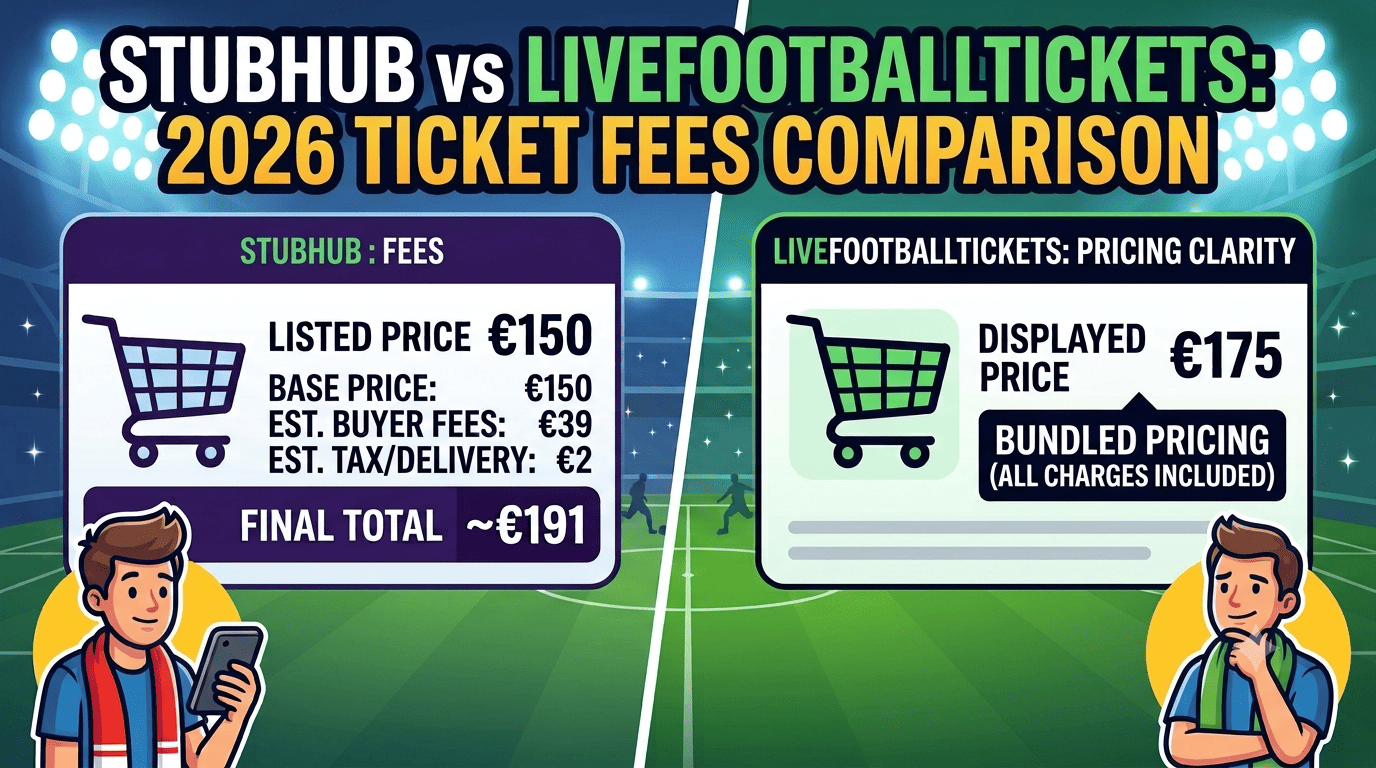
The numbers tell the story clearly. On a €150 face-value ticket, StubHub’s final checkout total reaches approximately €189–€191. LiveFootballTickets lands around €172–€180. TicketX Europe charges €150 — the displayed price, with zero additional fees at any stage of checkout. These totals are illustrative checkout calculations built from StubHub’s publicly documented buyer-fee range and the all-in pricing LiveFootballTickets typically displays.
How European Football Ticket Pricing Works in 2026
Understanding why StubHub and LiveFootballTickets charge what they charge requires understanding how the European football ticket ecosystem actually functions. Unlike North American sports where secondary markets are deeply integrated with leagues and teams, European football ticketing remains fragmented, with clubs, leagues, and governing bodies like UEFA each maintaining distinct policies on resale, transferability, and pricing. This fragmentation creates information asymmetry that resale platforms exploit — and that fans ultimately pay for through inflated prices and hidden charges.
Face Value vs Resale Price vs Final Checkout Price
Three distinct price points exist for any European football ticket, and most fans conflate at least two of them. Face value is the price printed on the ticket by the club or governing body — the amount the original purchaser paid through official channels. Resale price is the amount a secondary-market seller lists the ticket for, which can be anywhere from face value to 3–5 times face value for high-demand fixtures. For the highest-demand fixtures — Champions League finals and semi-finals in particular — secondary-market listings routinely reach three to five times face value within hours of a sell-out, and only a fraction of that resale activity flows through official channels such as UEFA’s own resale portal. The final checkout price is the number that actually leaves your bank account — the resale price plus every fee the platform adds during the purchasing process. On StubHub, the gap between the listed resale price and the final checkout price is typically 20–28%(variable). On LiveFootballTickets, the markup is often pre-embedded, making it harder to isolate but no less real. On TicketX Europe, the listed price and the final checkout price are identical, because there are no buyer fees to add.
Why Hidden Fees Are the Norm in European Ticket Resale
Hidden fees are not an accident or an oversight — they are a deliberate pricing strategy known as drip pricing. Platforms display a lower initial price to attract clicks and engagement, then incrementally add fees through the checkout funnel at stages where the buyer has already invested time selecting seats, entering personal details, and mentally committing to the purchase. The UK Competition and Markets Authority (CMA) has specifically cited drip pricing as a deceptive practice. Under the Digital Markets, Competition and Consumers Act 2024 (DMCCA) — the CMA’s new consumer-protection regime, which came into force in April 2025 — the regulator can act directly against businesses that fail to show the total price a consumer must pay upfront. The business logic is straightforward: platforms that show all-inclusive prices appear more expensive at first glance in comparison shopping, even when their total cost is identical or lower. This creates a race to the bottom on displayed prices and a race to the top on hidden fees. The global secondary ticketing market — valued at roughly $13 billion in 2025 and projected to grow to around $20 billion by 2034 — is built substantially on this opacity. Platforms that reject this model entirely — displaying the final price from the first listing — are the exception, not the rule. TicketX Europe is one of those exceptions.
StubHub Fees in Europe — What the 25%+ Markup Actually Covers
StubHub is the most recognized name in secondary ticketing globally, and its European operations cover every major football league from the Premier League to the Bundesliga. But recognition does not equal transparency. StubHub’s fee structure in European markets is one of the most aggressive among mainstream resale platforms, and understanding exactly where your money goes is essential before clicking “Buy Now.”
Buyer Fee Breakdown by Checkout Stage
StubHub’s European buyer fees follow a consistent pattern. When you browse listings, you see a base price — the amount the seller has listed the ticket for. This is already above face value in most cases for popular matches. At checkout, StubHub adds a buyer fee that typically ranges from 20% to 27.6% of the listed price. This fee is broken down into components that StubHub describes as covering “marketplace operations, customer service, and the FanProtect Guarantee,” but the individual line items are not disclosed to the buyer. On top of the buyer fee, an additional delivery fee may apply depending on the fulfillment method — electronic delivery is usually free, but expedited physical delivery can add €5–€15. In some European jurisdictions, VAT adjustments further increase the total, though StubHub’s approach to VAT display varies by country. The cumulative effect is stark.
| Checkout Stage | What Is Added | Typical Range (Europe) |
| Listed Price | Seller’s asking price (above face value) | Variable (40–120% above face value for high-demand) |
| Buyer Fee | Platform fee applied at checkout | Variable (20–28%) |
| Delivery Fee | Fulfillment charge (method-dependent) | €0–€15 |
| VAT Adjustment | Country-specific tax recalculation | Variable |
| Final Checkout Total | All fees combined | 25–35% above listed price in many cases |
When Reddit users in r/soccer and r/PremierLeague repeatedly post screenshots of StubHub checkout totals alongside the listed price, the disbelief is palpable — and entirely justified. A ticket listed at €150 that costs €191 at checkout is not a transparent transaction. It is a bait-and-switch rendered technically legal only because the fees are disclosed (in small text, late in the funnel).
FanProtect Guarantee — What It Covers and Where It Falls Short
StubHub’s FanProtect Guarantee is the platform’s primary trust mechanism, promising buyers that they will receive valid tickets in time for the event or receive a full refund. On paper, this is a strong consumer protection. In practice, the guarantee has meaningful gaps that European football fans should understand before relying on it. FanProtect covers three core scenarios: the seller fails to deliver tickets before the event, the tickets delivered are different from what was ordered (wrong section, wrong date), or the tickets are invalid and entry is denied. In each case, StubHub commits to finding replacement tickets of comparable or better quality, or issuing a refund or credit. Where FanProtect falls short is in the details. First, “comparable or better” replacements are subject to availability — for a sold-out Champions League semi-final, comparable replacements may simply not exist. Second, if you are denied entry at the stadium gate, you must contact StubHub support while standing outside the venue with thousands of other fans, during a window that may be only 30–60 minutes before kickoff. Third, and critically, StubHub’s guarantee does not extend to situations where the ticket was technically valid but the club or league’s own anti-resale policies triggered a cancellation or entry denial — a scenario that has become more common under UEFA’s tightened anti-tout measures. Users on r/football have documented instances where FanProtect could not resolve entry denials caused by membership-linked or name-specific tickets that were resold in violation of club terms.
Real Checkout Simulation — Champions League Cat 2 Ticket on StubHub
To make the fee impact concrete, consider a Champions League Quarter-Final, Category 2 ticket with a face value of €150. On StubHub in early 2026, a typical listing for this ticket appears at approximately €150 (at or near face value for lower-demand quarter-final matches). At checkout, StubHub applies its buyer fee of approximately 27%, adding roughly €40.50 to the order. The final checkout total arrives at approximately €189–€191 before any delivery fee. That is a 26–27% increase from the number that attracted you to the listing. For two tickets, you are now paying €378–€382 for what was initially presented as a €300 purchase. The €78–€82 difference is pure platform extraction — it does not go to the seller, does not improve your seat, and does not enhance your matchday experience in any way.
LiveFootballTickets Fees and Pricing Model Explained
LiveFootballTickets occupies a different niche in the European football ticket ecosystem than StubHub, and understanding that difference is essential to evaluating its pricing, reliability, and overall value proposition. While StubHub operates as a peer-to-peer marketplace connecting individual sellers with individual buyers, LiveFootballTickets functions as a broker-aggregator — a critical distinction that affects everything from pricing transparency to seat specificity.
Broker-Aggregator Model — Where LiveFootballTickets Sources Its Inventory
LiveFootballTickets does not hold ticket inventory directly in most cases. Instead, the platform aggregates listings from a network of third-party ticket brokers, travel agencies, and hospitality providers across Europe. When you purchase a ticket through LiveFootballTickets, you are not buying directly from a fellow fan (as on StubHub) or from the club itself — you are purchasing through an intermediary that has sourced the ticket from another intermediary. This chain of intermediation has two consequences. First, each link in the chain adds margin, which is reflected in the final price you pay even if it is not broken out as a separate “fee.” Second, the platform’s control over ticket authenticity and delivery reliability is partially dependent on the performance of its upstream suppliers. Trustpilot reviews for LiveFootballTickets as of early 2026 reflect this dynamic. The platform holds a strong overall rating of roughly 4.8 out of 5.0 across more than 17,000 reviews, yet a recurring minority of those reviews still flag the same friction points: delivery timing, unclear communication about ticket specifics, and occasional post-purchase service fees.
The Seat Specificity Problem — Why Your Exact Seat May Be Unknown Until After Payment
One of the most persistent complaints from LiveFootballTickets buyers — documented extensively in Trustpilot reviews and Reddit threads — is the lack of exact seat information at the time of purchase. On many listings, you will see a section or block designation (for example, “Long Side, Category 2”) but not a specific row or seat number. The exact seat details are confirmed only after payment, when the broker supplying the ticket finalizes the allocation. This creates a fundamentally different buying experience from platforms where you select a specific seat before committing your money. For fans with accessibility needs, strong section preferences, or anxiety about obstructed views, this ambiguity is not a minor inconvenience — it is a material risk. You may pay €175 expecting a midfield view and receive seats behind a goal. The platform’s terms typically note that seat assignments within the booked category are at the supplier’s discretion, but this caveat is not always prominently displayed during the browsing and selection phase. At TicketX Europe, exact seat details are provided before purchase, eliminating this uncertainty entirely.
Real Checkout Simulation — The Same Champions League Ticket on LiveFootballTickets
Using the same Champions League Quarter-Final, Category 2, €150 face-value ticket as our benchmark, a LiveFootballTickets listing in early 2026 typically shows an all-in displayed price of approximately €172–€180. This price includes the broker’s margin and the platform’s service charge, but because these are embedded rather than itemized, you cannot determine what portion of your payment represents the actual ticket cost versus intermediary markup. The displayed price is closer to the final checkout price than StubHub’s model — LiveFootballTickets generally does not add major fees at the last checkout step — but the total cost is still €22–€30 above face value with no clear justification for the premium beyond the platform’s role as an intermediary. Compared to StubHub’s €189–€191 final total for the same fixture, LiveFootballTickets offers a modestly better price outcome. Compared to TicketX Europe’s €150 final total — with 0% buyer fees and verified tickets — both platforms are extracting money from the fan that does not need to be extracted.
Fee Showdown — StubHub vs LiveFootballTickets vs a 0% Fee Platform
Numbers do not lie, and in ticket purchasing, the only number that matters is the one that actually leaves your bank account. This section puts all three platforms side by side using identical ticket parameters so you can see exactly how much each charges for the same seat in the same stadium on the same night.
Champions League Quarter-Final Simulation (€150 Face Value, Cat 2)
| Cost Component | StubHub | LiveFootballTickets | TicketX Europe |
| Listed / Displayed Price | €150 | €172–€180 (all-in display) | €150 |
| Buyer Fee | €39–€41 (≈27%) | Embedded in displayed price | €0 |
| Service / Booking Fee | Included in buyer fee | Included in displayed price | €0 |
| Delivery Fee | €0 (e-ticket) | Typically included | €0 |
| Final Checkout Total | €189–€191 | €172–€180 | €150 |
| Total Fees Paid Above Face Value | €39–€41 | €22–€30 | €0 |
For a pair of tickets, the cumulative difference becomes impossible to ignore. Two tickets on StubHub: €378–€382. Two tickets on LiveFootballTickets: €344–€360. Two tickets on TicketX Europe: €300. The gap between StubHub and TicketX Europe for a simple pair of quarter-final tickets is €78–€82 — enough to cover matchday transport, a stadium meal, and a scarf.
Why 0% Buyer Fees Save €22–€41 Per Ticket
The €22–€41 per-ticket saving is not a theoretical construct. It is the direct, measurable consequence of TicketX Europe’s business model, which does not extract revenue from buyers through fees layered onto the ticket price. Every euro you save by choosing a 0% buyer fee platform is a euro that stays in your pocket rather than subsidizing a platform’s customer acquisition costs, executive compensation, or shareholder returns. Multiply this saving across a season — say, four Premier League matches and one Champions League fixture — and a family of two saves between €220 and €410 per year simply by choosing the right platform. This is not about finding cheaper tickets. It is about not paying more than the ticket costs. TicketX Europe’s transparent pricing model means the price listed on the event page is the price you pay at checkout, with no booking fees, no service charges, no VAT surprises, and no delivery surcharges. In a market where surprise checkout fees rank among the most common complaints from event-goers, this is not a marginal improvement — it is a structural solution to one of the industry’s most widespread consumer grievances.
Refund and Cancellation Policies — StubHub vs LiveFootballTickets Compared
European football fixtures get rescheduled. Weather delays, security incidents, broadcasting conflicts, and scheduling congestion from the expanded Champions League format all contribute to date changes that can throw a carefully planned trip into chaos. When that happens, your platform’s refund policy becomes the most important feature it offers — and the differences between StubHub, LiveFootballTickets, and TicketX Europe are significant.
StubHub’s Refund Process for Rescheduled European Matches
StubHub’s refund policy for cancelled events is relatively clear: if an event is cancelled and not rescheduled, StubHub’s FanProtect Guarantee offers either a credit worth 120% of what you paid or, as an alternative, a full cash refund. However, when a match is rescheduled rather than cancelled, StubHub’s policy becomes more nuanced. In most cases, tickets for rescheduled events remain valid for the new date, and StubHub does not automatically issue refunds. Buyers who cannot attend the rescheduled date can relist their tickets on StubHub, but this re-listing does not guarantee a sale and subjects the original buyer to selling fees. The refund processing timeline for cancelled events typically ranges from 5 to 10 business days, though user reports on Reddit suggest that delays of 2–4 weeks are not uncommon during high-volume cancellation periods, such as when weather disrupts multiple fixtures simultaneously. Crucially, original delivery fees are generally not refunded, and the effort required to navigate StubHub’s support process during peak periods can be substantial.
LiveFootballTickets’ Refund Policy — Official Terms vs Real User Experiences
LiveFootballTickets’ official refund policy states that full refunds are provided for cancelled events, with rescheduled events handled on a case-by-case basis. The gap between official terms and real user experiences is where concerns arise. Trustpilot reviews from 2025–2026 include multiple accounts of delayed refund processing, difficulty reaching customer support for rescheduled fixtures, and instances where credit was offered instead of a cash refund. Because LiveFootballTickets sources tickets from a broker network, the refund chain includes an additional intermediary — the platform must secure the refund from its upstream supplier before passing it through to the buyer, a process that adds time and introduces potential friction. For fans who have booked non-refundable flights and hotels around a specific fixture date, a delayed or uncertain refund process compounds the financial damage of the rescheduling itself.
How TicketX Europe Handles Cancellations and Date Changes
TicketX Europe’s refund policy is built on the same transparency principle that governs its pricing: clear terms, no surprises, no hidden conditions. If an event is cancelled, buyers receive a full refund — no partial credits, no fee retention, no waiting for upstream suppliers to process their end. For rescheduled events, TicketX Europe proactively contacts affected ticket holders with their options, including a full refund if the new date does not work. The refund processing is handled directly by TicketX Europe without intermediary delays, and the entire process is designed to mirror the no-hidden-fees purchasing experience: straightforward, transparent, and resolved in the buyer’s favor whenever possible. In a comparison where all three platforms claim to offer buyer protection, the practical difference is in execution speed, policy clarity, and whether the platform’s structural model (broker chains, peer-to-peer anonymity) creates friction that its policy promises cannot fully overcome.
Best Platform for Your Specific Match — StubHub vs LiveFootballTickets Recommendations
Generic platform comparisons only go so far. The best platform for you depends on the specific league, fixture, and context of your purchase. Here are targeted recommendations for the most common European football ticket buying scenarios in 2026.
Premier League Matches
The Premier League’s 2025–26 season continues to draw enormous crowds, averaging roughly 41,600 fans per match — the second-highest average attendance of any domestic football league in Europe, behind only Germany’s Bundesliga at around 42,300. This demand drives secondary-market premiums averaging 40–120% above face value, making fee savings even more impactful. For Premier League tickets specifically, the anti-touting measures employed by most clubs — including membership-linked digital tickets and ID verification at gates — create significant risk for tickets purchased through peer-to-peer resale on StubHub or broker-aggregated inventory on LiveFootballTickets. TicketX Europe’s verified ticket model is specifically designed to navigate these restrictions, providing tickets that comply with each club’s individual transfer and entry policies.
Champions League Knockout Rounds and Finals
Champions League knockout fixtures are the highest-stakes purchases in European football ticketing. With millions of tickets sold across the 2025–26 Champions League season and finals generating resale listings at 3–5× face value within hours, the financial exposure on a single ticket can exceed €500–€750. At these price points, StubHub’s 20–28% (variable) buyer fee adds €100–€207 per ticket — a surcharge that no reasonable buyer should accept without exploring alternatives. LiveFootballTickets’ embedded markups are equally painful at this scale. TicketX Europe’s 0% buyer fee structure delivers the maximum savings precisely where the stakes are highest, and its verified inventory provides the trust assurance that a €500+ purchase demands.
El Clásico, Derby Matches, and High-Demand Fixtures
El Clásico, the North London Derby, the Milan Derby, Der Klassiker — these are the fixtures where demand peaks, prices inflate the most aggressively, and fraud risk is highest. They are also the matches most likely to attract traveling fans who are unfamiliar with local ticketing norms and most vulnerable to scam operators. For these fixtures, platform choice should be driven primarily by safety rather than price. StubHub’s FanProtect Guarantee provides a backstop, but one that is reactive rather than preventive. LiveFootballTickets’ broker model introduces an additional trust layer that adds complexity without adding security. TicketX Europe’s model of selling only official, verified tickets eliminates the fundamental risk — you are buying a ticket whose validity has been confirmed before it was listed, not one whose validity will be tested only when you arrive at the turnstile.
checkout shock. For group bookings or corporate hospitality requirements, LiveFootballTickets’ broker network can sometimes source packages that individual-seller platforms like StubHub cannot. If you are comfortable with seat-specificity uncertainty and willing to accept a 20–30% premium for a broker-managed experience, LiveFootballTickets is a viable option for mid-demand fixtures.
Why More Fans Are Choosing Transparent, Fee-Free Platforms in 2026
The trajectory of the European football ticket market in 2026 is unmistakable. Regulatory pressure from the CMA and the EU is forcing platforms toward all-inclusive pricing. Fan sentiment — and the wave of complaints about hidden fees that prompted that regulatory response — is demanding transparency. And platforms like TicketX Europe have proven that a 0% buyer fee, verified-ticket model is not only possible but superior on every metric that matters to the buyer: price, safety, transparency, and peace of mind.
The math is simple. On a €150 ticket, TicketX Europe saves you €22–€41 compared to LiveFootballTickets and StubHub respectively. On two tickets for a Champions League knockout match, that is €44–€82 back in your pocket. Over a season of European football, the savings compound into hundreds of euros — money better spent on the travel, the atmosphere, the experience that brought you to the stadium in the first place.
TicketX Europe offers 100% official tickets, 0% buyer fees, transparent pricing from the first click, exact seat details before purchase, and full refunds on cancellations and date changes. In a market where trust anxiety is the dominant emotion, every element of the TicketX Europe experience is designed to eliminate doubt rather than manage it after the fact.
- StubHub adds 20–28% (variable) in buyer fees at checkout, offers wide inventory and FanProtect Guarantee, but relies on drip pricing and anonymous seller inventory.
- LiveFootballTickets embeds broker markups of 20–30%, operates through a broker-aggregator model with limited seat specificity, and has mixed refund experiences despite a strong overall Trustpilot rating.
- TicketX Europe charges 0% buyer fees, provides only official and verified tickets, shows exact seat details pre-purchase, and offers full refunds on cancellations.
- For a €150 face-value Champions League ticket, the savings on TicketX Europe versus StubHub range from €39–€41 per ticket — based on an illustrative checkout calculation using StubHub’s published fee range.
- EU and UK regulatory changes — including the CMA’s DMCCA powers (in force April 2025) — are pushing toward all-inclusive pricing, favoring platforms already operating with transparent, fee-free models.
- Unexpected checkout fees rank among the most common frustrations cited by online ticket buyers — a concern significant enough that UK and EU regulators are moving to ban drip pricing.
- First-time European football ticket buyers should prioritize verified inventory and transparent pricing above all other factors to minimize fraud, entry-denial, and overpayment risk.

コメント