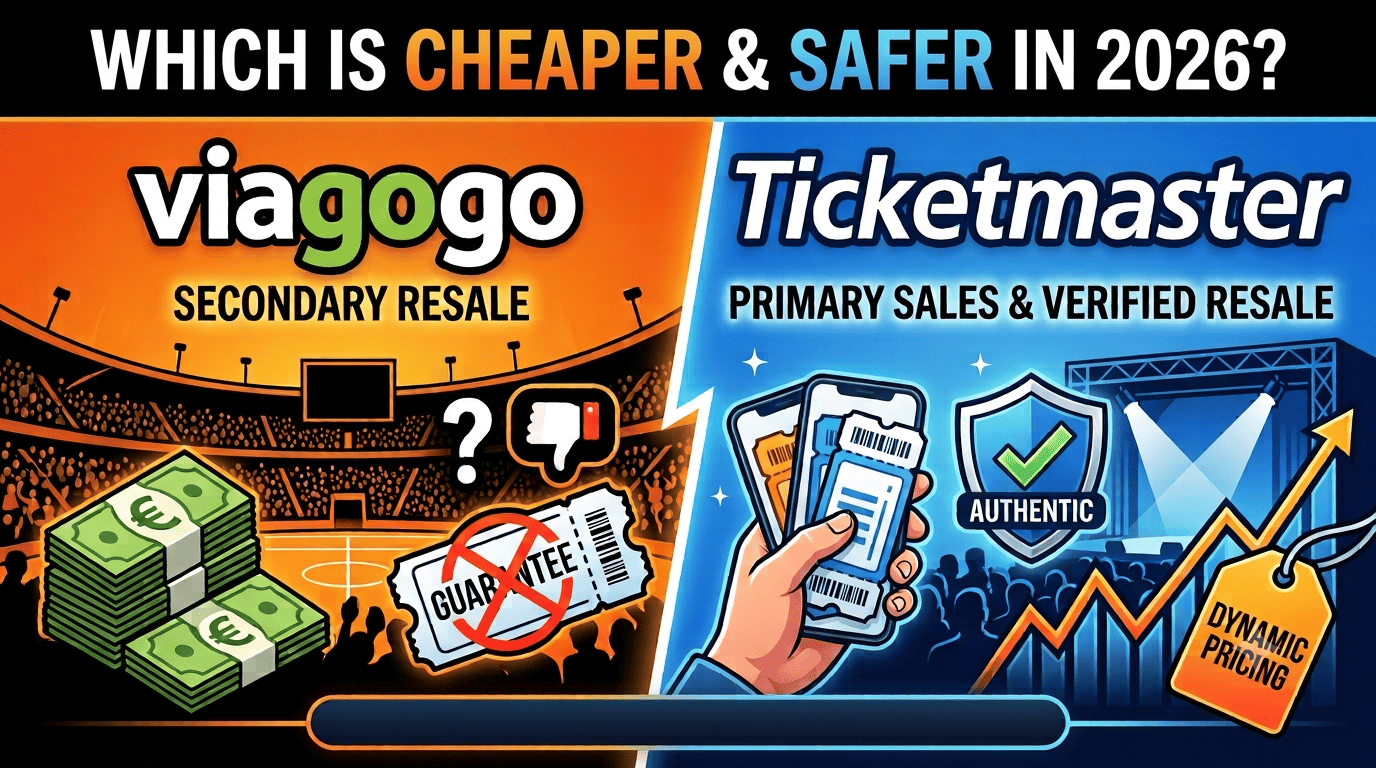
Neither Viagogo nor Ticketmaster delivers a genuinely transparent ticket-buying experience in 2026. Both platforms layer fees onto the advertised price, both have faced regulatory action in Europe, and both leave fans questioning whether they overpaid. The core difference comes down to business model: Ticketmaster dominates primary ticket sales through exclusive venue and promoter contracts, while Viagogo operates as an open secondary marketplace where third-party sellers set prices with no face-value ceiling. For European fans who want the simplest answer: buy from the platform that shows you the real price before you click “purchase,” guarantees official tickets, and charges zero buyer fees — and that platform is neither of these two legacy giants.
- Side-by-Side Comparison Table (Viagogo vs Ticketmaster vs TicketX Europe)
- Which Platform Should You Use? (Decision by Use Case)
- What Is Ticketmaster and How Does It Work?
- What Is Viagogo and Is It Legit?
- Fees Compared — The Real Cost of a Ticket on Viagogo vs Ticketmaster
- Refund Policies and Customer Service — Viagogo vs Ticketmaster
Side-by-Side Comparison Table (Viagogo vs Ticketmaster vs TicketX Europe)
| Feature | Viagogo | Ticketmaster | TicketX Europe |
| Business Model | Secondary / Resale marketplace | Primary seller + Verified Resale | Official / Verified ticket marketplace |
| Buyer Fees | 15–28% added at checkout | 20–30% (service + order + facility fees) | 0% — no buyer fees |
| Dynamic Pricing | Seller-set pricing; no cap | Algorithmic surge pricing on primary sales | No dynamic pricing surcharges |
| Price Transparency | Fees revealed at checkout stage | Fees partially shown; final total at checkout | What you see is what you pay |
| Ticket Authenticity | Third-party seller guarantee (limited) | Primary tickets authentic; resale varies | 100% official and verified tickets |
| Refund Policy | Restrictive; historically difficult | Refunds for cancellations; limited for resale | Clear refund terms for cancelled events |
| EU/UK Regulatory Record | CMA court order (2018); ongoing scrutiny | UK government dynamic pricing consultation (2025) | Compliant; transparent pricing by design |
| Best For | Sold-out events (with risk acceptance) | Presale access and primary on-sale | Fee-free, verified European event tickets |
Which Platform Should You Use? (Decision by Use Case)
The right platform depends entirely on what you are buying, where you are buying it, and how much risk you are willing to accept with your money.
Use Ticketmaster when the event is still in its primary on-sale window and you can access presale codes through fan clubs, credit card promotions, or artist memberships. Ticketmaster remains the default primary seller for the majority of major European venues and tours. If you can tolerate a 20–30% fee stack on top of the listed price, and the event has not triggered dynamic pricing surges, Ticketmaster’s primary inventory is at least authentic.
Use Viagogo only when the event is completely sold out on all official channels, you fully understand that the ticket price is set by a third-party seller at a markup, and you accept the risk that your ticket could be cancelled, duplicated, or flagged at the gate. European consumers have stronger protections under the EU Consumer Rights Directive and CMA orders than in some other regions, but exercising those rights through Viagogo’s customer service has historically been an uphill battle.
Use TicketX Europe when you want to eliminate guesswork entirely. With 0% buyer fees, 100% official tickets, and transparent checkout pricing, TicketX Europe is purpose-built for European fans purchasing Premier League, Champions League, La Liga, Bundesliga, concert, festival, and West End tickets without the anxiety of hidden surcharges or unverified inventory.
- Primary on-sale with presale access → Ticketmaster (accept the fee stack)
- Sold-out event, high risk tolerance → Viagogo (verify refund terms before purchasing)
- European events, 0% fees, verified tickets → TicketX Europe (transparent pricing, official inventory)
- High-value purchases (Champions League final, major tours) → Avoid open resale; prioritize verified/official platforms
- Budget-conscious buyers → Always compare the total checkout price, not the listing price
What Is Ticketmaster and How Does It Work?
Ticketmaster is the world’s largest primary ticket sales platform and a subsidiary of Live Nation Entertainment, the global live-events conglomerate that also owns or operates approximately 394 venues, manages more than 380 artists, and promotes more than 50,000 events annually. In practical terms, when a venue or promoter puts tickets on sale for a concert, football match, or theater production, Ticketmaster is most often the authorized technology and distribution partner handling that transaction. The company distributed over 637 million tickets globally in 2024 and controls an estimated 70–80% of primary ticket sales in major Western markets.
For European consumers, Ticketmaster operates country-specific sites across the UK, Ireland, Germany, Spain, the Netherlands, and the Nordics, among others. Its dominance means that for many events — particularly arena concerts, stadium tours, and large-scale festivals — Ticketmaster is the only authorized point of sale. This monopoly position has drawn sustained criticism from consumer advocates, regulators, and artists themselves, especially after high-profile failures like the Taylor Swift Eras Tour on-sale chaos in 2022 and the Oasis reunion dynamic pricing controversy in 2024.
What matters most for the Viagogo-vs-Ticketmaster comparison: Ticketmaster is a primary seller. When you buy a standard listing on Ticketmaster, you are purchasing a ticket at or near the promoter-set face value (before fees). The ticket is issued directly through Ticketmaster’s system and is, in almost all cases, authentic. The problems begin with the fee structure layered onto that face value and with the dynamic pricing algorithm that can inflate the base price itself.
Ticketmaster’s Verified Resale Program — Primary vs Secondary Inventory
Ticketmaster does not only sell primary tickets. Its “Verified Resale” or “Fan-to-Fan Resale” program allows existing ticketholders to list their tickets for resale directly on the Ticketmaster platform. These listings appear alongside primary inventory — sometimes without clear differentiation — and are priced by the individual seller, not by the promoter or venue.
This creates a critical transparency issue. A buyer searching for concert tickets on Ticketmaster may see two listings side by side: one at the promoter’s face value (plus Ticketmaster’s fees) and one at a resale markup (plus a separate resale fee structure). The distinction is not always immediately obvious, particularly on mobile devices. Ticketmaster’s resale tickets are marketed as “verified,” meaning the barcode is reissued through Ticketmaster’s system to reduce fraud risk — a genuine advantage over open resale marketplaces like Viagogo. However, the resale price itself is unregulated, and fans have reported paying two or three times face value for resale tickets on Ticketmaster without realizing they were not buying at the original price.
- Primary tickets: Issued at promoter-set price, authentic, subject to Ticketmaster’s standard fee stack (service fee + order processing fee + facility charge)
- Verified Resale tickets: Reissued barcodes (reduced fraud risk), but seller-set pricing with no price cap, plus separate resale fees
- Key risk: Blurred presentation between primary and resale listings can mislead casual buyers into paying inflated resale prices unknowingly
What Is Viagogo and Is It Legit?
Viagogo is a secondary ticket marketplace headquartered in Switzerland and founded in 2006. It operates exclusively as a resale platform — Viagogo does not sell tickets directly from venues, promoters, or artists. Instead, it provides a marketplace where third-party sellers (individuals, brokers, and commercial resellers) list tickets at prices they set themselves. There is no connection to face value; a ticket originally priced at €50 can be listed on Viagogo for €150 or €300, and Viagogo takes a commission plus charges the buyer a separate service fee.
Is Viagogo “legit” in the sense of being a legally operating company? Yes. Viagogo is a registered business, processes real transactions, and in February 2020 completed its acquisition of StubHub in its entirety for $4.05 billion (a deal announced in November 2019). It was later required by the UK CMA to divest StubHub’s international (non-North American) operations in 2021, but the acquisition cemented its position as one of the largest ticket resale operators in the world. However, “legit” and “safe” are not synonyms in the ticket industry. Viagogo has faced enforcement actions from the UK’s Competition and Markets Authority, lawsuits in Italy and Australia, and persistent consumer complaints about hidden fees, invalid tickets, and denied entry at venues across Europe.
The critical distinction: Viagogo is not an official ticket seller for any venue, league, or artist in Europe. Premier League clubs, UEFA, major concert promoters, and West End theaters do not authorize Viagogo as a sales channel. Tickets purchased on Viagogo may be genuine tickets resold by someone who originally purchased them elsewhere — or they may be speculative listings, duplicate barcodes, or tickets that violate the original terms of sale (many Premier League and Champions League tickets explicitly prohibit unauthorized resale and can be cancelled if detected).
What CMA Data, Trustpilot Reviews, and Industry Experts Actually Show
The UK Competition and Markets Authority (CMA) took formal enforcement action against Viagogo in 2018, securing a legally binding court order that required the platform to overhaul its business by January 2019 — clearly disclosing all fees upfront, identifying whether the seller is a professional broker or individual, and warning buyers when tickets may be cancelled due to resale restrictions. The CMA noted that Viagogo had been operating in breach of consumer protection law by obscuring the total cost of tickets and failing to disclose material information that would affect purchasing decisions. In 2021 the CMA went further, publishing recommendations to government for strengthening consumer protection across the secondary ticketing market. As of 2026, the CMA continues to monitor compliance, and consumer advocacy groups report that implementation remains inconsistent.
The FanFair Alliance, a UK campaign group that has documented industrial-scale ticket touting for years, has repeatedly warned that buyers on secondary marketplaces face inflated prices, invalid or duplicated tickets, and cancellations with limited recourse — with Viagogo a recurring subject of consumer complaints.
Reg Walker, a security and ticketing expert who has investigated resale fraud for years, has flagged cases where high-demand tickets surfaced on Viagogo in apparent breach of the rules — including questioning the lawfulness of resale listings for England football match tickets, as reported by The Guardian in May 2024.
Trustpilot ratings for Viagogo consistently reflect these structural problems. While the platform does facilitate legitimate resale transactions in many cases, the volume and severity of negative reviews — particularly around fee transparency, customer service responsiveness, and denied-entry incidents — place Viagogo well below industry trust benchmarks for European consumers.
Viagogo Scam Reports: Fake Tickets, Fraud Cases, and Denied Entry
To be clear: Viagogo itself is not a “scam” in the criminal sense. It is a registered marketplace that facilitates resale transactions. However, the platform’s structure creates an environment where fraudulent and problematic listings can and do reach buyers, and the consequences for European fans are serious.
Denied entry is the most devastating outcome. When a Premier League club, a UEFA tournament, or a major concert venue detects that a ticket was resold in violation of its terms and conditions, the barcode is deactivated. The ticket scans as invalid at the gate. The fan — who may have traveled internationally and booked hotels and flights around the event — is turned away. Viagogo’s “guarantee” promises a replacement ticket or refund in such scenarios, but resolution timelines and actual success rates have been widely criticized by consumer groups and affected buyers.
Duplicate barcodes represent another documented risk. Because Viagogo does not control the original issuance of tickets, a seller can list the same barcode multiple times or sell a ticket that has already been transferred to another buyer. The first person to scan enters; everyone else is denied.
Speculative listings are tickets listed for sale before the seller actually possesses them. The seller gambles on being able to acquire the ticket before the event. If they fail, the buyer receives a cancellation — sometimes days before the event, after non-refundable travel has been booked.
- Viagogo is a legal company, not a criminal enterprise — but its marketplace model carries measurable risk
- Consumer advocates including the FanFair Alliance report that secondary marketplace buyers face recurring problems — denied entry, counterfeit tickets, cancellations — with Viagogo among the most-complained-about platforms
- Denied entry, duplicate barcodes, and speculative listings are documented and recurring problems
- CMA-mandated disclosures have improved transparency on paper, but enforcement gaps persist
- European fans attending high-value events (Champions League, Premier League derbies, sold-out concerts) face disproportionate risk when purchasing through unverified resale channels
Fees Compared — The Real Cost of a Ticket on Viagogo vs Ticketmaster
The single most important number in any ticket comparison is not the listed price — it is the total checkout price. Both Viagogo and Ticketmaster have built business models where the price you see when browsing is not the price you pay when purchasing. The gap between those two numbers ranges from 15% to 30% or more, depending on the platform, the event, and — in Ticketmaster’s case — whether the dynamic pricing algorithm has been activated. For European fans, where the EU Consumer Rights Directive and the UK CMA have both pushed for all-in pricing, the persistence of checkout-stage fee escalation on both platforms is a documented regulatory concern, not merely a consumer annoyance.
Ticketmaster’s Fee Stack: Service Fee + Order Fee + Facility Fee + Dynamic Pricing Surcharge
Ticketmaster’s pricing architecture is a layer cake. A ticket listed at €80 does not cost €80. By the time you reach the payment screen, you have encountered some or all of the following:
Service Fee: The primary surcharge, typically 15–22% of the ticket face value. This is Ticketmaster’s core revenue on each transaction and is always present.
Order Processing Fee: A flat fee per order (not per ticket), usually €3–€8 depending on the market. Applied at the final checkout stage.
Facility Charge: A per-ticket fee passed through from the venue, ranging from €1 to €5. Not always present, but common for arena and stadium events.
Dynamic Pricing Surcharge: Since Ticketmaster introduced algorithmic demand-based pricing on primary tickets, the base price itself can surge before any of the above fees are calculated. This means a ticket with a promoter-set face value of €80 might be displayed at €140 during peak demand, and then the 20%+ fee stack is applied on top of the inflated base. The effective total can exceed 2x the original face value without any resale markup — this is a primary-market transaction on the official platform.
Ticketmaster’s combined fees typically add 20–30% to the listed price. When dynamic pricing is active, the effective premium can be substantially higher.
Viagogo’s Fee Structure: 15–28% Buyer Fees, Currency Conversion, and Delivery Charges
Viagogo’s fee architecture is simpler in structure but equally aggressive in impact. Every buyer pays:
Service Fee / Booking Fee: Typically 15–28% of the listed ticket price, charged to the buyer at checkout. This fee is Viagogo’s primary revenue and is layered on top of a resale price that already exceeds face value. A ticket listed at €150 (already marked up from a €60 face value) might carry an additional €30–€42 in service fees.
Delivery / Fulfillment Fee: A separate charge for ticket delivery — whether electronic or physical. This fee ranges from €3 to €10+ depending on the delivery method and urgency. Electronic ticket delivery, which costs the platform essentially nothing, still carries a fee on many listings.
Currency Conversion Surcharge: For cross-border European purchases (a common scenario when attending events in a different country), Viagogo applies currency conversion at rates that include an undisclosed markup. A UK buyer purchasing tickets for a La Liga match in Spain, or a German buyer purchasing Premier League tickets in the UK, may pay 2–5% above the interbank exchange rate without any clear disclosure.
The cumulative effect: once the resale markup and buyer fees are combined, Viagogo’s total cost routinely lands 55–115% above the original face value of the ticket — as the €100 test below shows. This is not a bug in the system — it is the system.
The €100 Ticket Test — What You Actually Pay on Each Platform
To make the fee comparison tangible, here is what happens when you try to buy a ticket with a €100 face value on each platform:
| Cost Component | Viagogo | Ticketmaster | TicketX Europe |
| Listed Price | €135–€160 (resale markup) | €100–€140 (may include dynamic pricing) | €100 |
| Service / Buyer Fee | €20–€45 (15–28% of listed price) | €15–€27 (15–22% service fee) | €0 |
| Order Processing Fee | Included in service fee | €3–€8 per order | €0 |
| Delivery Fee | €3–€10 | €0–€5 (varies by method) | €0 |
| Total Checkout Price | €158–€215 | €118–€180 | €100 |
| Premium Over Face Value | 58–115% | 18–80% | 0% |
The savings are not marginal. On a single ticket, TicketX Europe’s 0% buyer fees model can save €18 to €115 compared to the legacy platforms. For a group of four attending a Champions League match or a concert, that difference can exceed €400 — enough to cover a hotel night or a return flight within Europe.
Refund Policies and Customer Service — Viagogo vs Ticketmaster
A ticket is only as good as the refund policy behind it. When events get cancelled, rescheduled to a date you cannot attend, or when the tickets you purchased turn out to be invalid, the refund process determines whether you recover your money or absorb a total loss. Both Viagogo and Ticketmaster have refund frameworks, but the gap between stated policy and lived experience is substantial on both platforms.
Ticketmaster’s Refund and Rescheduling Policy (2026)
Ticketmaster’s refund policy is relatively straightforward for primary ticket purchases — at least on paper. If an event is cancelled by the promoter or artist, Ticketmaster issues a full refund including fees. This process is typically automatic and completes within 7–14 business days.
The complications begin with rescheduled events. Ticketmaster’s standard policy states that tickets for rescheduled events remain valid for the new date. Refunds for rescheduled events are offered at the promoter’s discretion, not Ticketmaster’s. Some promoters offer a refund window (typically 7–14 days after the new date is announced); others do not. For fans who booked travel around a specific date, a rescheduled event can mean hundreds of euros in non-recoverable travel costs even if the ticket itself is honored.
Resale purchases through Ticketmaster’s Verified Resale program carry additional refund uncertainty. Because the original ticket was purchased by a third-party seller, refund processing involves reversing a two-party transaction, which can extend timelines and introduce complications that do not exist in straightforward primary-sale refunds.
Change-of-mind refunds are generally not available. If you purchase a ticket and simply decide not to attend, Ticketmaster does not offer a refund. You can attempt to relist the ticket through Verified Resale, but there is no guarantee of sale.
Viagogo’s Refund Policy — The Guarantee vs the Reality
Viagogo markets a “Viagogo Guarantee” that promises buyers will receive valid tickets in time for the event, or receive a replacement or refund. On paper, this sounds comprehensive. In practice, the guarantee has been the subject of sustained criticism from consumer groups, regulatory bodies, and thousands of individual buyers.
For cancelled events, Viagogo does process refunds, but the timeline is often significantly longer than Ticketmaster’s — 30 days or more is commonly reported, and some buyers have documented waiting 60–90 days for resolution. The refunded amount is the purchase price paid to Viagogo, which already includes the resale markup and service fees.
For denied entry — the scenario European fans fear most — Viagogo’s guarantee theoretically applies, but enforcing it requires the buyer to document the denial (photographs, venue correspondence), file a claim through Viagogo’s support system, and wait for investigation. Consumer reports consistently describe this process as slow, adversarial, and inconsistent in outcome.
Customer service accessibility is a recurring pain point. Viagogo does not publish a direct customer service phone number in most markets. Support is primarily handled through an online form and email system. Response times of 5–10 business days are commonly reported during peak periods, which is functionally useless for a fan who has been denied entry at a stadium gate and needs immediate resolution.
- Ticketmaster: Reliable refunds for cancellations; inconsistent for rescheduled events; no change-of-mind refunds; resale refunds can be complicated
- Viagogo: Guarantee exists but enforcement is slow, documentation-heavy, and inconsistent; customer service is difficult to reach; denied-entry claims face a lengthy investigation process
- TicketX Europe: Transparent refund terms for cancelled events; 100% official tickets minimize the risk of denied entry entirely
コメント