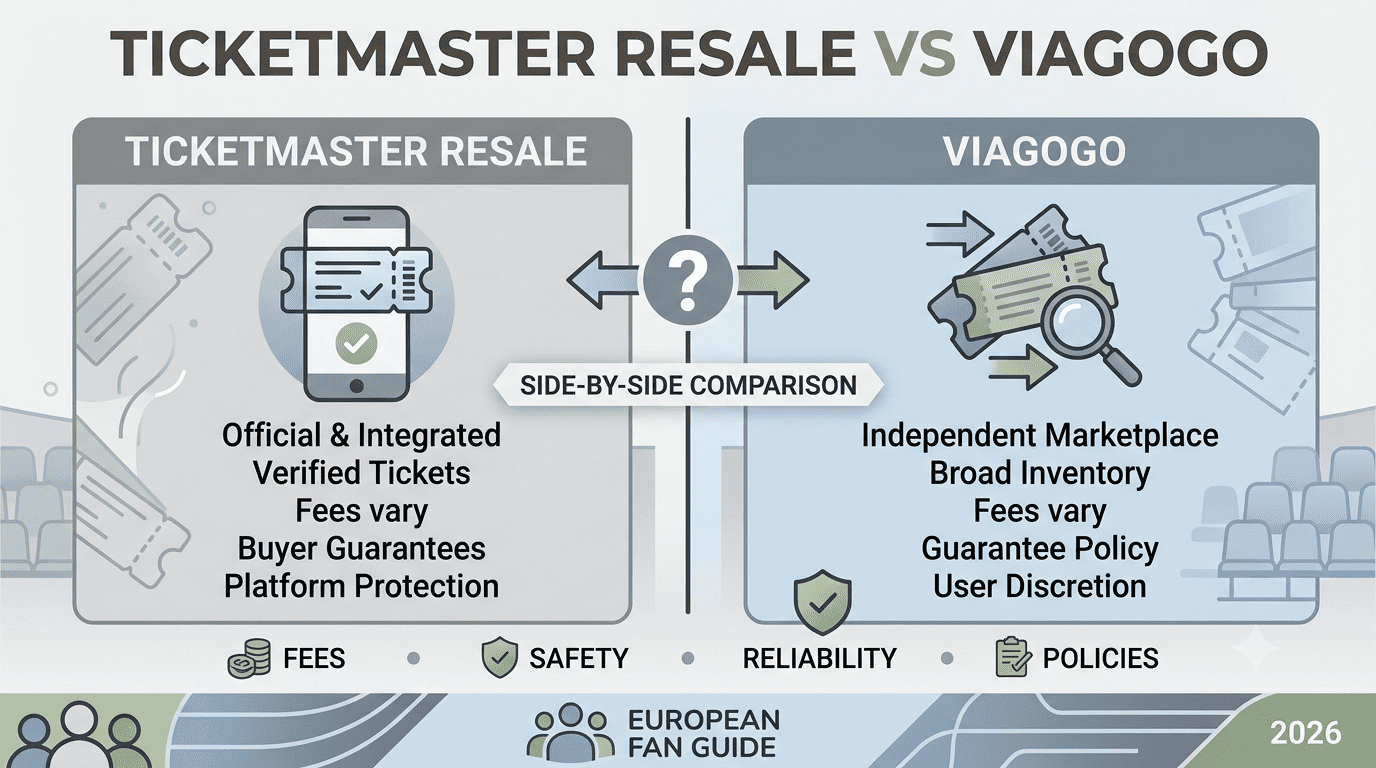
Choosing between Ticketmaster Resale and Viagogo is one of the most common dilemmas facing European fans hunting for sold-out event tickets in 2026. Both platforms facilitate secondary ticket sales, but they operate under fundamentally different business models, fee structures, and trust frameworks — and those differences have real consequences for your wallet, your entry at the gate, and your overall peace of mind.
Before diving into the granular mechanics of each platform, here is what you need to know at the highest level: Ticketmaster Resale functions as an official, integrated resale channel within the Ticketmaster ecosystem, meaning tickets are verified against the original purchase record before being relisted. Viagogo, by contrast, operates as an independent, open-marketplace platform where third-party sellers list tickets without direct integration into event organizers’ ticketing systems. This structural distinction shapes everything downstream — from fee transparency to ticket validity to refund eligibility.
Neither platform, however, fully solves the two biggest pain points European fans consistently report: fees that are often not shown until checkout and can significantly inflate the final price, and lingering uncertainty about whether a resale ticket will actually get you through the turnstile on matchday or concert night.
Side-by-Side Comparison Table — Fees, Legitimacy & Buyer Protection
The fastest way to grasp the core differences between Ticketmaster Resale and Viagogo is through a direct, data-backed comparison. The table below synthesizes fee disclosures, regulatory findings, and consumer research from sources including Which? Consumer Research, the UK Competition and Markets Authority (CMA), and official platform documentation as of 2026.
| Criteria | Ticketmaster Resale | Viagogo |
| Platform Type | Official integrated resale (within Ticketmaster system) | Independent third-party open marketplace |
| Buyer Fees | 15%–25% service fee + order processing fee (€2–€5) | 25%–45% total (booking fee + service fee + delivery fee) |
| Seller Fees | 10%–15% commission | ~10%–15% commission |
| Fee Transparency | Fees shown before final checkout but not on initial listing page | Fees added at final checkout step; initial price does not reflect the final total |
| Ticket Verification | Verified against original Ticketmaster purchase record | No direct integration with event organizer systems |
| Buyer Protection Guarantee | Replacement or refund for invalid tickets | Viagogo Guarantee (subject to regulatory scrutiny) |
| Regulatory Standing (Europe) | Compliant; owned by Live Nation Entertainment | More than €40M in cumulative fines/regulatory actions since 2018 |
| Club/Organizer Authorization | Authorized by most major event organizers | Not recognized by multiple Premier League clubs |
The Gap Both Platforms Leave for European Fans
Even after reviewing the comparison, a critical question remains: does either platform truly serve the interests of European fans attending sold-out matches, concerts, or festivals?
The honest answer is that both leave significant gaps. Ticketmaster Resale benefits from its integration with the primary ticketing system, which provides stronger ticket validity assurance, but its buyer-side service fees — typically 15%–25% of face value, on top of a separate processing fee — still add meaningful cost that many fans do not anticipate when they first see a listing price. The UK’s Advertising Standards Authority (ASA) has taken formal enforcement action against multiple secondary ticketing sellers after finding they were not upfront and clear with consumers about additional fees and charges added at the end of the booking process.
Viagogo adds to this further, with total buyer fees routinely reaching 25%–45% above the listed price and an ongoing history of regulatory enforcement across Europe. Meanwhile, Google Trends data shows a clear upward trend in European search interest for terms like “viagogo scam” and “viagogo fake tickets” over the past two years, alongside rising interest in “Ticketmaster hidden fees” — a signal of growing consumer scrutiny of both platforms’ pricing practices.
The pattern is clear: fans are increasingly dissatisfied with both incumbents. What European event-goers actually want — transparent pricing with no hidden fees, 100% official tickets verified within the event ecosystem, and a secure checkout that does not inflate the total at the final step — is precisely the gap that fee-free, verified-only platforms are now filling. TicketX Europe was built around this exact principle: 0% buyer fees, no hidden checkout charges, and a curated inventory of official tickets across Premier League matches, Champions League fixtures, European concert tours, and major festivals.
- Side-by-Side Comparison Table — Fees, Legitimacy & Buyer Protection
- The Gap Both Platforms Leave for European Fans
- How Ticketmaster Resale Works in Europe
- How Viagogo Works in the Secondary Ticket Market
- Real Cost Comparison: A €100 Ticket on Ticketmaster Resale & Viagogo
- Safety & Trust: Which Resale Platform Protects European Fans Best?
How Ticketmaster Resale Works in Europe
Understanding Ticketmaster Resale requires separating it from Ticketmaster’s primary ticket sales operation. When fans hear “Ticketmaster,” they typically think of buying tickets directly from the event organizer at face value during the initial on-sale window. Ticketmaster Resale is a different mechanism entirely — it is a secondary marketplace embedded within the same Ticketmaster platform, allowing fans who already own tickets to relist them for purchase by other fans.
Launched as a response to the growing unregulated secondary market, Ticketmaster Resale aims to keep resale activity within an “official” ecosystem where ticket barcodes can be verified against the original purchase database. In Europe, this system is used across the UK, Germany, the Netherlands, and several other markets, though availability varies by event and venue.
Live Nation Entertainment, Ticketmaster’s parent company, reported in its 2025 annual filing (10-K) that its Ticketing segment generated $3.1 billion in revenue in 2025 — 12% of the company’s total revenue for the year. For fans, this is a reminder that Ticketmaster Resale operates inside a large, professionally run commercial business — not a charitable fan-to-fan service — and understanding its mechanics, costs, and limitations is essential before committing money.
Listing, Buying & Delivery Process
The end-to-end process on Ticketmaster Resale works as follows. A seller who purchased tickets through Ticketmaster’s primary platform can navigate to their account, select the tickets they wish to resell, and set a price — often guided by Ticketmaster’s suggested price range, which may be at, above, or below face value depending on demand.
Once listed, the tickets appear alongside primary inventory on the same event page, sometimes distinguished only by a small “Resale” label that can be easy to miss. Some consumer advocates have noted that this blending of primary and resale listings can make it harder for buyers to tell face-value tickets apart from marked-up resale inventory.
When a buyer purchases a resale ticket, Ticketmaster’s system deactivates the original barcode and issues a new verified barcode linked to the buyer’s account. Delivery is typically digital via the Ticketmaster app or a mobile ticket transfer. In theory, this closed-loop system ensures that only one valid barcode exists at any time, reducing the risk of duplicate tickets.
However, the process is not instantaneous for all events — some sellers list tickets for events months away, and the actual barcode transfer may not complete until closer to the event date, which can create anxiety for buyers who want immediate confirmation of their purchase.
Ticketmaster Resale Fee Breakdown: What Buyers and Sellers Really Pay
One of the most persistent misconceptions among European fans — frequently surfacing on forums like r/TicketMaster and r/PremierLeague — is that Ticketmaster Resale is free because it is the “official” platform. It is not.
Sellers are typically charged 10% to 15% commission on each completed sale, deducted from the sale price before payout. Buyers face a separate layer of costs: a service fee that typically ranges from 15% to 25% of the ticket’s listed price, plus an order processing fee that can add an additional €2–€5 per transaction depending on the market and delivery method. Ticketmaster does not publish a single, fixed fee schedule — resale service fees are set on a per-event basis in agreement with organizers — but independent fee-tracking puts typical buyer-side service fees in this 15%–25% range.
For a ticket listed at €100, the buyer’s final checkout total can therefore land between €117 and €132 after all fees are applied. These fees are disclosed before the final payment confirmation, but they are not displayed on the initial event listing page — meaning the price a buyer first sees when browsing is not the price they will ultimately pay.
This structure, while more transparent than Viagogo’s fee layering, still falls short of the “what you see is what you pay” experience that many fans expect from an officially branded platform. According to Which? Consumer Research, Ticketmaster’s buyer-side fees are a recurring source of complaints among UK consumers.
Are Ticketmaster Resale Tickets Guaranteed Valid?
Within Ticketmaster’s own ecosystem, resale tickets carry a strong validity guarantee. Because resale transactions occur within the same database that issued the original ticket, the platform can verify, deactivate, and reissue barcodes with a high degree of reliability. Ticketmaster’s buyer guarantee policy states that if a resale ticket is found to be invalid or entry is denied due to a platform-side error, the buyer is entitled to a comparable replacement ticket or a full refund.
In practice, denied-entry incidents on Ticketmaster Resale are relatively rare compared to open-marketplace platforms, precisely because of this integrated verification system. That said, the guarantee is not absolute. Edge cases exist: events where the promoter or venue has changed its ticketing provider between the original sale and the event date, situations where mobile ticket transfers fail due to app glitches, or instances where a club’s own anti-touting policy clashes with Ticketmaster’s resale terms.
For high-profile European events — Champions League knockout rounds, major festival weekends, or once-in-a-generation reunion tours — even a small percentage of failed transfers can translate into thousands of affected fans. The guarantee provides a safety net, but it does not eliminate risk entirely, and fans attending premium events should always confirm their ticket status directly through the Ticketmaster app well before the event date.
How Viagogo Works in the Secondary Ticket Market
Viagogo occupies a fundamentally different position in the secondary ticket market. Unlike Ticketmaster Resale, which operates within the primary ticketing provider’s own infrastructure, Viagogo is an independent, open-marketplace platform headquartered in Switzerland. Any seller — professional reseller, individual fan, or bulk broker — can list tickets on Viagogo without needing to have originally purchased them through any specific primary platform.
This open-marketplace model means Viagogo draws inventory from a broad pool of independent sellers who are not individually vetted by the platform before listing, offering wide availability for sold-out events but with less built-in certainty around ticket validity, pricing transparency, and consumer protection than a closed-loop resale system provides. The platform has been the subject of sustained regulatory scrutiny across Europe since at least 2018 — when the UK’s Competition and Markets Authority (CMA) first brought court proceedings against it — with cumulative fines and enforcement actions now exceeding €40 million across EU member states and the UK, more than €39 million of that in Italy alone.
Despite these interventions, Viagogo continues to operate across European markets, often ranking prominently in Google search results for high-demand event queries — which is why understanding its fee mechanics, regulatory history, and real-world outcomes is worth doing before any purchase.
Viagogo’s Fee Layers: Why Checkout Prices Jump 25%–45%
One of the most common complaints about Viagogo — echoed across Reddit threads, X (Twitter) posts, and formal regulatory complaints — is the gap between the price displayed on a listing page and the price presented at final checkout.
A ticket listed at €100 on Viagogo can rise to €125–€145 by the time the buyer reaches the payment confirmation screen. This inflation occurs through a series of stacked fees that are not visible on the initial browsing page: a combined booking and service fee (typically 15%–25%), a delivery or fulfillment fee (€5–€12), and an additional service charge (€5–€8) that can vary by the buyer’s country.
The cumulative effect is a 25%–45% markup over the listed price — a figure consistently documented by consumer watchdog organizations including Which?.
This isn’t just anecdotal: Viagogo has been the most frequently named platform in enforcement actions and consumer complaints about secondary-ticket pricing transparency across Europe, and the UK’s ASA has formally found that secondary ticketing sellers were not disclosing additional fees upfront. For fans buying multiple tickets — a family attending a Premier League match, a group heading to a festival — the fee stacking compounds rapidly, turning what appeared to be a reasonable resale price into a substantial financial premium.
Regulatory Actions & Bans Across Europe
Viagogo’s business practices have attracted enforcement action from regulators across multiple European jurisdictions, creating a patchwork of legal obligations and ongoing compliance disputes.
The most significant early intervention came from the UK Competition and Markets Authority (CMA), which in 2018 secured a legally binding court order requiring Viagogo to:
- Tell buyers if there is a risk they could be turned away at the venue door
- Inform buyers which specific seat in the venue they will get
- Disclose who is actually selling the ticket
- Avoid misleading claims about a ticket’s availability or popularity
- Make it easy for buyers to get their money back under Viagogo’s own guarantee when something goes wrong
- Prevent sellers from listing tickets they do not actually own
Compliance with these requirements has been inconsistent, and the CMA has continued to monitor the platform.
Beyond the UK, Italy’s communications regulator AGCOM has fined Viagogo repeatedly: €3.7 million in 2020 for misleading fee practices — a decision upheld by the Regional Administrative Court of Lazio in April 2021 — a further €23.5 million in 2022 for related secondary-ticketing violations, and more than €12 million in March 2023 for breaching Italy’s rules against reselling tickets above face value, bringing Italy’s own cumulative penalties against the platform to more than €39 million. France’s Direction Générale de la Concurrence has investigated the platform’s compliance with French ticket resale price-cap laws, and Germany’s consumer protection authorities have flagged Viagogo’s practices under the EU’s Unfair Commercial Practices Directive.
The UK has since gone further still. On 19 November 2025, the UK government announced plans to make it illegal to resell live event tickets above their original face value — a change it said would cut resale prices by an average of £37 per ticket and save fans a combined £112 million a year. FanFair Alliance’s Adam Webb welcomed the move as “fantastic news for music fans” after years of campaigning for a resale price cap. The legislation is expected to be introduced during 2026 and would apply directly to both Ticketmaster Resale and Viagogo’s UK operations.
Looking further ahead at EU level, the European Commission’s planned Digital Fairness Act — expected to be formally proposed in the fourth quarter of 2026, with provisions targeting hidden fees on ticketing platforms — could bring one of the most stringent regulatory environments Viagogo has faced in Europe, though the proposal has not yet been published or approved. If adopted as currently framed, it would require all online ticket sellers operating in the EU to display the total price inclusive of all fees from the first page of listing.
Can You Be Denied Entry With Viagogo Tickets?
This is a real risk for some fans who purchase through Viagogo for high-profile European events. Because Viagogo operates independently from event organizers’ ticketing systems, the platform can’t always confirm that a ticket’s barcode hasn’t been duplicated, that the original seller hasn’t already used the ticket, or that the event organizer hasn’t voided the barcode as part of its anti-touting measures.
For UEFA Champions League matches, the risk is even more acute — UEFA’s strict ticket personalization policies mean that tickets purchased through unauthorized resale channels may require the original purchaser’s ID at the gate, rendering them useless for a different holder. Across Reddit communities like r/ChampionsLeague and r/soccer, denied-entry stories from fans holding Viagogo tickets surface regularly during knockout-round weeks, often accompanied by photos of long queues at box offices where affected fans attempt last-minute resolutions.
Viagogo’s buyer guarantee can offer a refund or replacement in some cases, though for many fans a refund is a poor substitute for a missed Champions League semi-final or a once-in-a-lifetime concert experience.
Real Cost Comparison: A €100 Ticket on Ticketmaster Resale & Viagogo
Abstract fee percentages become meaningful only when translated into actual euros leaving your bank account. To make the cost impact concrete, this section applies documented fee structures from all three platforms to a standardized €100 face-value ticket — the type of price point common across mid-tier Premier League matches, European arena concerts, and major football league fixtures. The figures below are based on independent tracking of Ticketmaster’s fee patterns, and Which? Consumer Research’s analysis of Viagogo checkout totals.
Fee Breakdown Table — €100 Face-Value Ticket
| Fee Component | Ticketmaster Resale | Viagogo |
| Listed Price | €100 | €100 |
| Service / Booking Fee | €15–€25 | €15–€25 |
| Order Processing Fee | €2–€5 | — |
| Delivery / Fulfillment Fee | €0–€2 (digital) | €5–€12 |
| Additional Service Charge | — | €5–€8 |
| Total at Checkout | €117–€132 | €125–€145 |
| Markup Over Face Value | 17%–32% | 25%–45% |
What “0% Buyer Fees” Actually Means for Your Wallet
The difference between €100 and €145 on a single ticket may seem manageable in isolation, but resale ticket purchases rarely happen in isolation. Consider a group of four friends attending a Premier League away day: on Viagogo, the fee premium alone — €25 to €45 per ticket — could add €100 to €180 to the group’s total cost, money that could cover matchday travel, food, or even a second event entirely. On Ticketmaster Resale, the group still faces an additional €68 to €128 in combined fees. On TicketX Europe, the total remains €400 — exactly four times the listed price, with zero additional charges at checkout.
Over the course of a season, a dedicated European football fan attending six to eight matches could save €150 to €360 compared to Viagogo and €102 to €256 compared to Ticketmaster Resale simply by purchasing through a platform that charges 0% buyer fees. “What you see is what you pay” is not a marketing slogan on TicketX Europe — it is the literal checkout experience, designed to eliminate the fee anxiety that comes with not knowing the final price until the last step of checkout.
Safety & Trust: Which Resale Platform Protects European Fans Best?
Fee transparency matters, but it becomes irrelevant if the ticket you purchased does not get you through the gate. For European fans spending hundreds of euros on resale tickets — often for bucket-list experiences like a Champions League Final, an El Clásico at the Santiago Bernabéu, or a sold-out arena residency — the safety and legitimacy of the ticket itself is the paramount concern. This section evaluates how Ticketmaster Resale, Viagogo, and verified-only alternatives like TicketX Europe handle ticket verification, buyer protection, and fraud prevention across the European market.
Official Verified Tickets vs Open-Marketplace Resale Inventory
The distinction between verified-inventory platforms and open-marketplace models is the single most important concept for European fans to understand when navigating the secondary ticket market.
A verified-inventory platform — whether Ticketmaster Resale or TicketX Europe — operates within or directly alongside the event organizer’s ticketing infrastructure. When a ticket is resold on such a platform, the system can confirm that the original barcode exists in the primary database, deactivate it, and issue a new valid barcode to the buyer. This closed-loop process makes it structurally impossible for a duplicate barcode to grant entry to two different people.
An open-marketplace model like Viagogo cannot perform this verification because it lacks integration with the event organizer’s ticketing system. Instead, Viagogo relies on sellers to self-report ticket details and provides its own buyer guarantee — a promise to supply replacement tickets or a refund if the originals fail.
FanFair Alliance, the consumer campaign group that has long pushed for stronger secondary-ticketing rules, has been particularly vocal about Viagogo specifically — campaign manager Adam Webb has criticized the platform’s continued disregard for UK consumers and its promotion of practices he considers exploitative and unlawful, arguing they reinforce the case for a statutory price cap on ticket resale.
For high-value events where entry requirements are strict and ticket personalization is enforced, the difference between a verified ticket and an open-marketplace listing is not academic — it is the difference between watching the match and watching it on a screen in a nearby pub.
How Premier League Clubs Are Fighting Unauthorized Resale
European football clubs — particularly in England’s Premier League — have moved aggressively to shut down unauthorized resale channels and protect fans from fraudulent or overpriced tickets. Arsenal, Manchester City, Liverpool, Chelsea, and Tottenham Hotspur have all implemented official ticket transfer systems that allow season ticket holders and members to resell tickets through club-controlled platforms at or below face value. These systems are designed to ensure that tickets circulate only within verified channels, with barcodes deactivated and reissued upon transfer.
The impact has been measurable: Arsenal has cancelled almost 74,000 accounts attempting to obtain tickets through unauthorised channels since introducing its new digital ticketing and ballot system — including more than 7,000 memberships banned in the 2025–26 season alone, as of the club’s statement to the BBC in September 2025 — a scale of enforcement the club has linked to activity on Viagogo and similar unauthorized platforms. Clubs have also deployed in-venue scanning technology that flags tickets purchased through unauthorized resale sites, and several have publicly warned fans that tickets bought outside official channels may result in denied entry, cancellation of the original season ticket, and even lifetime bans from the stadium.
These club-level interventions reinforce a broader trend: the European live events industry is actively closing the door on open-marketplace resale platforms and steering fans toward verified, transparent alternatives. For fans, the practical takeaway is straightforward — purchasing through platforms that work within the official ticket ecosystem is no longer just a safety preference; it is increasingly the only reliable path to guaranteed entry.
The EU Digital Fairness Act: What May Change for Ticket Buyers
The regulatory landscape for European ticket resale may be approaching its most significant shift in a decade — though the change is still ahead of us, not yet in force. The European Commission has listed the Digital Fairness Act as a legislative initiative in its 2026 work programme, with a formal proposal expected in the fourth quarter of 2026. The Commission ran a public consultation on the forthcoming Act until 24 October 2025, gathering input on issues including hidden fees on ticketing platforms.
If adopted as currently framed, the rules would require all online ticket sellers operating in the EU — including both primary and secondary platforms — to display the total price inclusive of all mandatory fees from the first page on which a ticket is listed, not just at the final checkout step.
Such a rule would be a direct response to the practices that have made Viagogo one of the most-complained-about ticketing platforms in Europe: showing an attractive base price on the browsing page, then stacking booking fees, service fees, delivery fees, and other charges at the final checkout moment, after the buyer has already invested time and emotional commitment in the purchase.
For Ticketmaster Resale, the eventual impact would likely be moderate — the platform already shows fees before the final payment confirmation, just not on the initial listing page, so some adjustment would be required. For Viagogo, compliance would likely require a more fundamental restructuring of its checkout flow and pricing display. For platforms like TicketX Europe that already display the total price from the first listing — because 0% buyer fees means the listed price is the checkout price — the proposed Act would simply codify what is already standard practice.
Early drafts under discussion are also expected to include stronger refund obligations for cancelled or invalid tickets and a more standardized complaint mechanism across EU member states — though the specifics won’t be settled until the Commission publishes its formal proposal.
コメント