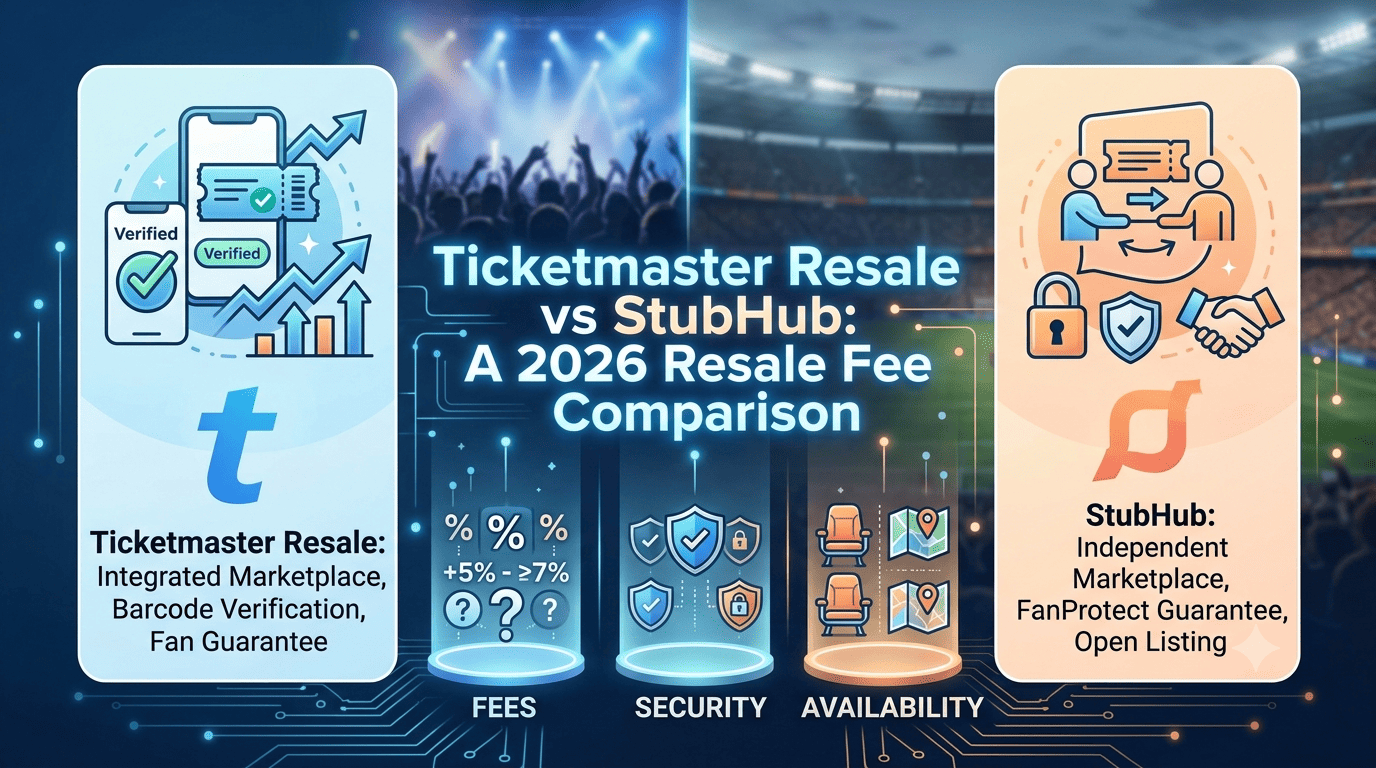
Every critical differentiator between the three platforms is distilled into the single scannable table below. Bookmark it — you will want to return here once you have read the deeper analysis further down the page.
- Ticketmaster resale vs Stubhub at a Glance — Quick Comparison Table
- How Ticketmaster Resale Works — Listings, Fee Layers & Seller Payouts
- How StubHub Works — Marketplace Model, Fees & Seller Payouts
- StubHub vs Ticketmaster Fees — Real Checkout Price Examples
- Is StubHub Legit? Is Ticketmaster Resale Safe? Trust & Buyer Protection Compared
Ticketmaster resale vs Stubhub at a Glance — Quick Comparison Table
| Criteria | Ticketmaster Resale | StubHub |
| Platform Type | Integrated resale within primary ticketing ecosystem | Independent secondary marketplace (StubHub Holdings, Inc. — NYSE: STUB) |
| Buyer Service Fee | 15%–25% of face value | ~25%–30% (service fee + fulfillment fee combined) |
| Seller Fee | ~5%–15% commission | ~10%–15% commission |
| Drip Pricing? | Yes — fees revealed at checkout | Yes — fees revealed at checkout |
| Ticket Verification | Barcode verified within Ticketmaster ecosystem | Seller-verified; FanProtect delivery guarantee |
| Speculative Listings? | Rare (ecosystem restrictions) | Permitted (sellers may not hold ticket at listing time) |
| European Event Coverage | Strong for Live Nation–promoted events; limited for club-controlled football | Broad but relies on third-party sellers; currency conversion charges |
| Buyer Guarantee | Fan Guarantee (replacement or refund for invalid tickets) | FanProtect Guarantee (replacement or refund for non-delivery) |
| Currency Handling (Europe) | Local currency; occasional FX spreads on cross-border events | Often lists in USD/foreign currency; FX markup at payment |
The takeaway is stark: both Ticketmaster Resale and StubHub add hefty charges that inflate the price you actually pay at checkout. TicketX Europe removes that markup entirely with 0% buyer fees and no hidden charges — a difference that can save European fans £20–£40 per ticket on a typical Premier League match or concert.
Why Both Platforms Still Rely on Drip Pricing
Drip pricing is the practice of advertising a low headline price and then layering additional fees — service charges, booking fees, fulfillment fees, facility surcharges — only after a buyer is emotionally committed and deep into the checkout funnel. It is not an accident of website design — UK regulators have documented it as a widespread, standard practice across the event-ticketing industry.
In November 2025, the UK Competition and Markets Authority (CMA) put event-ticketing businesses on notice over drip pricing under the Digital Markets, Competition and Consumers Act, citing UK government research that found the practice at 93% of event-ticket businesses reviewed — and noting that 72% of UK secondary-ticketing users have concerns about additional fees. The behavioral evidence explains why platforms retain the model: a large-scale field experiment run on StubHub itself, led by UC Berkeley economist Steven Tadelis, found that buyers who saw fees only at checkout spent about 21% more and were 14% more likely to complete a purchase than buyers shown all-in prices upfront.
Both Ticketmaster Resale and StubHub benefit from this model because:
- Sunk-cost psychology: Once a fan has selected seats, entered personal details, and visualized attending the event, abandoning the cart over a £20 surcharge feels irrational — even though the fee was never disclosed upfront.
- Competitive camouflage: If every major platform drip-prices, no single platform is punished by comparison shoppers because headline prices appear similar across sites.
- Revenue maximization: Bundling all costs into a transparent price would force platforms to compete on real total cost, compressing margins.
Regulatory pressure is mounting. The EU’s Digital Services Act (DSA) — fully applicable to all platforms since February 2024 — tightened transparency obligations for online marketplaces, and the CMA’s November 2025 enforcement drive shows national regulators are now willing to act on drip pricing directly. Yet compliance remains inconsistent. For fans tired of guessing what they will actually pay, the simplest solution is choosing a platform that never drip-prices in the first place.
How Ticketmaster Resale Works — Listings, Fee Layers & Seller Payouts
Primary vs Resale Listings on the Same Event Page
Ticketmaster’s resale marketplace is not a separate website. Resale inventory appears on the same event page as primary (face-value) tickets, distinguished only by a small “Resale” or “Verified Resale” tag next to certain listings. For a first-time buyer scrolling quickly, the difference is easy to miss.
This integrated design has clear advantages: barcode verification is handled within Ticketmaster’s own ecosystem, reducing fraud risk. However, it also creates a documented consumer-confusion problem. Consumer groups and press investigations have repeatedly criticized the blending of primary and resale listings without adequate visual separation, with fans inadvertently purchasing resale tickets at inflated prices while cheaper face-value options were still available on the same page.
What this means in practice:
- A Premier League fixture at Emirates Stadium might show a Category 2 seat at £80 (primary) and an identical section seat at £130 (resale) within the same results grid.
- Unless a buyer carefully filters for “Standard” or “Primary” listings, the higher-priced resale ticket can be added to the cart without realizing the markup.
- The resale listing then carries its own service-fee layer on top of the already-elevated price — compounding the overpayment.
Understanding this blending is the essential first step before comparing Ticketmaster’s resale fees to StubHub’s.
Ticketmaster Resale Fee Breakdown for Buyers (2026 Rates)
Ticketmaster does not publish a single universal fee rate. Fees vary by event, venue, promoter agreement, and country. However, based on publicly disclosed information and real checkout observations across European events in 2025–2026, the following ranges apply:
| Fee Component | Typical Range (Europe) | When Disclosed |
| Service Fee | 15%–25% of listed resale price | At checkout (after seat selection) |
| Order Processing Fee | £2.50–£5.00 / €3.00–€6.00 per order | At checkout |
| Facility Charge (select venues) | £1.00–£3.50 per ticket | At checkout |
| Delivery / E-Ticket Fee | £0–£2.50 (mobile transfer usually free) | At checkout |
A concrete example: a resale ticket listed at £100 for a London stadium concert could generate a final checkout total of £122–£133 once all fees are applied. None of those additional charges appear on the initial search-results page.
Live Nation Entertainment — Ticketmaster’s parent company — distributed over 637 million tickets through its systems in 2024, up 2.7% year-over-year. With volume at that scale, even small per-ticket fees add up — and the lack of upfront disclosure is a persistent source of frustration for European buyers.
How Sellers List and Get Paid on Ticketmaster Resale
Selling on Ticketmaster Resale is straightforward for anyone who originally purchased through Ticketmaster:
- Navigate to “My Events” in your Ticketmaster account.
- Select the ticket you wish to resell and choose “Sell.”
- Set your asking price — Ticketmaster may impose a price floor or ceiling depending on the event and territory.
- Confirm the listing — the ticket’s barcode is automatically transferred to the buyer upon sale, eliminating manual delivery.
Seller commissions typically range from 5%–15% of the final sale price, deducted before payout. Payouts are processed to the seller’s original payment method or a designated bank account, usually within 5–7 business days after the event date (not the sale date).
Key limitations for sellers:
- You can only resell tickets originally purchased through Ticketmaster — tickets from other sources cannot be listed.
- Some promoters and clubs (especially in European football) disable resale entirely, restricting the inventory available on the platform.
- Price caps may limit how much above face value a seller can list, particularly for events in jurisdictions with anti-scalping regulations.
How StubHub Works — Marketplace Model, Fees & Seller Payouts
StubHub’s Double-Fee Model — Why Buyers and Sellers Both Pay
StubHub operates as a fully independent secondary marketplace — StubHub Holdings, Inc. has traded on the New York Stock Exchange under the ticker STUB since its September 2025 IPO, after five years under the viagogo Group following the 2020 buyback from eBay. Unlike Ticketmaster, it has no connection to primary ticket issuance — it is purely a platform connecting third-party sellers with buyers.
The defining structural feature of StubHub’s economics is its double-fee model: both the buyer and the seller pay separate fees on every transaction. This means the total platform take — the combined revenue StubHub collects from a single ticket sale — often exceeds 35%–45% of the ticket’s displayed price.
From a buyer’s perspective, this two-sided fee structure inflates costs in two ways:
- Directly, through service fees and fulfillment fees added at checkout.
- Indirectly, because sellers price their listings higher to offset the 10%–15% commission they will lose, effectively passing their fee burden onto the buyer.
StubHub reported $8.7 billion in gross merchandise sales in 2024 — up 27% year-over-year — from buyers in more than 200 countries and territories. The sheer volume confirms that the model is profitable for the platform — but “profitable for the platform” and “good value for the buyer” are fundamentally different propositions.
A recurring complaint across fan forums asks why StubHub charges the buyer and the seller separate fees on the same transaction. The answer is straightforward — because the marketplace structure allows it, and until fans have a transparent alternative, they absorb the cost.
StubHub Fee Breakdown for Buyers (2026 Rates Including Fulfillment Fees)
StubHub’s buyer-side fee structure for European transactions in 2025–2026 typically breaks down as follows:
| Fee Component | Typical Range (Europe) | When Disclosed |
| Service Fee (Buyer) | ~20%–28% of listed price | At checkout |
| Fulfillment / Delivery Fee | £5.00–£10.00 / €6.00–€12.00 per order | At checkout |
| Currency Conversion Fee (cross-border) | ~2%–5% FX markup (varies by payment provider) | Embedded in exchange rate — rarely itemized |
| VAT (where applicable) | Applied on fees, not ticket face value | At checkout |
Combined, a European buyer purchasing a ticket listed at €100 on StubHub can expect a final checkout total of approximately €128–€142. For high-demand events — a Champions League knockout match or a sold-out arena tour — the listed price itself is often already inflated well above face value before fees are applied.
The gap between what you see and what you pay is the core problem. Travelers on Reddit regularly describe being hit with roughly 30% in extra fees at the StubHub checkout and asking whether that is normal in Europe. The answer, unfortunately, is yes.
How Sellers List and Get Paid on StubHub
StubHub’s open-marketplace model allows anyone to list tickets — regardless of where they were originally purchased:
- Create a listing by entering the event, section, row, and seat numbers.
- Set your price — StubHub imposes no universal price ceiling, so sellers can list at any markup the market will bear.
- Choose a delivery method — electronic transfer, mobile screenshot, or physical shipping (for paper tickets).
- Complete the sale — once a buyer purchases, the seller must deliver the ticket by the specified deadline.
Seller commissions on StubHub typically range from 10%–15%, deducted from the sale price. Payouts are issued via PayPal, direct deposit, or check, generally 5–8 business days after the event occurs.
Critical differences from Ticketmaster Resale for sellers:
- No inventory verification at listing time: Sellers can list tickets they do not yet possess — a practice known as speculative selling. They plan to acquire the tickets later, often from a primary sale or another resale source, and fulfill the order. If they fail, the buyer’s order is canceled, sometimes days before the event.
- No price restrictions: Unlike Ticketmaster’s occasional caps, StubHub imposes no universal price ceiling, so listings for high-demand events can reach several times face value.
- Open-source inventory: Tickets from any origin can be listed, meaning StubHub cannot independently verify barcode authenticity at the point of listing. Verification relies on the FanProtect Guarantee — a reactive remedy, not a preventive one.
StubHub vs Ticketmaster Fees — Real Checkout Price Examples
Abstract fee percentages are hard to internalize. Worked examples make the cost difference undeniable. Consider a Category 2 seat for a Premier League match at a major London stadium with a face value of £80.
| Platform | Listed Price | Service Fee | Order/Fulfillment Fee | Total at Checkout | % Above Face Value |
| Ticketmaster Resale | £85 (5% resale markup) | ~£17–£21 (20–25%) | £2.50 | £104.50–£108.50 | 31%–36% |
| StubHub | £95 (19% resale markup) | ~£24–£27 (25–28%) | £7.50 | £126.50–£129.50 | 58%–62% |
Example 2 — European Concert Tour (Face Value €95)
The fee disparity is not limited to football. Consider a standing ticket for a major European arena tour stop with a face value of €95.
| Platform | Listed Price | Service Fee | Order/Fulfillment Fee | Total at Checkout | % Above Face Value |
| Ticketmaster Resale | €105 (11% resale markup) | ~€18–€26 (17–25%) | €3.50 | €126.50–€134.50 | 33%–42% |
| StubHub | €120 (26% resale markup) | ~€30–€34 (25–28%) | €8.00 | €158.00–€162.00 | 66%–71% |
The “Bill Shock” Problem — Why Fans Cannot Predict Their Final Price
The examples above are not outliers. UK government research found drip pricing at 93% of event-ticket businesses reviewed, and 72% of the one in ten UK consumers who use secondary ticketing sites say they are concerned about additional fees. A field experiment on StubHub’s own platform showed the mechanism at work: buyers who saw fees only at checkout spent about 21% more than buyers shown all-in prices from the start.
The problem is structural, not incidental:
- Fee variability: Neither Ticketmaster nor StubHub publishes a single, predictable fee rate. Fees fluctuate by event, venue, territory, and even by time of purchase — making it impossible for a buyer to calculate total cost before reaching checkout.
- Anchoring bias: The initial listed price anchors the buyer’s expectation. By the time fees are revealed, the psychological cost of abandoning the purchase (losing the seat, restarting the search) exceeds the financial cost of the fee — so most buyers proceed.
- No real-time comparison tools: There is no widely adopted aggregator that shows all-in prices across platforms simultaneously, leaving buyers to open multiple tabs and manually reconstruct totals.
- Enforcement lags behind: Regulators in the UK and EU are moving against drip pricing, but rules arrive faster than compliance — leaving buyers exposed in the meantime.
Bill shock is not a minor inconvenience. It erodes trust in the entire live-events ecosystem and discourages casual fans from attending in the first place. Eliminating it requires a fundamentally different pricing model, not incremental fee-disclosure improvements.
Is StubHub Legit? Is Ticketmaster Resale Safe? Trust & Buyer Protection Compared
Ticketmaster Verified Resale — What the Guarantee Covers (and Where It Falls Short)
Ticketmaster’s Fan Guarantee is the primary trust mechanism for its resale marketplace. It states that if a resale ticket purchased through Ticketmaster turns out to be invalid at the venue gate, the buyer is entitled to a comparable replacement ticket or a full refund.
This guarantee carries real weight because Ticketmaster controls the ticketing infrastructure. When a ticket is resold within its ecosystem, the original barcode is deactivated and a new one is issued to the buyer — making duplication or double-selling technically difficult. This is a genuine advantage over open marketplaces.
However, the guarantee has documented limitations:
- It does not cover price fairness. A buyer who unknowingly selects a resale listing at 2× face value (because primary and resale listings are blended on the same page) has no recourse to claim a refund on the markup.
- Rescheduled events are treated differently. If an event is rescheduled rather than canceled, Ticketmaster Resale generally does not offer automatic refunds — the ticket remains valid for the new date. For international fans who booked flights and hotels around the original date, this policy creates substantial unrecoverable losses.
- Resale availability is limited. Many European football clubs — particularly in the Premier League — restrict or entirely disable Ticketmaster’s resale function for their fixtures, limiting inventory and pushing fans toward less controlled marketplaces.
The Fan Guarantee is meaningful but narrow. It addresses authenticity risk effectively while leaving fee transparency and price-fairness concerns entirely unresolved.
StubHub FanProtect Guarantee — Delivery Protection vs Price Protection
StubHub’s FanProtect Guarantee promises that if a buyer does not receive valid tickets in time for the event, StubHub will provide comparable replacement tickets or issue a full refund.
This is a delivery guarantee, not a value guarantee. The distinction matters enormously:
- Covered: Seller fails to deliver tickets; tickets are invalid at the gate; event is canceled entirely.
- Not covered: The buyer paid 50% above face value due to speculative pricing; fees inflated the total by 30%; the seller listed tickets they did not hold at the time and acquired them at the last minute at a lower price than the buyer paid.
A persistent misconception — flagged repeatedly on r/StubHub — is that FanProtect shields buyers from inflated pricing. It does not. As users there often put it: the guarantee means you will get in, not that you got a fair deal.
For European buyers, an additional layer of risk exists: if StubHub’s replacement ticket for a failed delivery is in a different section, the guarantee specifies “comparable or better” — but “comparable” is subjective, and disputes over seat quality are common in user reports.
Speculative Selling — When the Seller Does Not Actually Own the Ticket Yet
Speculative selling — also called “sell first, source later” — is a practice where a seller lists tickets on a marketplace before actually possessing them. The seller bets on acquiring the tickets at a lower price from a future primary sale, pre-sale allocation, or another resale source, and fulfills the order if successful.
This practice has been repeatedly documented on StubHub and other open marketplaces. The scale of the problem made UK headlines in August 2025, when The Guardian reported that a single prolific reseller had listed roughly 300 tickets on StubHub for a sold-out Lewis Capaldi show. Reg Walker, a leading ticketing-security expert at the Iridium Consultancy, said the listings by that seller gave clear reason to suspect industrial-scale criminality.
The consequences for buyers include:
- Last-minute cancellations: If the speculative seller cannot source the ticket, the order is canceled — sometimes 24–48 hours before the event, leaving the buyer scrambling for alternatives at even higher prices.
- Inflated pricing with zero cost basis: Because the seller has no inventory cost when listing, they can set substantial markups with limited financial risk to themselves.
- Phantom inventory: Multiple speculative listings for the same seat can appear across platforms simultaneously, creating the illusion of abundant supply while actual inventory is scarce.
Ticketmaster Resale largely avoids this problem because sellers can only list tickets they have already purchased through Ticketmaster — the system verifies possession before enabling the listing. TicketX Europe eliminates the risk entirely by sourcing from official and verified inventory rather than relying on third-party sellers.
Why “Legit” and “Good Value” Are Two Different Questions
This is the critical reframe that most comparison articles miss. A ticket can be simultaneously:
- 100% legitimate — a real, valid ticket that will get you through the gate
- A terrible deal — priced 60% above face value with 30% in hidden fees stacked on top
Both Ticketmaster Resale and StubHub can deliver legitimate tickets. The buyer-protection guarantees on both platforms address authenticity and delivery. What neither guarantee addresses is whether the total price paid represents fair value.
When a fan asks “Is StubHub legit?” or “Is Ticketmaster resale safe?”, they are usually asking a compound question: “Will I get a real ticket, AND will I pay a fair price?” The answer to the first part is generally yes on both platforms (with caveats for speculative selling on StubHub). The answer to the second part is far less certain — because on both platforms, the full cost only becomes visible at checkout, after the buying decision has effectively been made.
A platform that is both legitimate and transparently priced — official tickets at displayed cost with 0% buyer fees — resolves both halves of the question simultaneously.
コメント