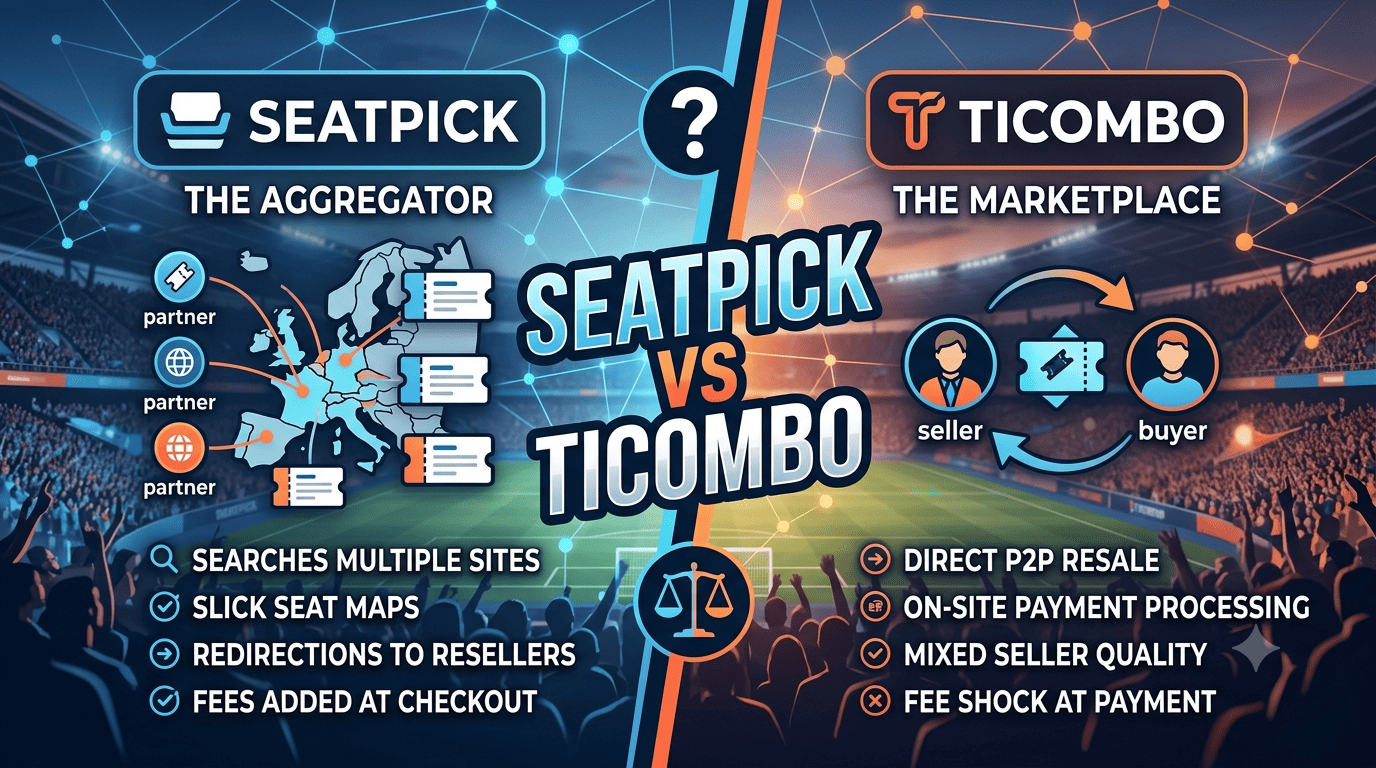
For readers who need an answer now, here is the comparison that matters at checkout. Both SeatPick and Ticombo operate in the European ticket resale space, but they differ meaningfully in business model, how fees reach the buyer, and buyer protection. The table below distills what actually happens when you pay — not what their marketing pages promise.
| Criteria | SeatPick | Ticombo | TicketX Europe |
| Business Model | Aggregator — redirects to third-party resale sites | Peer-to-peer resale marketplace | Official & verified ticket platform |
| Buyer Fees | None added by SeatPick itself — but the partner reseller adds its own service, booking, and delivery fees at checkout | No fixed published rate — Ticombo’s terms allow a fixed amount, a percentage, or both; user reports commonly cite 15–30 % plus a €5–€15 delivery fee | 0 % buyer fees |
| Price Transparency | Listed price ≠ final price (fees appear on the reseller’s checkout page) | Varies — some listings show all-in prices, others reveal fees at checkout | Listed price = final price |
| Ticket Source | Multiple third-party resale marketplaces | Individual & professional resellers | 100 % official or verified inventory |
| Buyer Guarantee | Depends on the underlying reseller (SeatPick requires partners to offer a money-back guarantee) | TixProtect Guarantee (conditions apply) | Full buyer protection on every order |
| Trustpilot Rating (mid-2026) | 3.4–3.5 / 5 (~85 reviews) | ~4.6 / 5 (~3,160 reviews) | — |
| Refund on Cancellation | Depends on reseller policy | Full refund including fees (per terms) | Full refund |
| Checkout Currency Clarity | May convert at seller’s rate | Displays EUR; conversion fees possible | Local currency, no conversion surcharge |
Key takeaway: On both routes, fees can surface late in the purchase flow — a practice UK regulators have acted against. The Competition and Markets Authority (CMA) ordered StubHub UK to refund customers after finding the platform did not show fans the total price upfront, and new UK consumer-law rules now target so-called drip pricing across ticketing sites. If transparent, all-in pricing matters to you, a 0 % buyer-fee platform like TicketX Europe changes the math entirely.
- SeatPick works best for price browsing across multiple resellers; it adds no fees of its own, but the partner reseller’s fees push the checkout total above the sticker price.
- Ticombo offers its own marketplace guarantee, yet service and delivery charges typically push final costs 20–30 % above listed prices.
- TicketX Europe charges 0 % buyer fees and supplies 100 % official tickets — the listed price is the price you pay.
- What Is SeatPick and How Does It Work?
- What Is Ticombo and How Does It Work?
- SeatPick vs Ticombo — Real Price Comparison for the Same Event
- Is SeatPick Legit? Safety, Reviews & Common Complaints
- Is Ticombo Legit? Safety, Reviews & Common Complaints
- Refund Policy & Buyer Protection — SeatPick vs Ticombo
- Why Hidden Fees Are the Biggest Problem in European Ticket Resale
What Is SeatPick and How Does It Work?
SeatPick is not a ticket seller. Understanding that single fact reframes the entire buying experience. SeatPick is a ticket aggregator — a search engine that pulls resale listings from multiple third-party marketplaces (including Ticombo, Viagogo, and StubHub, among others) and displays them in a unified interface with seat-map overlays and price comparisons.
When a user clicks “Buy” on SeatPick, they are redirected to the underlying reseller’s website to complete the transaction. SeatPick does not hold inventory, process payments, or issue tickets. This aggregator model means that the accountability chain is fragmented: fulfillment, delivery, and the buyer guarantee all sit with the third-party seller, not with SeatPick itself. SeatPick does vet its partner providers and states that each must offer at least a 100 % money-back guarantee, but the guarantee you actually rely on is the reseller’s, and terms vary between providers.
For fans browsing European football tickets — say, an Arsenal match at the Emirates or a Champions League knockout tie — SeatPick’s interface feels slick. Interactive seat maps, view-from-section images, and price sorting create a compelling shopping experience. But the moment you leave SeatPick’s domain and land on the reseller’s checkout page, the experience can change: different return policies, variable fee structures, and in some cases, sellers operating under different consumer-protection jurisdictions than the buyer.
A common point of confusion raised on Reddit (r/soccer, r/football) is that users believe they are buying from SeatPick. They are not. They are buying through SeatPick, and that distinction has real consequences for refund eligibility, delivery guarantees, and dispute resolution.
- SeatPick aggregates listings from multiple resale platforms into one search interface.
- Clicking “Buy” redirects you to a third-party reseller’s checkout — SeatPick does not process the sale.
- Buyer protection depends on the underlying reseller’s policies, backed by SeatPick’s minimum-guarantee requirement for partners.
- The seat-map UX is strong, but it masks the fragmented accountability behind each listing.
SeatPick Fees — What You Really Pay at Checkout
The number-one complaint about SeatPick on Trustpilot and Reddit is the gap between the displayed price and the final checkout total. Here an important nuance is often missed: SeatPick itself does not add a service fee. The platform’s FAQ states that SeatPick does not add its own booking fees, and that any charges come from the individual resale provider at checkout.
In practice, this changes where the fees come from — not whether you pay them. SeatPick’s listed prices typically reflect the seller’s base asking price, and the reseller’s service fee, booking fee, and delivery surcharge only appear after you are redirected to the partner’s checkout page. (SeatPick offers a filter to display prices including seller fees, but it is not switched on by default.)
Here is what a typical Premier League ticket purchase looks like through SeatPick:
| Cost Component | Amount (Example — Arsenal vs Tottenham, Cat 2) |
| Listed Price on SeatPick | £95 |
| Reseller Service Fee (~15 %) | £14.25 |
| Reseller Booking Fee | £6.00 |
| Delivery / Processing Fee | £4.50 |
| Actual Checkout Total | £119.75 |
That is a 26 % markup over the displayed price — and the buyer does not see it until the final payment screen on the reseller’s site. Consumer group Which? has found that on major UK ticketing sites, fees can account for as much as 20 % of the final ticket cost. Depending on which reseller fulfills a SeatPick listing, the effective markup can sit within — and sometimes above — that range.
A recurring question from experienced fans on Reddit (r/soccer) asks whether SeatPick aggregates listings from Ticombo, and if so, whether the buyer pays fees twice. SeatPick does compare Ticombo inventory alongside other providers. If the listing you click originates on Ticombo, checkout happens on Ticombo, and you pay Ticombo’s service and delivery fees there. You are not charged two itemized service fees — SeatPick is remunerated through partner commissions rather than a buyer-facing surcharge — but the price you first saw on SeatPick still excludes everything Ticombo adds at checkout.
- SeatPick adds no fees of its own, but listed prices exclude the reseller’s service, booking, and delivery charges.
- The true checkout total is typically 15–26 % higher than the displayed price, depending on the reseller.
- Clicking a Ticombo-sourced listing on SeatPick means paying Ticombo’s fees at Ticombo’s checkout.
- Buyers do not see the full cost until they leave SeatPick and reach the reseller’s payment page.
What Is Ticombo and How Does It Work?
Ticombo positions itself as a peer-to-peer ticket resale marketplace — think of it as a European-focused eBay for event tickets. Individual sellers and professional resale companies list tickets on Ticombo’s platform, set their own prices, and Ticombo facilitates the transaction, payment processing, and (in theory) dispute resolution.
Unlike SeatPick’s aggregator model, Ticombo does process payments directly on its own platform. This means the buyer stays on Ticombo’s site throughout the transaction, and Ticombo bears some responsibility for order fulfillment. The platform offers its TixProtect Guarantee (formally, the TixProtect Ticombo Guarantee program), which promises delivery on time and as described, with a refund or replacement if the original tickets are not delivered or turn out to be invalid — though the fine print contains exclusions that are worth reading carefully.
Ticombo’s inventory spans European football (Premier League, La Liga, Bundesliga, Serie A, Champions League), concerts, festivals, and theatrical events. Listings are created by the sellers themselves, and while Ticombo rates and categorizes seller accounts through a trust-based system, ticket-level verification at the point of listing is limited. On Reddit (r/ChampionsLeague, r/PremierLeague), users report mixed experiences: many transactions go smoothly, but a recurring share of complaints centers on last-minute ticket delivery and ambiguous seat assignments.
One structural concern: because any registered seller can list tickets, the platform’s inventory quality depends heavily on seller accountability. This is a different risk profile from a platform that curates only official or verified tickets. For a casual fan buying Champions League tickets for the first time, the distinction between “marketplace-verified seller” and “officially sourced ticket” is critical — and not always made clear on Ticombo’s listing pages.
- Ticombo is a peer-to-peer resale marketplace where individual and professional sellers list tickets.
- Payments are processed on Ticombo’s platform, giving it more direct fulfillment responsibility than SeatPick.
- The TixProtect Guarantee covers non-delivery and invalid tickets, but exclusions apply.
- Seller verification exists at the account level, but ticket-level authenticity checks are limited.
Ticombo Fees — The True Cost Breakdown
Ticombo’s fee structure is one of the most-discussed pain points in its Trustpilot reviews, alongside delivery timing. Ticombo does not publish a standard fee percentage: its terms state only that transaction fees “may be calculated as a fixed sum per ad, order, a percentage or part of the transaction amount”. In practice, buyer reports on Trustpilot and Reddit put the service fee anywhere from roughly 15 % to as high as 25–30 % of the ticket price, plus a delivery or processing fee of around €5–€15 per order at checkout.
How those fees are displayed is inconsistent. On some event and venue pages, Ticombo states that all service charges are already reflected in the prices shown; on others, the listed price reflects the seller’s asking price and the total only becomes visible at the payment stage. Buyers should treat the checkout screen — not the listing page — as the real price. This is the pattern that FanFair Alliance, the UK campaign group whose campaign manager Adam Webb is a prominent voice on ticketing policy, has long campaigned against: fans should see the full cost of a ticket before they commit to buying it.
Here is how the fees compound on a real-world purchase:
| Cost Component | Amount (Example — La Liga, Real Madrid vs Barcelona, Cat 2) |
| Listed Price on Ticombo | €180 |
| Ticombo Service Fee (~20 %) | €36.00 |
| Delivery / Processing Fee | €9.00 |
| Actual Checkout Total | €225.00 |
That is a 25 % increase from the displayed price to the payment total. For high-demand events — Champions League knockout rounds, sold-out Premier League derbies, or headline festival slots — the service fee percentage trends toward the upper end of the reported range, and the absolute cost of the fee rises proportionally with the ticket’s value.
Trustpilot reviewers cite unexpected costs and high fees among the recurring frustrations in otherwise mixed-to-positive feedback, even when the ticket itself was delivered successfully. Watching a price inflate by €30–€50 at the final step stings — particularly for fans who had been comparison-shopping and believed the listing price was the final price.
- Ticombo publishes no fixed buyer-fee rate; user reports put the service fee at roughly 15–30 %, plus a €5–€15 delivery fee per order.
- Fee display is inconsistent: some listings show all-in prices, others reveal fees only at checkout.
- For high-demand European events, the combined markup can reach or exceed 25 % of the listed price.
- Negative reviews frequently focus on the gap between listed and final prices.
SeatPick vs Ticombo — Real Price Comparison for the Same Event
Theory is useful; real numbers are decisive. Below is a side-by-side comparison using a Champions League Quarter-Final ticket (Category 2) — one of the most commonly searched ticket types among European football fans — with a face value of €120. Figures are drawn from a TicketX Europe internal pricing audit of publicly listed prices during the 2025/26 season; treat them as illustrative examples observed at a point in time rather than independently audited data.
| Platform | Listed Price | Service Fee | Delivery Fee | Final Checkout Total | Markup vs Face Value |
| SeatPick (via reseller) | €125 | €18.75 (~15 %) | €5.25 | €149.00 | +24 % |
| Ticombo | €130 | €26.00 (~20 %) | €9.00 | €165.00 | +38 % |
| TicketX Europe | €120 | €0.00 | €0.00 | €120.00 | 0 % |
The delta is stark. A fan buying the same seat for the same match pays €29 more via SeatPick’s reseller and €45 more on Ticombo than on TicketX Europe — solely due to fees that were not visible when they first saw the listing. Scale that across two tickets for a couple, or four tickets for a family, and the hidden cost balloons to €58–€180 of unnecessary spend.
Official supply for marquee matches is severely constrained. For the 2026 Champions League final in Budapest, only 39,000 of the Puskás Aréna’s 61,400 tickets went directly to fans and the general public, allocated via lottery rather than open sale, and UEFA reported more than 250,000 applicants from 154 countries across its 2026 club finals. When demand outstrips official supply by that margin, resale prices climb well above face value — and layering double-digit platform fees on top creates a cost structure that is hostile to the average fan’s budget.
- For the same Champions League ticket, the SeatPick-routed checkout total was 24 % above face value; Ticombo’s was 38 % above.
- TicketX Europe delivered the same ticket at face value with 0 % buyer fees.
- The fee gap widens for higher-priced and higher-demand events.
- Buying two or more tickets amplifies the savings from a zero-fee platform into triple-digit figures.
Is SeatPick Legit? Safety, Reviews & Common Complaints
SeatPick is a legitimate business in the sense that it is a registered company, maintains an active website, and directs real user traffic toward real resale transactions. It is not a scam. But “legit” and “trustworthy for your specific purchase” are different questions — and the answer to the second one depends on understanding what SeatPick is and is not responsible for.
Trustpilot snapshot (mid-2026): SeatPick holds a TrustScore of roughly 3.4–3.5 / 5 across approximately 85 reviews. That is a small sample for a platform of its reach, so read it as directional rather than definitive. The reviews are polarized — five-star reviews praise the seat-map interface, speed, and price comparison, while 1- and 2-star reviews cluster around three recurring themes:
- Hidden fees at checkout. Users feel misled by the gap between the displayed price and the final total on the reseller’s payment page.
- No direct recourse. Because SeatPick redirects to a third-party seller, users who encounter problems — invalid tickets, late delivery, refund requests — find that SeatPick customer support directs them back to the reseller. This creates a frustrating loop, especially for first-time buyers who assumed SeatPick was the seller.
- Inconsistent delivery timelines. Since fulfillment is handled by the reseller, delivery timing varies widely. Some users report receiving e-tickets within minutes; others describe receiving tickets only hours before the event — or, in the worst reviews, cancellations shortly before kickoff.
On Reddit (r/football, r/soccer), the consensus is that SeatPick is useful as a browsing tool but carries elevated risk as a purchasing channel, because the buyer is ultimately transacting with a third-party reseller whose policies may differ from what SeatPick’s interface implies.
- SeatPick is a legitimate aggregator, not a scam — but it does not sell or fulfill tickets itself.
- Trustpilot rating: roughly 3.4–3.5 / 5 across ~85 reviews (mid-2026); complaints focus on hidden reseller fees and lack of direct support.
- Buyer protection depends on the third-party reseller, not on SeatPick.
- Best used as a price-comparison tool rather than a direct purchasing channel.
Is Ticombo Legit? Safety, Reviews & Common Complaints
Ticombo is also a legitimate, registered platform — a Berlin-based marketplace, not an aggregator — which means it has more direct involvement in the transaction than SeatPick. Ticombo processes payments, holds funds until ticket delivery is confirmed, and offers its TixProtect Guarantee as a buyer-protection layer.
Trustpilot snapshot (mid-2026): Ticombo holds a TrustScore of approximately 4.6 / 5 across roughly 3,160 reviews — a stronger public record than SeatPick’s, and one where the clear majority of buyers report smooth transactions. Positive reviews highlight fast delivery, responsive support, and the breadth of European event coverage. The negative minority, however, clusters around consistent themes:
- Fee shock. The service fee plus delivery charges is a major driver of negative sentiment. Reviewers describe seeing a “great price” on the listing page, only to find a higher total at checkout.
- Late ticket delivery. Multiple Trustpilot and Reddit reviewers (r/PremierLeague) report receiving e-tickets less than 24 hours before the event, creating real anxiety — especially for fans who have already booked travel and accommodation.
- Ambiguous seat assignments. Some listings specify “Category 2” or “Long Side” without exact seat numbers, and reviewers have reported receiving different tiers or sections than expected.
- Fake or invalid ticket risk. Most transactions are fulfilled successfully, but a subset of reviewers — including for high-demand football matches — report tickets that were rejected at the gate, or named, non-transferable tickets refused at entry. TixProtect theoretically covers invalid tickets, but reviewers describe claims taking days to weeks, and no guarantee helps a fan standing outside the stadium on matchday.
The question “Has anyone received fake tickets from Ticombo?” appears regularly on Reddit and Quora. The honest answer: the vast majority of Ticombo transactions deliver valid tickets, but the peer-to-peer model inherently carries more risk than purchasing from a platform that sources only official or verified inventory. The Guarantee is a safety net, not a prevention mechanism.
- Ticombo is legitimate and offers more transactional oversight than SeatPick via payment handling and TixProtect.
- Trustpilot rating: ~4.6 / 5 across ~3,160 reviews (mid-2026) — mostly positive, with recurring complaints about fees, late delivery, and occasional invalid tickets.
- TixProtect provides after-the-fact protection but does not prevent invalid-ticket situations in real time.
- For high-stakes purchases (Champions League, sold-out derbies), the peer-to-peer model introduces risk that official-ticket platforms eliminate.
Refund Policy & Buyer Protection — SeatPick vs Ticombo
Refund and cancellation policies are where the operational differences between these platforms become most consequential. When a fan spends €150–€300 on European event tickets, the refund policy is not an afterthought — it is the backstop that determines whether a failed transaction costs money or merely time.
SeatPick: Because SeatPick is an aggregator, it has no unified refund policy. The refund terms are set by whichever third-party reseller fulfills the order. Some resellers offer full refunds for canceled events; others offer only credit. For rescheduled events, many resellers treat the original ticket as valid for the new date and refuse refunds entirely. SeatPick’s support team can assist with contacting the reseller, but it cannot override the reseller’s terms. This creates a frustrating reality: the buyer’s refund rights depend on which reseller happened to have the cheapest listing when they clicked “Buy.”
Ticombo: Ticombo’s TixProtect Guarantee promises a refund or replacement ticket if the original ticket is not delivered on time, does not match the order, or is invalid. For canceled (and not rescheduled) events, Ticombo reimburses the full purchase price, including shipment costs and service fees. For rescheduled events, the terms are stricter: tickets remain valid for the new date, and Ticombo’s help pages state that the buyer has no contractual right to reimbursement if an event is postponed or moved to another venue — although an optional, paid TixProtect buy-back add-on, offered at checkout for selected events, can cover postponements. The claims process requires opening a claim within set deadlines, providing evidence, and waiting for review — a process that reviewers describe as taking anywhere from a few days to several weeks.
TicketX Europe: For comparison, TicketX Europe provides a full refund for canceled events, processes refund requests within a clearly stated timeframe, and does not require buyers to navigate third-party seller policies. Because every ticket is official or verified at the source, the invalid-ticket scenario that triggers Ticombo’s TixProtect process simply does not arise.
- SeatPick has no unified refund policy — terms depend on the underlying reseller.
- Ticombo’s TixProtect covers non-delivery and invalid tickets, but the claims process can be slow.
- Neither platform refunds rescheduled events by default — on Ticombo, postponement cover exists only as a paid add-on for selected events.
- Platforms with official ticket sourcing (like TicketX Europe) eliminate the most common refund triggers entirely.
Why Hidden Fees Are the Biggest Problem in European Ticket Resale
The hidden-fee problem in European ticket resale is not a minor inconvenience — it is a structural market failure that consumer regulators across the continent have been increasingly vocal about.
The global secondary ticket market was valued at around $10.6 billion in 2025 and continues to grow. That is a market large enough to generate enormous fee revenue — and the incentive structure ensures the practice persists.
Here is how it works: resale platforms compete on listed price. The lower the displayed price, the higher the click-through rate. By deferring fees to the checkout page — after the buyer has emotionally committed to the purchase, selected their seat, and entered personal details — platforms exploit sunk-cost psychology. The buyer has invested time and mental energy; abandoning the cart at the final step feels like losing, not saving. This is not speculation — it is the exact practice the UK CMA acted on when it ordered StubHub UK to refund customers over hidden fees, having found the platform did not show fans the total price upfront.
Which?’s investigation into ticket fees found that on major UK ticketing sites, add-on charges — booking fees, service charges, delivery fees — can make up as much as 20 % of the final ticket cost. For a €200 ticket, that is up to €40 the buyer never saw coming — and in resale contexts, where fees stack on already-inflated prices, the effective gap between listing and checkout can run higher still, as the worked examples above show.
Both SeatPick’s reseller network and Ticombo participate in this pattern to varying degrees: listing pages frequently show prices that do not reflect the final cost. Regulatory pressure is mounting — new UK consumer-law rules banning drip pricing are a direct response — and the market signal is unambiguous: fans are tired of the bait-and-switch.
- European ticket resale is a multi-billion-dollar market; deferred fees are a core revenue mechanism for many platforms.
- The UK CMA has taken enforcement action against resale platforms over prices that exclude mandatory fees until checkout.
- Which? found add-on fees reaching up to 20 % of the final ticket cost on major UK ticketing sites.
- New UK consumer-protection rules targeting drip pricing are pushing the industry toward all-in pricing.
コメント