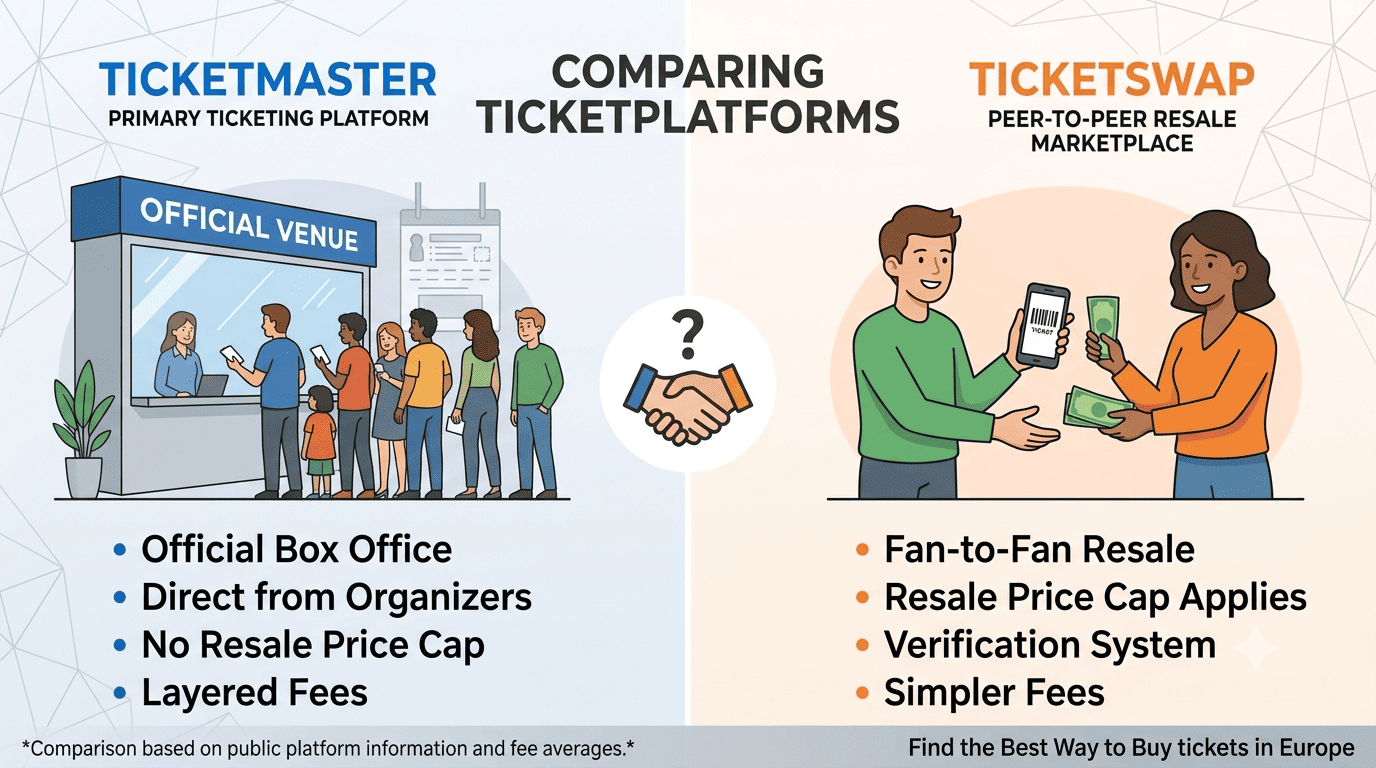
One distinction underpins everything else in this comparison: Ticketmaster and TicketSwap are fundamentally different types of ticket platforms, and comparing them without acknowledging that difference leads to confusion that costs you money.
Ticketmaster is a primary-market ticketing platform. It acts as the official box office for thousands of venues, promoters, and artists across Europe. When you buy a ticket on Ticketmaster, you are purchasing it at the initial point of sale — directly from the event organizer’s authorized inventory. Ticketmaster is owned by Live Nation Entertainment, the world’s largest live entertainment company, which reported $23.2 billion in revenue for FY 2024. This vertical integration means that Live Nation often promotes the tour, owns the venue, and sells the ticket through Ticketmaster — controlling the entire chain from stage to seat.
TicketSwap is a secondary-market, peer-to-peer resale platform. It does not sell tickets directly. Instead, it provides a marketplace where fans who already hold tickets can resell them to other fans. Founded in Amsterdam in 2012, TicketSwap serves more than 18 million users across 42 countries. Its headline consumer-protection feature is a resale price cap: sellers cannot list tickets at more than 20% above face value in most markets.
The critical difference is the ticket source. On Ticketmaster, you are buying from official inventory. On TicketSwap, you are buying from another individual. Both platforms charge fees — but the amount, transparency, and structure of those fees vary dramatically.
Here is the quick-reference snapshot:
| Feature | Ticketmaster | TicketSwap |
| Market Type | Primary (official box office) | Secondary (peer-to-peer resale) |
| Buyer Fees | 20–35% above face value | ≈10% (7% service fee + 3% transaction fee) |
| Hidden Checkout Fees | Yes (service fee, order fee, facility charge) | Minimal but present |
| Price Cap on Resale | No cap (demand-based pricing applies) | Max 20% above face value |
| Ticket Verification | Official inventory; resale arm less controlled | Barcode verification system |
| European Football Coverage | Strong for some leagues, venue-dependent | Growing but inconsistent |
| Best For | On-sale-day primary purchases | Sold-out event resale at capped prices |
The summary takeaway: Ticketmaster gives you first access but burdens you with layered fees. TicketSwap gives you a second chance at sold-out events but carries peer-to-peer risk. TicketX Europe removes the fee problem entirely — 0% buyer fees, 100% official tickets, and a checkout total that matches the listed price. The rest of this article explains exactly why that matters and how to make the smartest buying decision for your next European event.
What Is Ticketmaster? Primary Ticket Sales and Fees in Europe
Ticketmaster is the default starting point for the vast majority of ticket purchases across Europe. If a major artist announces a stadium tour, a Premier League club opens general sale, or a festival drops its first wave of tickets, there is a high probability that the transaction runs through Ticketmaster’s infrastructure. Understanding what Ticketmaster actually is — and what it is not — is the foundation for every comparison that follows.
At its core, Ticketmaster is a primary-market ticketing technology and distribution platform. It provides the digital box office that venues and promoters use to sell tickets at face value during the initial on-sale period. The company does not own the tickets in most cases; it acts as the authorized sales channel, taking a cut in the form of service fees, order processing fees, and facility charges that are added to the face-value price.
Ticketmaster also operates a resale marketplace — Ticketmaster Resale (formerly “Fan-to-Fan Resale” and, in some markets, “GET ME IN!”) — where fans can relist tickets they can no longer use. This resale arm has no price cap, meaning tickets for high-demand events can be listed at multiples of face value. The coexistence of primary and resale inventory on the same platform creates confusion: many users do not realize they have been redirected from the primary listing to a resale listing at an inflated price until they reach checkout.
Market Position and the Live Nation Integration
To understand Ticketmaster’s pricing and behavior, you must understand its corporate parent. Ticketmaster is a wholly owned subsidiary of Live Nation Entertainment, the largest live entertainment company in the world. Live Nation controls approximately 70–80% of primary ticket sales in major Western markets and processed over 500 million tickets annually as of its 2024 fiscal year.
Live Nation’s business model is vertically integrated:
- Live Nation Concerts promotes tours and signs artists to touring deals.
- Live Nation Venues owns or operates hundreds of venues globally, including major European arenas.
- Ticketmaster is the exclusive ticketing partner for those venues and tours.
This means the same company that books the artist, owns the arena, and promotes the show is also the sole platform selling tickets to that show. For European consumers, this integration has two practical consequences:
- Limited competition at the point of sale. If your favorite artist plays a Live Nation venue, you have no choice but to buy through Ticketmaster (or a venue-specific box office that often still uses Ticketmaster’s back end).
- Fee structures that are difficult for consumers to anticipate. Because there is no competitive pressure to reduce fees on exclusive inventory, Ticketmaster can layer multiple charges without losing customers to a rival primary-sale platform.
Regulatory bodies have taken notice. The UK Competition and Markets Authority (CMA) investigated Ticketmaster’s pricing practices after the 2024 Oasis reunion on-sale, during which standing tickets with a £135 face value were selling at more than £350 by the time many fans reached the front of the queue. The investigation, concluded in September 2025, found no evidence of algorithmic dynamic pricing — the price jumps came from a tiered pricing structure that fans waiting in the queue were not told about — and the CMA secured legally binding undertakings from Ticketmaster on pricing transparency. Across the EU, the Digital Services Act (DSA) and momentum toward all-in pricing rules are specifically aimed at the kind of drip-pricing behavior Ticketmaster has been criticized for.
Ticketmaster Fees Breakdown — Service Fees, Order Fees, and Demand-Based Pricing
The single most common complaint about Ticketmaster across Reddit threads, Quora discussions, and consumer forums is the moment of checkout shock: the face-value price you selected balloons by 20–35% once all fees are revealed. A 2018 U.S. GAO report (GAO-18-347) found that primary-market ticketing fees — a market in which Ticketmaster is the dominant player — averaged 27% of the base ticket price across the events it sampled. European markets experience comparable markups depending on the event and venue.
Here is the typical fee stack on a Ticketmaster purchase in Europe:
| Fee Type | Typical Range | What It Covers |
| Service Fee | 12–20% of face value | Platform transaction costs, technology, customer service |
| Order Processing Fee | €2.50–€5.00 per order | Payment processing, order confirmation delivery |
| Facility Charge | €1.50–€10.00 per ticket | Venue operational costs (passed through by the venue) |
| Delivery / Fulfillment Fee | €0–€5.00 | E-ticket delivery, mobile transfer, or postal delivery |
| Demand-Based Pricing Surcharge | Variable — can exceed 200% of face value | “Official Platinum” / “In-Demand” pricing that adjusts the face value itself |
In concrete terms, for a €100 face-value concert ticket in a European market:
- Service fee: €18
- Order processing fee: €3.50
- Facility charge: €5.50
- Total at checkout: €127–€135
That is €27–€35 in fees that were not visible when you clicked “Buy.” Surprise fees at checkout rank among the most common complaints in consumer research on online ticket buying, and public frustration extends to pricing tactics more broadly — YouGov polling in the UK found that half of Britons strongly oppose dynamic ticket pricing for live events.
Demand-based pricing adds a further layer of opacity. Ticketmaster’s “Official Platinum” and “In-Demand” ticket categories use pricing that adjusts the face value itself based on demand. This is not a fee — it is a fundamental change to the ticket’s base price. A seat that starts at €80 on sale day can cost far more by the time you reach checkout during a high-demand window. Ticketmaster describes this as “market-based pricing,” but many fans on r/Music have questioned whether “Official Platinum” pricing is meaningfully different from resale markups. Either way, the practical effect for the consumer is similar — you can end up paying far more than expected, with little visibility into how the price was set. Notably, in the Oasis case the CMA found that “Platinum” tickets were sold at roughly 2.5 times the standard price while offering no additional benefits.
The combination of layered fees and opaque pricing structures means that the price you see on Ticketmaster is often not the price you pay. This is the fundamental transparency problem that regulators, consumer groups, and millions of frustrated fans are pushing back against in 2026.
What Is TicketSwap? Fan-to-Fan Resale, Fees, and Safety
TicketSwap occupies a different niche in the ticketing ecosystem. Launched in Amsterdam in 2012, the platform was built to solve a specific problem: what happens after an event sells out or when a fan’s plans change and they need to offload a ticket without resorting to unverified Facebook groups or street resellers?
TicketSwap is a peer-to-peer (P2P) resale marketplace. It does not hold inventory, does not act as a primary seller, and does not represent venues or promoters. Instead, it provides the rails — listing tools, barcode verification technology, payment processing, and a buyer-protection guarantee — for one fan to sell a ticket to another fan.
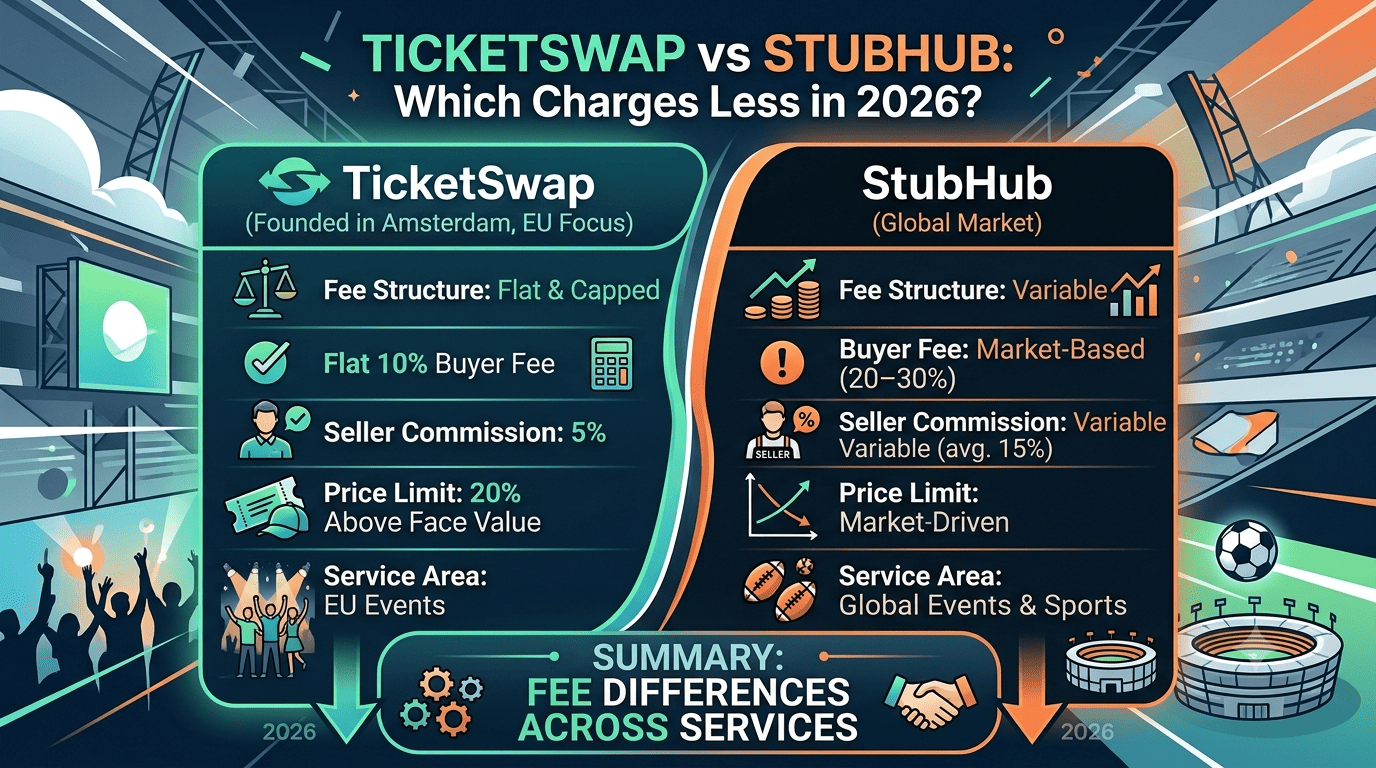
The platform’s core consumer-protection mechanism is a resale price cap: in most markets, sellers cannot list a ticket for more than 20% above its original face value. This cap is designed to prevent speculative scalping and keep resale prices within a range that most fans consider fair. It is a feature that Ticketmaster’s resale arm notably does not offer — Ticketmaster Resale imposes no ceiling on what a seller can charge.
TicketSwap has grown to more than 18 million users across 42 countries since its founding. Its strongest market is the Netherlands, where it has become the default fan-to-fan resale channel for festivals like Lowlands, Dekmantel, and King’s Day events. It has expanded across Europe — Germany, the UK, France, Belgium, and Spain — and into concerts, football, and theater, though its inventory depth varies widely by market and event type.
TicketSwap Fee Structure — 7% Service Fee + 3% Transaction Fee for Buyers
TicketSwap’s fee structure is simpler and lower than Ticketmaster’s, which is one of its primary selling points. Here is the breakdown:
- Buyer service fee: 7% of the ticket price
- Buyer transaction fee: 3% of the ticket price (payment processing; some payment methods, like PayPal, can add around 2% more)
- Seller fee: 5% of the sale price (deducted from the seller’s payout)
- A minimum service fee (€1.50 in most markets) applies where the percentage would fall below it
For a €100 face-value ticket resold at face value on TicketSwap:
- 7% service fee: €7.00
- 3% transaction fee: €3.00
- Total paid by buyer: €110.00
If the seller lists the ticket at the maximum allowed markup (20% above face value, so €120):
- 7% service fee on €120: €8.40
- 3% transaction fee on €120: €3.60
- Total paid by buyer: €132.00
Compared to Ticketmaster’s €127–€135 total on the same €100 face-value ticket, TicketSwap is meaningfully cheaper at face-value resale — but once a seller lists at the price cap, the total lands inside Ticketmaster’s range. The key difference is transparency: TicketSwap displays the total cost including fees before you commit, whereas Ticketmaster’s drip-pricing model reveals fees incrementally through checkout.
However, there is a nuance that price-conscious fans should recognize: any fee above 0% is still a fee. The roughly 10% in combined buyer charges on TicketSwap is lower than Ticketmaster’s 20–35%, but it is not zero. For fans who have been conditioned to accept that “every platform charges something,” platforms like TicketX Europe — which charges 0% buyer fees with no hidden charges — challenge that assumption entirely.
Is TicketSwap Legit? Barcode Verification, Scam Reports, and Refund Policy
This is the most-asked question about TicketSwap on Reddit, Quora, and X (formerly Twitter). The short answer: TicketSwap is a legitimate company with genuine consumer protections, but peer-to-peer resale inherently carries risks that official-source platforms do not.
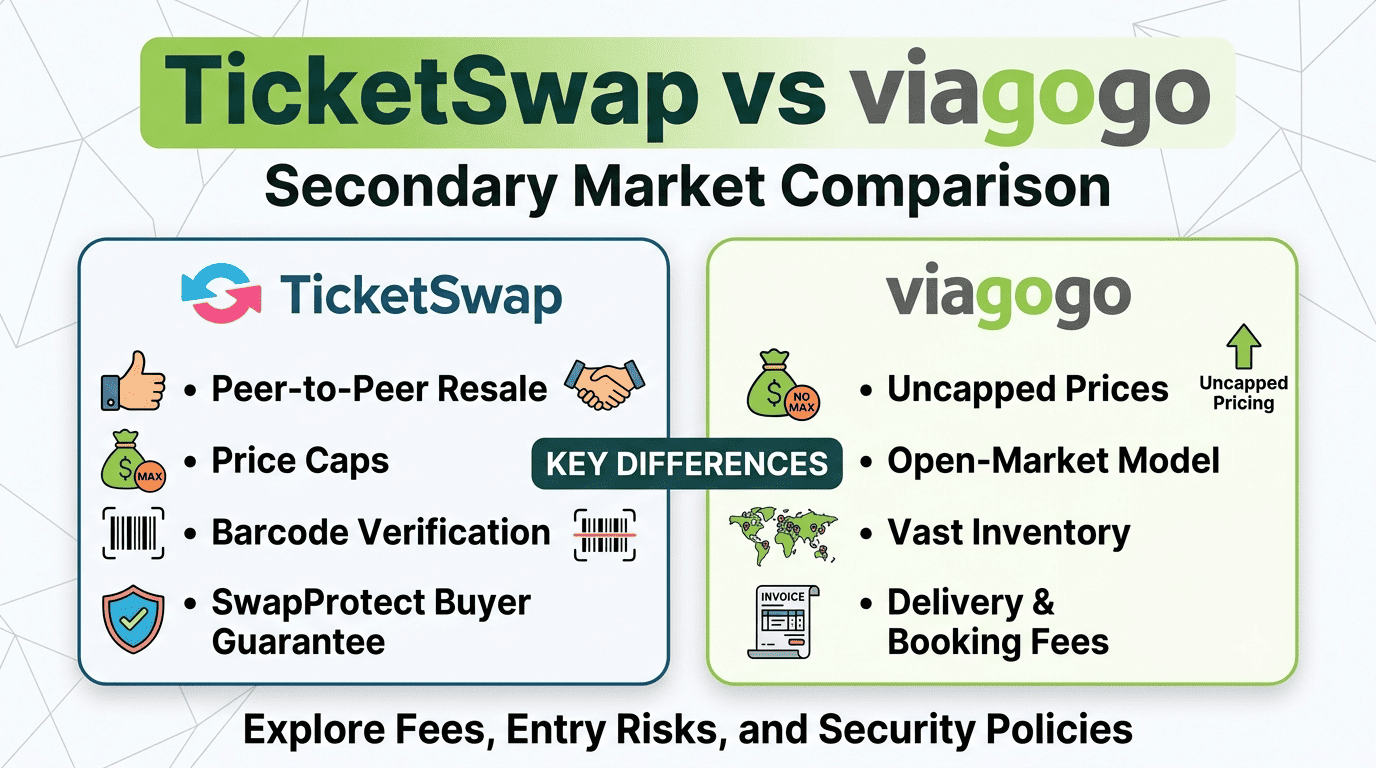
Barcode verification is TicketSwap’s primary anti-fraud tool. When a seller uploads a ticket, TicketSwap’s system scans and validates the barcode, then generates a new, unique barcode for the buyer. The original barcode is deactivated. This prevents the most common scam vector — a seller distributing the same barcode to multiple buyers. The system works well for standard PDF and mobile-transfer tickets.
However, gaps remain, particularly for:
- Tickets bound to mobile apps (e.g., Ticketmaster’s app-only tickets that cannot be transferred outside the Ticketmaster ecosystem)
- Named tickets requiring ID matching at the gate (common for high-profile Premier League and Champions League fixtures)
- Last-minute barcode invalidation by the original issuer, which can occur if the event organizer flags the resale as unauthorized
Ticket fraud remains a persistent problem across Europe — Action Fraud data for England and Wales alone records roughly £9.8 million lost to ticket fraud over a recent 12-month period, covering only reported cases in one country. While TicketSwap is not a primary source of these losses — unregulated social media resales carry far higher fraud rates — user discussions on r/festivals and r/soccer suggest that isolated problem cases have been reported, most often around sold-out football matches and major festival headliner nights where demand far outstrips supply.
TicketSwap’s refund policy provides a buyer guarantee: if you arrive at the venue and your ticket is invalid, TicketSwap will issue a refund. This is a meaningful safety net, but it does not replace the ticket — you are refunded the money, but you miss the event. For a Champions League final or a once-in-a-decade reunion tour, a refund is cold comfort compared to holding a verified, official ticket from the outset.
Key takeaways:
- TicketSwap is legitimate and far safer than unregulated resale channels.
- The roughly 10% total buyer fees and 20% price cap are still consumer-friendly by resale-market standards.
- Barcode verification reduces — but does not eliminate — fraud risk.
- For maximum safety and zero buyer fees, sourcing official tickets directly remains the gold standard.
TicketSwap vs Ticketmaster Fees — Side-by-Side on a €100 Ticket
Abstract fee percentages are useful, but nothing clarifies the comparison like a concrete, apples-to-apples price scenario. Below is the total cost breakdown for a single €100 face-value ticket purchased on each of the three platforms discussed in this article. All figures are based on publicly documented fee structures.
| Cost Component | Ticketmaster | TicketSwap (at face value) | TicketSwap (at 20% cap) |
| Face Value / Listed Price | €100.00 | €100.00 | €120.00 |
| Service Fee | €18.00 | €7.00 (7%) | €8.40 (7%) |
| Order Processing / Transaction Fee | €3.50 | €3.00 (3%) | €3.60 (3%) |
| Facility Charge | €5.50 | — | — |
| Total at Checkout | €127.00–€135.00 | €110.00 | €132.00 |
| Fee as % of Face Value | 27–35% | 10% | 32% (incl. markup) |
Three observations are immediately clear:
- Ticketmaster’s fees transform a €100 ticket into a €127–€135 purchase. The 27% figure is not a one-time anomaly — the GAO found it to be the average across the primary-market events it sampled.
- TicketSwap at face value is meaningfully cheaper than Ticketmaster, but once a seller lists at the 20% price cap, the total cost lands squarely inside Ticketmaster’s range. The savings depend entirely on whether the seller lists at or near face value.
- TicketX Europe is a platform where €100 means €100. Zero buyer fees, zero service charges, zero order processing fees, zero facility charges. The listed price is the checkout price.
For fans buying multiple tickets — a group of four for a Premier League match, for example — the fee differential compounds. Four tickets at €100 each cost €508–€540 on Ticketmaster, €440 on TicketSwap at face value, and exactly €400 on TicketX Europe. That is up to €140 in savings — enough to cover matchday food, drinks, and a program for the entire group.
Safety and Ticket Authenticity — TicketSwap vs Ticketmaster
Ticket fraud in Europe is not a marginal problem. Action Fraud data shows ticket fraud cost consumers in England and Wales around £9.8 million in a single recent 12-month period — and that figure covers only reported cases in one country, with unreported losses and the rest of Europe on top. The victims are overwhelmingly fans buying from unverified sources — social media sellers, classified sites, and resale platforms with weak verification. But even “legitimate” platforms carry varying degrees of risk depending on how they source and verify their inventory.
Ticketmaster — Official Inventory with Pricing Trade-Offs
When you buy a ticket through Ticketmaster’s primary sale, the ticket is genuinely official. There is no authenticity question because Ticketmaster is the authorized issuing platform — the ticket originates from its system. This is Ticketmaster’s most powerful trust signal, and it is valid.
However, Ticketmaster’s trust picture becomes more complicated in two scenarios:
Opaque pricing erodes trust in a different way. The ticket is real, but the price is not what fans expected when they joined the queue. When standing tickets for the Oasis reunion jumped from £135 to more than £350 during the on-sale, fans did not question whether the ticket was genuine — they questioned whether the price was legitimate. The CMA investigation that followed concluded in September 2025 that Ticketmaster had not used algorithmic dynamic pricing in that sale — the jump came from an undisclosed two-tier pricing structure — but the regulator still secured legally binding undertakings requiring Ticketmaster to give fans clear price information before and during ticket queues. A ticket can be “official” and still leave fans feeling misled if the pricing structure was hidden until it was too late to react.
Ticketmaster Resale introduces third-party risk within the Ticketmaster ecosystem. Tickets listed on Ticketmaster Resale are sold by other fans or professional resellers, not by Ticketmaster directly. The platform does provide a guarantee covering invalid tickets, but the mixing of primary and resale inventory on the same interface — often without clear visual differentiation — means buyers may not realize they are purchasing a resale ticket at an inflated price until deep in the checkout flow.
TicketSwap — Peer Verification Strengths and Residual Fraud Gaps
TicketSwap’s barcode-swap technology is genuinely innovative for the P2P resale space. By invalidating the original barcode and issuing a new one to the buyer, the system addresses the most prevalent scam type: duplicate barcode distribution. For the majority of standard-format tickets (PDF, print-at-home, basic mobile), this system works reliably.
The residual risks are concentrated in scenarios where TicketSwap’s verification technology cannot fully control the chain of custody:
- App-locked tickets that cannot be transferred outside the original platform’s ecosystem. TicketSwap cannot reissue a barcode for a ticket that lives exclusively within Ticketmaster’s mobile app.
- Named/ID-linked tickets for high-security events (UEFA Champions League, certain Premier League fixtures) where the name on the ticket must match the attendee’s ID at the turnstile.
- Post-sale invalidation by the original issuer, which can occur if the event organizer detects and flags the resale.
TicketSwap’s buyer guarantee provides a financial safety net — a refund if the ticket fails at the gate — but it does not guarantee entry. For a one-time event, missing entry is a consequence that money alone cannot fix.
TicketX Europe — Official Tickets with 0% Buyer Fees and No Hidden Charges
TicketX Europe addresses the authenticity question at the source level. Rather than attempting to verify tickets after they have passed through one or more hands, TicketX Europe provides 100% official and verified tickets sourced directly from authorized inventory. There is no peer-to-peer element, no reseller intermediary, and no barcode-swap workaround required.
This means:
- Every ticket is guaranteed to be valid at the gate — not refunded after failure, but valid from the start.
- No risk of app-lock incompatibility, name mismatch, or post-sale invalidation by the original issuer.
- Secure checkout with trusted payment processing and full transaction protection.
Combined with 0% buyer fees and no hidden charges, TicketX Europe eliminates both of the primary anxieties that drive the “TicketSwap vs Ticketmaster” search in the first place: “Am I overpaying on feesshady Facebook groups or street scalpers?” and “Will the ticket actually work?”
Key takeaways:
- Ticketmaster primary sales = authentic but fee-heavy, with opaque demand-based and tiered pricing.
- Ticketmaster Resale = third-party risk within a trusted brand shell.
- TicketSwap = strong verification for standard tickets, but gaps persist for locked/named/high-demand events.
- TicketX Europe = official tickets, 0% buyer fees, no verification workarounds needed, transparent pricing throughout.
コメント