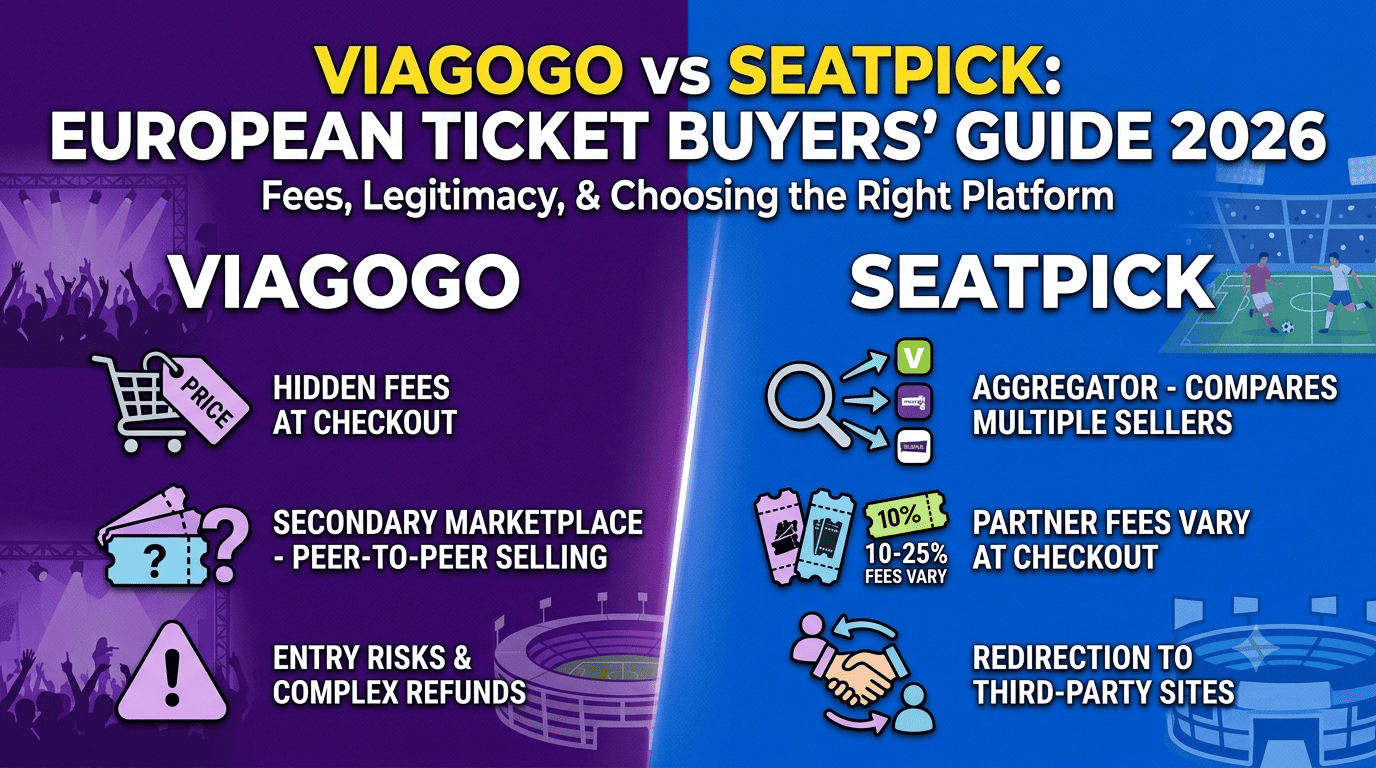
Choosing between Viagogo and SeatPick for European event tickets is not a simple either-or decision — it is a matter of understanding two fundamentally different business models, each carrying distinct risks for your wallet and your entry at the gate. Viagogo is a peer-to-peer secondary ticket marketplace where individual sellers and brokers list tickets at market-driven prices. SeatPick, by contrast, is a ticket search aggregator that compares listings across multiple resale platforms and redirects you to a third-party seller to complete the purchase. Neither platform is an official ticket retailer, and neither guarantees you a face-value price. For European football fans, concertgoers, and festival travelers weighing their options in 2026, the comparison below lays out every decision-critical factor — fees, ticket authenticity, refund reliability, and the increasingly important question of whether a more transparent alternative exists that eliminates hidden checkout fees entirely.
Side-by-Side Comparison Table (Fees, Ticket Source, Buyer Protection, Trustpilot Score, Refund Policy)
Before diving into the detail, this snapshot captures the essential differences between Viagogo and SeatPick across the criteria that matter most to European ticket buyers. Data is current as of mid-2026.
| Criteria | Viagogo | SeatPick | TicketX Europe |
| Business Model | Secondary resale marketplace (peer-to-peer) | Ticket search aggregator (redirects to third-party sellers) | Verified ticket platform (official & authenticated inventory) |
| Buyer Fees | 25–35% above listed price (booking fee + VAT surcharge + delivery fee) | Varies by partner seller (typically 10–25% added at partner checkout) | 0% Buyer Fees — listed price = final price |
| Ticket Source | Individual sellers & brokers (unverified origin) | Third-party marketplaces (Viagogo, StubHub, others) | Official & verified ticket inventory |
| Trustpilot Rating | ~3.8 / 5 (70,000+ reviews across regional sites) | ~3.4–3.6 / 5 (~85 reviews) | Verified & transparent — check current rating |
| Buyer Protection | Viagogo Guarantee (limited scope, exclusions apply) | No direct protection — depends entirely on partner seller’s policy | Verified ticket guarantee + secure checkout |
| Refund Policy | Refunds for cancellations only; replacements or credit for invalid tickets (claims process widely reported as difficult) | No refund mechanism — disputes go through the underlying marketplace | Clear, upfront refund policy — stated before purchase |
| Price Transparency | Listed price excludes mandatory fees until checkout (drip pricing model) | Shows “best price” but final cost revealed only at partner checkout | All-in pricing from the first click |
| European Coverage | Global — strong European football & concert inventory | Aggregates across markets — primarily European focus | Europe-focused: Premier League, La Liga, Serie A, Bundesliga, Champions League, concerts, festivals, West End |
The Hidden-Fee Gap Neither Platform Closes — and Who Does
The comparison table reveals a structural problem that persists across both Viagogo and SeatPick: neither platform shows you the real price upfront. Viagogo employs a drip-pricing model, layering booking fees, VAT surcharges, and delivery charges that can inflate a listed €100 ticket to €127–€135 by the time you reach payment. SeatPick’s aggregator model creates a different version of the same problem — the “best price” displayed on SeatPick is rarely the final price, because clicking through to the partner marketplace triggers that seller’s own fee stack at checkout.
Concern about hidden charges is well documented. In a 2022 survey conducted by the UK Competition and Markets Authority (CMA), 85% of respondents who had encountered misleading online practices said they were worried about hidden charges added late in the purchase process. The European Consumer Organisation (BEUC), in its 2025 paper Towards the Digital Fairness Act, likewise identifies drip pricing — also called “junk fees” — as a deceptive technique documented in sectors such as live entertainment and hotels.
This is where the market gap becomes a tangible opportunity for informed buyers. Platforms that operate on a 0% Buyer Fees model — where the listed price is the checkout price with no hidden surcharges — directly solve the problem that both Viagogo and SeatPick leave unresolved. TicketX Europe operates precisely on this principle: 100% official tickets, transparent all-in pricing, and zero hidden checkout fees. For European event buyers in 2026, the question is no longer which resale platform charges slightly less — it is whether you need to accept hidden fees at all.
What Is Viagogo? Business Model, Fees & Legitimacy
Viagogo is one of the most recognized names in the global secondary ticket market — and one of the most controversial. Founded in 2006 by Eric Baker (who also co-founded StubHub), Viagogo operates as a peer-to-peer resale marketplace headquartered in Geneva, Switzerland, with operations spanning 195 countries, 33 languages, and 49 currencies. The platform allows individual ticket holders, professional brokers, and commercial resellers to list tickets for sale at prices set by the seller, not by the original event organizer. Viagogo and eBay announced their agreement for Viagogo to acquire StubHub in November 2019, the deal closed in February 2020 for around $4 billion, and — following regulatory review by the UK CMA — the full merger was completed in 2022, creating one of the world’s largest secondary ticketing groups. For European consumers, understanding what Viagogo is — and what it is not — is essential before committing to a purchase.
How Viagogo’s Resale Marketplace Operates
The single most important distinction about Viagogo is that it is not an official ticket seller. When you buy a ticket on Viagogo, you are purchasing from a third-party seller — an individual or a broker — who originally acquired the ticket elsewhere and is reselling it at a price they determine. Viagogo acts as the intermediary facilitating the transaction, not as the ticket’s source.
This peer-to-peer model means several things for buyers:
- Prices are market-driven, not face-value. Sellers set prices based on supply and demand. For high-demand events like Champions League knockout rounds or sold-out stadium concerts, resale prices routinely exceed face value — often substantially.
- Ticket origin is opaque. Viagogo does not consistently disclose how or where the seller originally obtained the ticket. Buyers cannot independently verify whether the ticket came from an official allocation, a presale code, a corporate hospitality package, or another resale platform.
- The seller, not Viagogo, is responsible for delivery. Tickets are delivered by the seller through various methods — e-ticket transfer, PDF download, physical shipping, or mobile entry — and delivery timelines vary. If the seller fails to deliver, Viagogo’s guarantee process kicks in, but the friction involved is a common complaint.
For buyers accustomed to purchasing from a club box office or an authorized primary retailer, the Viagogo experience can feel opaque and unpredictable. The platform serves a real market need — providing access to sold-out events — but the price premium and lack of transparent sourcing are trade-offs every buyer should understand before clicking “confirm.”
Viagogo Fee Structure — Booking Fee, VAT, Delivery & the 25–35% Markup
Viagogo’s fee structure is one of the platform’s most criticized features and a frequent theme in its negative reviews. The platform employs a drip-pricing model: the ticket price shown on the listing page does not include the mandatory fees that are added at checkout. This means the price you see when browsing is never the price you pay.
Here is the typical fee stack on a Viagogo purchase in Europe:
| Fee Component | Typical Range | When Revealed |
| Booking / Service Fee | 15–22% of listed price | Checkout step 2 (after entering details) |
| VAT / Tax Surcharge | 5–8% additional | Checkout step 2–3 |
| Delivery / Handling Fee | €3–€11 flat | Checkout step 3 (delivery selection) |
| Total Markup Range | 25–35% above listed price | Payment confirmation page |
Consumer testing and regulatory reviews have repeatedly flagged Viagogo’s late-stage fees as difficult to anticipate, with the full cost only visible at the final payment step. On a €100 listed ticket, the real cost at checkout typically lands between €127 and €135 — a gap that European consumers consistently cite as deceptive.
The drip-pricing strategy is not accidental. It exploits a well-documented cognitive bias: once a buyer has invested time selecting an event, choosing seats, and entering personal information, they are psychologically reluctant to abandon the purchase — even when the final price is higher than expected. The CMA has specifically targeted this practice, the EU’s Digital Services Act already imposes platform transparency obligations, and the forthcoming Digital Fairness Act — a headline initiative in the EU’s 2030 Consumer Agenda, adopted in November 2025, with a formal proposal expected in 2026 — is set to further target drip pricing and “junk fees” across member states.
Is Viagogo Legit? Trustpilot Reviews, CMA Actions & Regulatory History
Viagogo is a legally registered business, and it does facilitate real ticket transactions. In that narrow sense, it is “legit.” But the question most European consumers are actually asking is broader: can I trust this platform with my money, my tickets, and my experience?
The evidence paints a mixed picture:
- Trustpilot: ~3.8 out of 5 stars across roughly 70,000 reviews (combined across regional sites) as of June 2026. Viagogo’s overall score has improved in recent years, but recurring complaint themes still include hidden fees, difficulty obtaining refunds, and tickets that did not work at venue entry.
- UK CMA Enforcement: The Competition and Markets Authority pursued Viagogo in multiple enforcement actions between 2018 and 2020, requiring the platform to improve pricing transparency, disclose seat locations, and stop misleading urgency tactics (“only 2 tickets left” messaging). In 2019 the CMA notified Viagogo that it intended to ask a court to find the company in contempt for incomplete compliance, but it suspended that action in September 2019 after Viagogo made the required changes to its site.
- European Commission action (2024): Following dialogue with the Commission and national consumer authorities, Viagogo committed in May 2024 to improving its terms and consumer information — a separate EU-level track from the UK CMA’s enforcement.
- Renewed 2025–2026 scrutiny: In November 2025 the CMA opened a fresh consumer-protection investigation into Viagogo over drip pricing, and in June 2026 it fined StubHub UK roughly £890,000 and ordered refunds to more than 50,000 buyers — a clear signal of tightening enforcement across secondary ticketing.
- European Regulatory Scrutiny: Multiple EU member states — including France, Germany, and Italy — have investigated or sanctioned Viagogo for non-compliance with consumer protection standards. The EU Digital Services Act now imposes transparency requirements that apply directly to platforms like Viagogo, with potential fines of up to 6% of global turnover for non-compliance.
- Denied Entry Reports: European football fan forums — particularly on Reddit’s r/PremierLeague and r/football — feature repeated reports of ticket holders being denied entry at stadiums after purchasing through Viagogo, particularly when clubs operate strict anti-resale policies tied to membership or season-ticket holder accounts.
The bottom line: Viagogo processes millions of transactions, and many buyers receive valid tickets without incident. But the platform’s fee opacity, regulatory history, and documented entry-denial cases mean that every Viagogo purchase carries a layer of risk that better alternatives now eliminate entirely.
What Is SeatPick? Aggregator Model, Fees & Legitimacy
SeatPick occupies a different position in the ticket ecosystem than Viagogo, and understanding that distinction is critical for anyone comparing the two. Launched as a ticket search and comparison tool focused primarily on European events, SeatPick aggregates ticket listings from multiple resale marketplaces — including Viagogo, StubHub, and other secondary platforms — and presents them in a unified interface, often with interactive seating charts that show a stadium or venue view. It positions itself as a way for buyers to compare prices across sellers and find the best deal. But SeatPick’s model has a structural limitation that most consumers do not fully understand until they are deep into the purchase process.
SeatPick’s Redirect Model — Who Actually Sells You the Ticket?
SeatPick does not sell tickets. It does not hold inventory. It does not process payments. When you click “buy” on a SeatPick listing, you are redirected to a third-party resale marketplace — the platform that actually holds the listing and processes the transaction. SeatPick earns revenue through referral commissions from these partner marketplaces.
This means:
- The ticket you buy does not come from SeatPick. It comes from Viagogo, StubHub, or another partner marketplace that SeatPick aggregates.
- The checkout experience is controlled by the partner seller, not SeatPick. The partner site’s fees, terms, and refund policies govern your purchase.
- SeatPick has no direct relationship with the ticket once you click through. If something goes wrong — invalid ticket, wrong seats, delivery failure — your recourse is with the third-party marketplace, not with SeatPick.
This is the single biggest misconception flagged across user forums, particularly on Reddit (r/musicals, r/concerts) and Quora: buyers assume SeatPick is a direct seller with its own customer service, buyer protection, and accountability. It is not. It is a comparison shopping engine for resale tickets, structurally similar to how Google Flights or Skyscanner works for airfare — except that the underlying “airlines” in this case are resale marketplaces with their own fee models and trust profiles.
SeatPick Fees and Refund Policies — Why They Vary by Partner Seller
One of the most confusing aspects of using SeatPick is that the fees and refund terms change depending on which partner marketplace you are redirected to. SeatPick displays a listed price on its own interface, but this price may or may not include the fees that the partner marketplace will add at checkout.
For example:
- If SeatPick redirects you to Viagogo, you will encounter Viagogo’s standard 25–35% fee stack at checkout.
- If SeatPick redirects you to StubHub, you will face StubHub’s service fees (typically 15–25% in Europe).
- If SeatPick redirects you to a smaller niche marketplace, the fee structure could vary even further.
The practical effect is that the “best price” shown on SeatPick’s comparison interface is often not the best actual price you will pay. A listing that appears cheapest on SeatPick may land you on a partner site with the highest checkout fees, while a listing that looks slightly more expensive could route to a partner with lower surcharges. Without manually clicking through to each partner and advancing to the payment page, you cannot make a true apples-to-apples cost comparison.
SeatPick’s own refund policy mirrors this structural gap. Because SeatPick does not process the transaction, it does not offer refunds. If you need a refund — for any reason, including event cancellation, invalid tickets, or non-delivery — you must navigate the refund policy of whichever partner marketplace processed your order. This creates a fragmented and often frustrating support experience, especially for first-time buyers who expected SeatPick to be their point of contact.
Is SeatPick Legit? Trust Signals, Limitations & What Users Report
SeatPick is a legitimate business operating as a ticket comparison aggregator. Its Trustpilot rating of approximately 3.4–3.6 out of 5 stars (~85 reviews as of June 2026) sits in a broadly similar range to Viagogo’s, and users generally appreciate the interactive seating charts and the ability to compare prices across platforms in one view.
However, the limitations are structural and worth understanding:
- SeatPick cannot guarantee ticket authenticity. Because it never possesses or verifies the ticket, SeatPick cannot confirm that the ticket you receive is valid. That responsibility falls entirely to the partner marketplace.
- SeatPick cannot intervene in disputes. If the partner seller provides a fraudulent ticket or fails to deliver, SeatPick’s customer support has no mechanism to resolve the issue directly.
- Pricing accuracy is inconsistent. Users on Reddit and Quora report cases where the price displayed on SeatPick differed from the price shown on the partner marketplace after redirect, creating confusion and eroding trust.
- The “best price” framing can be misleading. Displaying the lowest listed price without including partner fees creates a perception of savings that may not materialize at checkout.
SeatPick is a useful research tool — helpful for scanning available inventory across multiple resale platforms quickly. But it is not a ticketing platform, and treating it as one exposes buyers to risks that a direct, verified ticket provider would not impose.
Viagogo vs SeatPick Fees — What a €100 Ticket Really Costs
For European ticket buyers, the most consequential comparison between any two platforms is not the listed price — it is the final checkout price. The gap between what you see and what you pay is where trust is built or destroyed. This section simulates the real-world purchase experience on Viagogo, SeatPick, and TicketX Europe for a ticket with a €100 listed price.
Viagogo Checkout Simulation: €100 Listed → €127–€135 at Payment
A ticket listed at €100 on Viagogo goes through the following cost escalation during the checkout process:
| Checkout Stage | What Happens | Running Total |
| Listing Page | Ticket displayed at €100 — no fees shown | €100 |
| Seat Selection & Login | You select the ticket, create an account or log in, enter personal details | €100 (still no fees visible) |
| Checkout Step 2 | Booking Fee added: ~€18 (18%); VAT surcharge added: ~€6 (6%) | €124 |
| Delivery Selection | E-ticket delivery fee: €3–€11 | €127–€135 |
| Payment Page | Final price revealed for the first time | €127–€135 |
At this point, the buyer has already invested 5–10 minutes entering information, selecting seats, and building psychological commitment to the purchase. Abandoning at the payment page feels like wasted effort — which is exactly the behavioral dynamic that drip pricing exploits. The result: a 27–35% markup that was invisible when the ticket first appeared in search results.
SeatPick Checkout Simulation: €100 Listed → €110–€125 at Partner Checkout
SeatPick’s checkout experience adds a different layer of complexity because the transaction does not happen on SeatPick at all. Here is the typical flow:
| Checkout Stage | What Happens | Running Total |
| SeatPick Interface | Ticket displayed at €100 — often labeled as “best price” or “lowest available” | €100 |
| Click “Buy” / “Get Tickets” | Redirected to partner marketplace (Viagogo, StubHub, or other) | €100 (partner site may show same or slightly different base price) |
| Partner Checkout | Partner’s own service fees added — varies by platform (10–25%) | €110–€125 |
| Partner Payment Page | Final price controlled entirely by the partner marketplace | €110–€125 |
The fee range is wider than Viagogo’s because it depends entirely on which partner marketplace SeatPick sends you to. If the redirect lands on Viagogo, you face the full 25–35% markup. If it lands on a platform with lower service fees, you might pay only 10–15% above listed. The uncertainty itself is a form of hidden cost — buyers cannot predict their final price until after they leave SeatPick’s interface.
TicketX Europe Checkout: €100 Listed → €100 at Payment
TicketX Europe’s checkout experience is designed around a single principle: the listed price is the final price. No booking fees, no service charges, no VAT surcharges, no delivery fees layered in at the end.
| Checkout Stage | What Happens | Running Total |
| Listing Page | Ticket displayed at €100 — all-in price, inclusive of all fees and charges | €100 |
| Seat Selection | Select your seats with full transparency — no additional charges | €100 |
| Secure Checkout | 0% Buyer Fees confirmed — no booking fee, no service charge, no delivery fee | €100 |
| Payment Page | Final price matches the listed price exactly | €100 |
The contrast is stark. On Viagogo, a €100 listed ticket costs up to €135 at payment. On SeatPick, it costs anywhere from €110 to €125 depending on which partner marketplace you are redirected to. On TicketX Europe, it costs €100. Period. For European consumers who have grown accustomed to checkout surprises, this level of transparency is not incremental — it is structurally different.
コメント