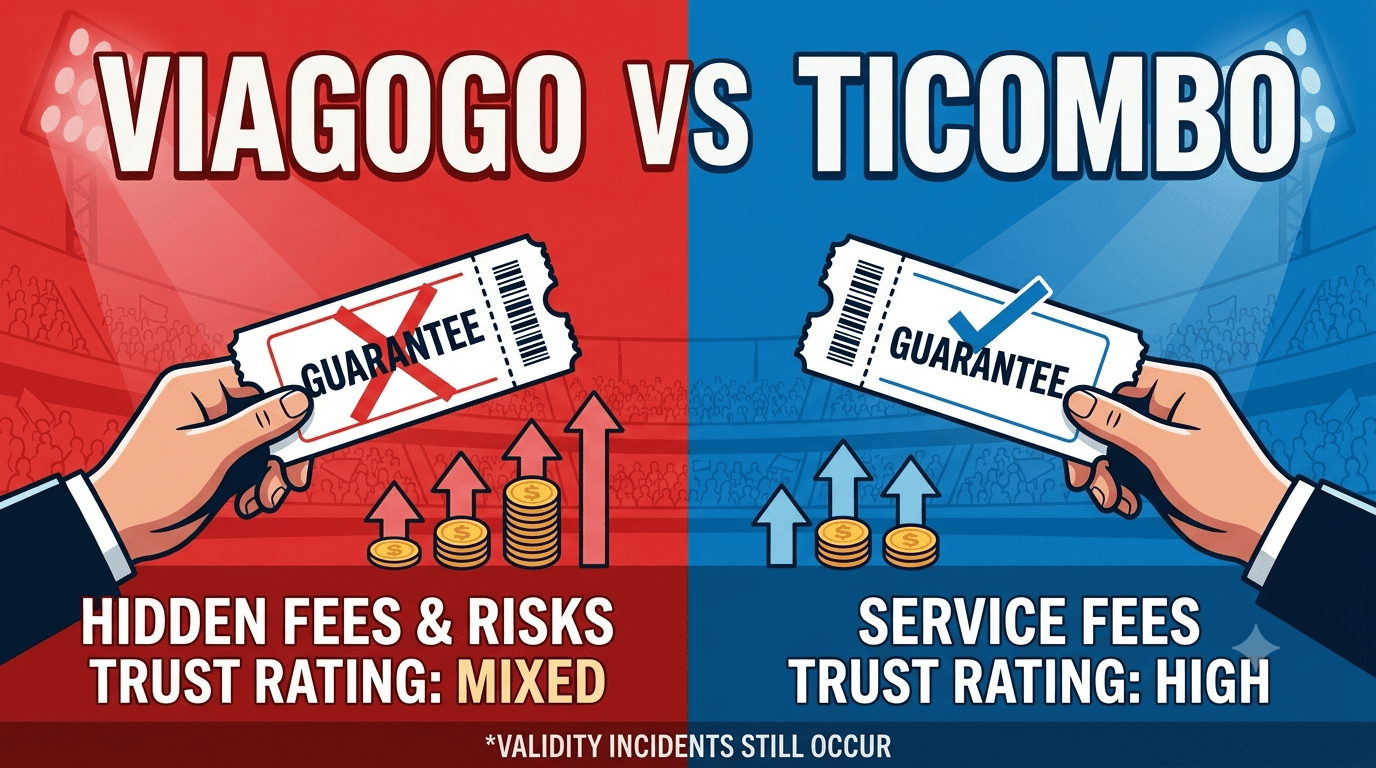
When European fans search for event tickets online, two resale platforms appear constantly: Viagogo and Ticombo. Both promise access to sold-out matches and in-demand concerts. Both charge fees that inflate the price you actually pay. And in the 2025–26 season, both carry a risk that many buyers do not discover until they are standing at the stadium gate with a voided ticket and no way in.
Below is a detailed look at what each platform charges, how their buyer protections work in practice, and whether either one can guarantee a ticket will scan at European venues that now enforce non-transferable digital ticketing. It also covers a different approach — buying verified tickets with 0% buyer fees and no hidden charges.
- Viagogo vs Ticombo at a Glance — Which Platform Is Worth Your Money?
- What Is Viagogo? Business Model, Fees, and Trust Rating
- What Is Ticombo? Business Model, Fees, and Trust Rating
- Viagogo vs Ticombo Fees — Checkout Price vs Listed Price
- Are Viagogo and Ticombo Tickets Safe for European Events?
- Viagogo vs Ticombo Refund and Buyer Protection Policies
Viagogo vs Ticombo at a Glance — Which Platform Is Worth Your Money?
Before diving into the details, here is a direct comparison of the two platforms across the metrics that matter most to European ticket buyers in 2026.
| Criteria | Viagogo | Ticombo | TicketX Europe |
| Business Model | Peer-to-peer resale marketplace | Resale marketplace with mixed seller sourcing | Verified / official ticket platform |
| Buyer Fees | 25%–35% added at checkout | 15%–25% service fee + fixed booking fee | 0% buyer fees |
| Fee Transparency | Fees revealed at final checkout stage | Partially disclosed; total often unclear until payment | Listed price = final price |
| Trustpilot Rating (June 2026) | ~3.8 / 5.0 (≈50,000 reviews, viagogo.co.uk) | ~4.6 / 5.0 (≈3,150 reviews) | Transparent pricing, verified inventory |
| Ticket Source Verification | Anonymous sellers; no source disclosure | Mixed: some verified, some unverified resellers | Official / verified tickets only |
| Buyer Guarantee | Replacement or refund (with reported delays and denials) | TixProtect buyer protection (limited scope, time-restricted claims) | Secure checkout, verified ticket guarantee |
| Regulatory History | 2018 CMA court order (UK); fresh CMA investigation opened Nov 2025; ACCC penalty (Australia); multiple EU complaints | Lower regulatory profile; limited enforcement record | Compliant with EU Consumer Rights Directive |
| Best For | Last-resort availability for sold-out events | Mid-range resale with strong review ratings and slightly better transparency than Viagogo | European fans who want fair pricing and guaranteed entry |
The picture is more nuanced than a simple “good vs bad” split. Viagogo loads the heaviest fees onto buyers and carries the longest regulatory record of the three, though its Trustpilot score has recovered to mixed-to-fair territory in recent years. Ticombo rates highly on Trustpilot and charges less, but it operates on a much smaller review base, and validity incidents still occur. Critically, neither platform can guarantee that a resold ticket will actually get you through the gate at a Premier League stadium or Champions League venue operating under non-transferable digital ticket policies.
What a £80 Premier League Ticket Actually Costs on Each Platform
Abstract fee percentages are easy to gloss over. Actual pounds spent at checkout are not. Here is what happens to a standard Category 2 Premier League ticket with an £80 face value when purchased through each platform, based on publicly listed prices as of June 2026.
| Fee Component | Viagogo | Ticombo | TicketX Europe |
| Listed Ticket Price | £80 | £80 | £80 |
| Service / Booking Fee | £14–£18 | £8–£14 | £0 |
| Handling / Delivery Fee | £4–£6 | £2–£4 | £0 |
| FX / Processing Surcharge | £2–£4 | £1–£2 | £0 |
| Total at Checkout | £100–£108 | £91–£100 | £80 |
| Effective Markup | ~25%–35% | ~14%–25% | 0% |
That £20–£28 gap between Viagogo’s checkout total and the face value is not a premium for a better seat or a VIP upgrade — it is pure platform fees layered onto the same ticket. On Ticombo, the gap narrows to £11–£20, which is more reasonable but still represents money that does not go toward the event experience itself. On TicketX Europe, the listed price is the final price: £80 in, £80 out, with 0% buyer fees and no hidden charges at checkout.
For a family of four attending a Premier League derby, the difference between Viagogo and a 0%-fee platform can approach £80–£110 — enough for matchday food, a program, and a scarf.
What Is Viagogo? Business Model, Fees, and Trust Rating
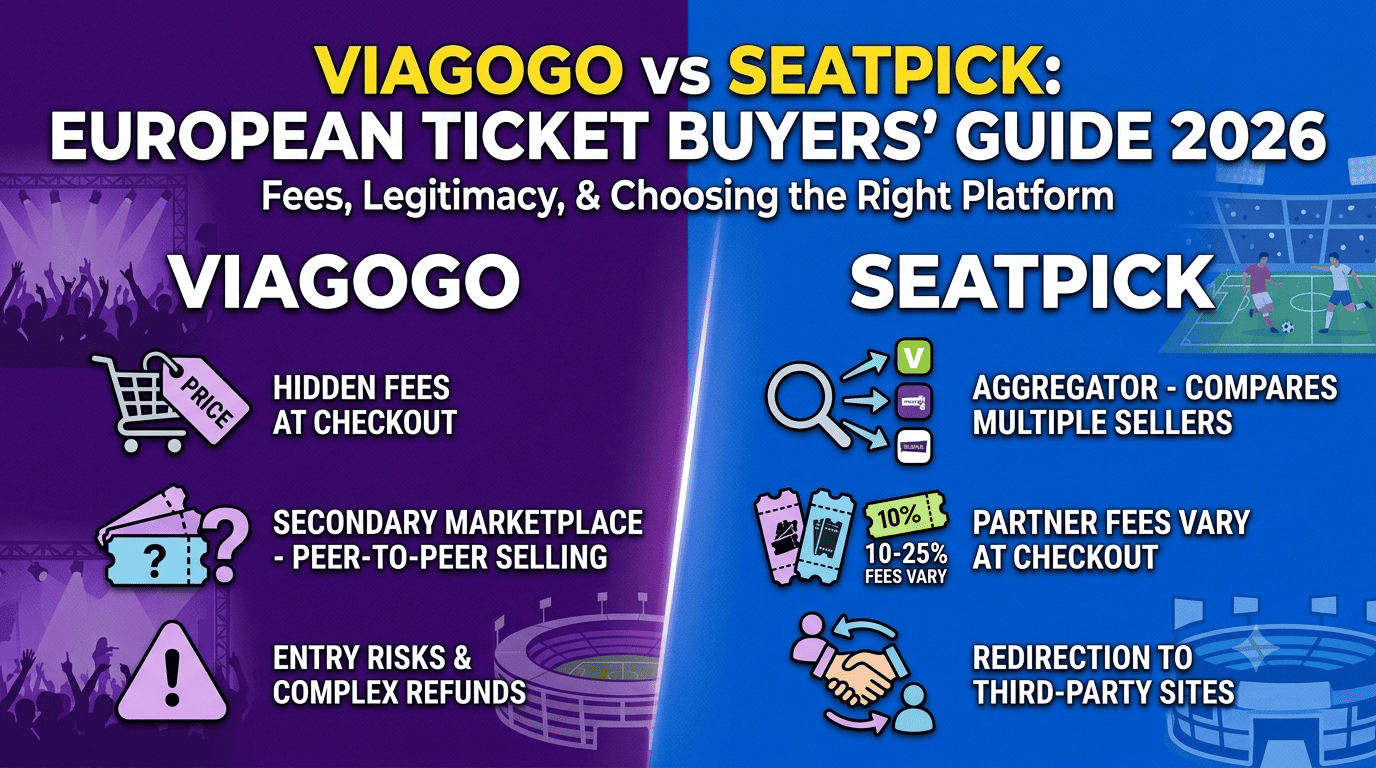
Viagogo is a secondary-market ticket marketplace headquartered in Switzerland. Founded in 2006, it operates as a peer-to-peer platform where individual sellers and commercial resellers list tickets for events across Europe and globally. Viagogo itself does not own or source the tickets — it provides the marketplace infrastructure and takes a commission from both buyers and sellers on every transaction.
The platform uses dynamic pricing, meaning ticket prices fluctuate based on demand, event proximity, and available inventory. A Champions League semifinal ticket listed at £150 on Monday might be £220 by Thursday if demand surges. This model rewards early browsing but punishes hesitation, creating urgency-driven purchasing behavior that benefits the platform’s fee revenue.
A critical detail that many buyers overlook: sellers on Viagogo are anonymous. You do not know whether your ticket is coming from a season-ticket holder who cannot attend, a professional broker with bulk inventory, or a speculative reseller who purchased tickets specifically to flip at markup. This anonymity eliminates any ability for buyers to assess seller credibility before committing to a purchase.
Viagogo’s corporate footprint expanded when it acquired StubHub from eBay in February 2020 for about $4.05 billion. UK regulators then raised competition concerns about the combined business, and Viagogo was required to sell StubHub’s international operations, which it divested in September 2021 to Digital Fuel Capital LLC. Viagogo retained the StubHub brand in North America.
Viagogo Fee Breakdown — Where the 25%–35% Markup Comes From
Viagogo’s fee structure is the single most criticized aspect of the platform, and for good reason. Multiple fee layers are added during checkout, often invisible on the initial listing page.
Here is how the markup builds:
- Booking Fee: Typically 15%–20% of the listed ticket price. This is Viagogo’s primary revenue source from buyers and is not shown on the search results page or the listing detail page until the buyer reaches checkout.
- Handling Fee: A fixed charge (usually £4–£8 per order) nominally covering “order processing.” In practice, this is an additional margin layer for electronic ticket delivery that costs the platform virtually nothing.
- Delivery Fee: Ranges from £2–£6 depending on the delivery method. Even for e-tickets delivered by email — which have zero fulfillment cost — a delivery charge is applied.
- FX / Currency Conversion Surcharge: Because Viagogo processes transactions through its Swiss entity, purchases made in GBP or EUR may include an undisclosed currency conversion markup of 2%–4%.
The cumulative effect: a ticket listed at £100 on the search page routinely costs £125–£135 at checkout. UK regulators reviewing the platform have found that Viagogo’s buyer fees typically add between 25% and 35% on top of the listed price — making it one of the most expensive ways to purchase event tickets in Europe.
The frustration is compounded by the timing of fee disclosure. Buyers invest time selecting their event, choosing their seats, and entering personal details before the true cost is revealed. By that point, psychological commitment to the purchase is high and the platform benefits from checkout inertia.
Viagogo Trustpilot Rating and CMA Enforcement History
Viagogo’s Trustpilot profile is more favourable than it once was. As of June 2026, its UK profile holds a TrustScore of about 3.8 out of 5.0 across roughly 50,000 reviews, and its global .com profile sits near 3.9. That is a mixed-to-fair rating — not the “bad” score it carried in earlier years — but the review content is polarised. The most common negative themes are:
- Hidden fees revealed late in checkout that inflate the listed price
- Refund difficulties after canceled or rescheduled events
- Invalid or last-minute tickets, with some buyers reporting problems entering European football stadiums and concert venues
- Unresponsive customer service with automated replies and extended resolution timelines
Many positive reviews also appear — often from buyers who received tickets on time and entered without incident — which is why the average lands in mixed territory rather than at either extreme.
Viagogo’s regulatory history is long. The UK Competition and Markets Authority (CMA) secured a court order against the company in November 2018 requiring clearer upfront pricing and disclosure of resale restrictions; in 2019 the CMA pursued Viagogo over compliance concerns before confirming improvements later that year. In November 2025 the CMA opened a fresh investigation into Viagogo’s compliance with consumer protection law, which remained ongoing as of mid-2026 with no findings yet made.
Beyond the UK, Viagogo was penalised by the Australian Competition and Consumer Commission (ACCC) — a court ordered a A$7 million penalty in 2020 for misleading consumers — and it has drawn consumer protection complaints across several EU member states as well as sustained criticism from live music industry bodies including the FanFair Alliance.
For European fans weighing their options, the pattern is consistent: Viagogo offers wide event inventory and last-resort availability for sold-out fixtures, but at the cost of late-appearing fees, a long regulatory record, and significant financial markup.
What Is Ticombo? Business Model, Fees, and Trust Rating
Ticombo is a newer, Berlin-based entrant in the European secondary ticket market, positioning itself as an alternative to legacy resale platforms like Viagogo and StubHub. The platform operates as a fan-to-fan ticket marketplace where both individual sellers and commercial ticket agencies list inventory for sports events, concerts, and festivals across Europe.
Unlike Viagogo’s fully anonymous seller model, Ticombo provides slightly more information about seller sourcing — some listings are tagged as coming from verified agencies or authorized sellers, while others come from individual resellers with less transparency about ticket origin. This hybrid approach gives the appearance of greater legitimacy, but the inconsistency means buyers still cannot uniformly verify whether a specific ticket is officially sourced or coming from a speculative reseller.
Ticombo has positioned itself with a particular focus on European football — Premier League, Champions League, La Liga, Serie A, and Bundesliga fixtures feature prominently in its inventory and marketing. The platform also covers major concert tours and music festivals, though its depth of inventory in those categories is thinner than its football offerings.
The platform’s European positioning is deliberate: it targets the exact audience frustrated by Viagogo’s fee practices while offering a marginally more transparent experience. Whether that margin is wide enough to matter is the question this comparison answers.
Ticombo Fee Breakdown — Service Fees, Booking Fees, and the Real Total
Ticombo’s fee structure is lower than Viagogo’s on average, but it is not zero — and it is not always as transparent as the platform suggests.
Here is how Ticombo’s fees typically break down:
- Service Fee: Ranges from 10%–20% of the ticket price, varying by event demand, ticket category, and seller. This fee is the primary buyer-facing charge and is sometimes partially visible on the listing page — but the exact percentage often becomes clear only at checkout.
- Booking Fee: A fixed per-order charge (typically £2–£5) applied on top of the percentage-based service fee. This is disclosed in the terms of service but not always prominently displayed during the browsing experience.
- Delivery / Processing Fee: Generally lower than Viagogo’s (£1–£3), but still present for digital ticket deliveries.
The net result: a ticket listed at £80 face value on Ticombo typically costs between £92 and £100 at checkout, representing a 15%–25% total markup. Some buyers on Trustpilot report even higher effective fees on high-demand listings.
This is meaningfully lower than Viagogo’s 25%–35% inflation, and for budget-conscious fans it represents real savings. However, the fee structure still means buyers are paying a premium above face value that is not fully visible until the final stages of the purchase process — a pattern that, while less aggressive than Viagogo, still falls short of true price transparency.
Ticombo Trustpilot Rating and Mixed User Sentiment
Ticombo’s Trustpilot profile is strong. As of June 2026 it holds a TrustScore of about 4.6 out of 5.0 from roughly 3,150 reviews, with around 82% of reviewers awarding five stars — a notably high rating for a secondary marketplace.
That said, the review base is far smaller than Viagogo’s, and a high average does not eliminate risk. Positive reviews tend to highlight:
- Lower fees compared to Viagogo
- Successful ticket delivery for European football matches
- Functional buyer protection (marketed as “TixProtect”) for problem transactions
Negative reviews cluster around:
- Fee transparency gaps: Some buyers report that the final checkout price exceeded their expectations despite the platform’s lower-fee positioning
- Delivery timing: Some users report receiving e-tickets very close to event dates, creating anxiety about whether they would arrive in time
- Ticket validity incidents: A minority of reviewers report receiving invalid or edited PDF tickets and being denied entry at events using personalised, non-transferable tickets
- Seller verification inconsistency: While some listings are tagged as verified, others lack clear sourcing information, leaving buyers uncertain about ticket origin
The overall picture: Ticombo is a better-rated and cheaper experience than Viagogo for most European ticket buyers. But strong review scores do not remove the structural reality that it is still a secondary marketplace with inherent risks around ticket validity, fee transparency, and seller accountability — risks that are particularly acute for high-stakes events governed by non-transferable digital ticket policies.
Viagogo vs Ticombo Fees — Checkout Price vs Listed Price
The most revealing comparison between any two ticket platforms is not what they list — it is what they charge. Below are representative checkout scenarios based on real event categories in the European market as of June 2026.
| Event Type | Face Value | Viagogo Checkout Total | Ticombo Checkout Total | TicketX Europe Total |
| Premier League (Cat 2) | £80 | £100–£108 | £92–£100 | £80 |
| Champions League League Phase | €120 | €150–€162 | €138–€150 | €120 |
| La Liga El Clásico (Cat 1) | €200 | €250–€270 | €230–€250 | €200 |
| Major Concert Tour (Floor) | £95 | £119–£128 | £109–£119 | £95 |
| Music Festival (Weekend Pass) | €180 | €225–€243 | €207–€225 | €180 |
In every scenario, the pattern holds. Viagogo inflates the checkout total by roughly 25%–35%. Ticombo inflates by 15%–25%. TicketX Europe charges 0% buyer fees — the listed price is the price you pay.
For a pair of Champions League league phase tickets, the fee difference between Viagogo and TicketX Europe is €60–€84. That is a night at a hotel in many European cities, or a round-trip airport transfer. The fees are not trivial — they are material costs that add nothing to the experience of watching your team play.
EU Consumer Rights Directive and CMA Rules — Are These Platforms Compliant?
European buyers are protected by specific regulations designed to prevent exactly the kind of fee practices both platforms have been criticized for.
The EU Consumer Rights Directive (2011/83/EU), reinforced by the Digital Services Act (2022), requires that online ticket platforms operating in Europe disclose all mandatory fees before a consumer is bound by a purchase. This means the total price — including all unavoidable charges — must be visible before the buyer clicks “confirm.”
In the UK specifically, the CMA’s 2018 court order against Viagogo required upfront total-price disclosure and clear labeling when tickets are listed above face value, and the CMA opened a new compliance investigation in November 2025.
How do the platforms perform against these rules?
- Viagogo: Compliance has been contested. Despite the 2018 court order, consumer groups and reviewers report that fees are still revealed late in the checkout flow on many listings — a concern reflected in the CMA’s decision to reopen its investigation in 2025.
- Ticombo: The platform has not been subject to the same level of regulatory scrutiny, partly because of its smaller market share. However, user reviews on Trustpilot indicate that fee transparency is partial — some fees are shown early, but the complete total is often unclear until the final payment page.
Neither platform fully delivers on the spirit of upfront price transparency that EU and UK regulations are designed to enforce. For European fans who want compliance without compromise, platforms operating on a 0% buyer fee model eliminate the issue entirely — there are no hidden fees to disclose because there are no fees at all.
Are Viagogo and Ticombo Tickets Safe for European Events?
For the 2025–26 season, UEFA and Premier League tickets are fully digital, identity-linked, and non-transferable outside official club or league channels. A ticket bought through Viagogo or Ticombo can look entirely genuine and still be voided the moment it is scanned at the turnstile if it was resold outside those approved routes. For fans who have booked flights and hotels around a single match, that risk is serious — and as this guide explains, the buyer-protection guarantees offered by both platforms do not reliably cover the cost of being turned away at the gate.
UEFA and Premier League Non-Transferable Digital Ticket Policies (2025–26)
Safety is not just about whether a ticket is “real” in the sense that it was once a valid ticket — it is about whether it will actually work when you present it at the turnstile. In the 2025–26 season, the answer depends heavily on the ticketing policies of the event organizer, and those policies have become considerably more restrictive.
UEFA has confirmed that Champions League and major national-team tickets are fully digital and non-transferable through unauthorized resale platforms. Tickets are linked to the original purchaser’s identity and can only be transferred through UEFA’s own official resale or transfer channels. UEFA has publicly warned that any ticket purchased through an unauthorized third-party resale marketplace risks being voided at entry — regardless of whether the buyer paid full price and received a valid-looking confirmation.
The Premier League has implemented similar restrictions. Most clubs now issue digital-only matchday tickets tied to the purchaser’s club account. Official resale is facilitated through each club’s own ticket exchange system. Tickets resold outside these authorized channels — including through platforms like Viagogo and Ticombo — may be canceled by the club, leaving the buyer with no ticket and no entry.
These are not edge cases or theoretical risks. They are documented, enforced policies that have resulted in denied entries across European football over the past two seasons.
Entry-Denial Risk — What Happens When a Resold Ticket Gets Voided
What actually happens when you arrive at a stadium with a resold ticket that has been voided?
Ticketing-security specialists in the UK — including firms such as The Iridium Consultancy, which works on ticket fraud for major venues — have repeatedly warned that when a ticket is resold in breach of an event’s terms, the fan is the one left stranded at the gate while the resale platform accepts no responsibility for entry. Buyer reviews of both platforms include first-hand accounts of exactly this outcome.
The experience is painfully simple:
- You arrive at the venue with your e-ticket or mobile barcode.
- The scanner rejects the ticket because it has been flagged as resold through an unauthorized channel, or because the identity linked to the ticket does not match yours.
- There is no on-site resolution. Stewards and stadium staff cannot override the ticketing system. You are turned away.
- You have no physical ticket to present as evidence of purchase. Your only recourse is the platform’s buyer protection process — which may take weeks and may not cover your travel, accommodation, or the cost of missing the event.
For fans traveling from another country to attend a match — booking flights, hotels, and planning around the fixture — denied entry is not just a financial loss. It is a trip-defining disaster.
Both Viagogo and Ticombo sell tickets for events governed by these non-transferable policies. Neither platform consistently warns buyers at the point of purchase that the ticket they are buying may be voided under the event organizer’s terms.
Viagogo vs Ticombo Refund and Buyer Protection Policies
Both Viagogo and Ticombo market buyer protection guarantees designed to reassure customers, but a closer look at the terms reveals a far more limited safety net than the marketing suggests. Each program generally covers non-delivery or outright event cancellation, yet neither one reliably protects against the scenario European football fans should fear most: a ticket voided at the gate because it was resold outside UEFA’s or the club’s approved channels. Before trusting either guarantee with a costly resale purchase, it is worth understanding exactly where each platform’s coverage ends — including claim windows, fee exclusions, and dispute-resolution delays that can leave buyers stranded.
Viagogo’s Guarantee — What It Covers and What It Does Not
Viagogo markets a “Viagogo Guarantee” that promises buyers will receive valid tickets or get a replacement or refund. On paper, this sounds comprehensive. In practice, the guarantee has significant limitations that buyers should understand before relying on it.
What the guarantee covers:
- If the seller fails to deliver tickets, Viagogo will attempt to find replacement tickets of comparable or better quality. If replacements are unavailable, a full refund is issued.
- If an event is canceled (not postponed or rescheduled), buyers are eligible for a refund.
What the guarantee does not reliably cover:
- Entry denial due to unauthorized resale: If your ticket is voided because it was resold in breach of the event organizer’s terms and conditions, Viagogo’s guarantee does not consistently cover this scenario. Many buyers have reported that claims filed after being denied entry were rejected on the grounds that the ticket was “delivered as described.”
- Postponed or rescheduled events: Viagogo’s refund policy for postponements is more restrictive than for outright cancellations. Buyers may be told their tickets remain valid for the rescheduled date, even if they cannot attend.
- Processing timelines: Refund claims can take 4–8 weeks to resolve, with multiple buyers reporting longer waits during high-volume event periods.
Trustpilot reviews consistently cite refund difficulties as a leading complaint category, with buyers describing the claims process as opaque, slow, and biased toward denial.
Ticombo’s Buyer Protection — Terms, Timelines, and Gaps
Ticombo offers a buyer protection program (marketed as “TixProtect”) that covers non-delivery and event cancellation. The terms are more straightforward than Viagogo’s on paper, but user reports reveal gaps in practice.
What Ticombo’s protection covers:
- Non-delivery of tickets before the event date
- Full event cancellation (refund of the ticket price)
- Significant venue or date changes that materially alter the event
Where gaps appear:
- Claim windows: Ticombo requires buyers to file claims within a specific timeframe. Buyers who do not realize their ticket was invalid until they are denied entry may face tight deadlines to file.
- Partial refunds: Some users report receiving refunds for the ticket face value but not for the service fees and booking fees charged by the platform — meaning the platform keeps its cut even when the ticket fails.
- Dispute resolution speed: During peak football season (August–May), customer support response times can stretch, with some buyers reporting multi-day waits for initial acknowledgment of a claim.
- Scope exclusions: Like Viagogo, Ticombo’s protection does not explicitly guarantee entry. If a ticket is voided by the event organizer due to unauthorized resale, the buyer’s recourse depends on individual claim assessment rather than automatic coverage.
The bottom line: buyer protection on both platforms functions as a partial safety net, not a comprehensive guarantee. Neither program fully protects against the most consequential risk European ticket buyers face — being denied entry at a venue that enforces non-transferable digital ticket policies.
コメント