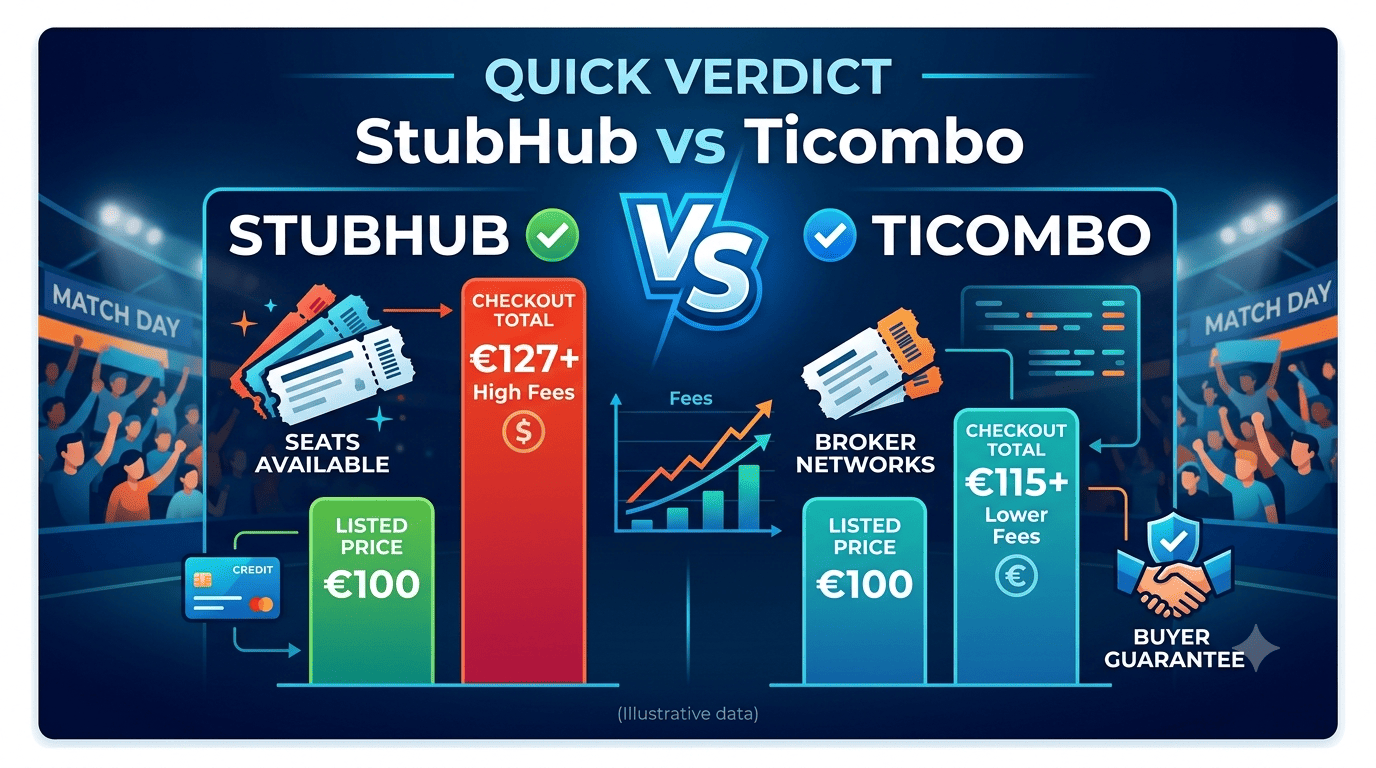
You find two seats for a Champions League night listed at €100 each, add them to your cart, and reach the payment screen — where the total has quietly climbed past €250. That gap, between the price that pulled you in and the price you actually pay, is the real story behind StubHub and Ticombo. On a €100 listing, a high-demand StubHub checkout fee can push each ticket toward €127; Ticombo lands lower, around €115, but still adds a markup you do not see until the final step.
Both platforms are legitimate, both deliver valid tickets for the large majority of orders, and both have a place in the European resale market. The question is not whether they work — it is how much they cost once every fee is counted, how confident you can be that your ticket clears the gate, and whether a 0% buyer fee alternative changes the math. This comparison benchmarks StubHub, Ticombo, and the official-inventory option TicketX Europe on the one number that decides the purchase: the all-in total at checkout.
The 60-Second Summary Before You Read Further
If you are comparing StubHub and Ticombo for European event tickets in 2026, the single most important variable is not inventory size or brand recognition — it is the total price you actually pay at checkout. Both platforms operate as secondary ticket marketplaces, meaning they connect buyers with third-party sellers rather than issuing tickets directly. Both add fees that inflate the listed price before you complete your purchase. The difference lies in how much those fees inflate your total and how transparent each platform is about disclosing them upfront.
The table below captures the essential comparison across every dimension that matters to a European ticket buyer right now.
| Criteria | StubHub | Ticombo | TicketX Europe |
| Business Model | Peer-to-peer resale marketplace | Broker aggregator + resale marketplace | Official / verified ticket marketplace |
| Buyer Fee Range | Variable; no fixed published rate, commonly substantial on high-demand events | ~10–15% buyer fee + booking fee | 0% buyer fees |
| Price Transparency | Listed price excludes fees until final checkout step | Listed price excludes fees until final checkout step | Price displayed = price paid |
| Ticket Source | Third-party resellers (individual + professional) | Professional broker network + individual sellers | Official and verified inventory |
| Buyer Guarantee | FanProtect Guarantee | Ticombo Buyer Guarantee | 100% official ticket guarantee + secure checkout |
| European Football Coverage | Strong (Premier League, Champions League, La Liga) | Moderate (growing European focus) | Strong (Premier League, Champions League, La Liga, Serie A, Bundesliga) |
| Concert / Festival Coverage | Extensive global inventory | Growing European tour coverage | Major European tours and festivals |
| Trustpilot Sentiment (2026) | Mixed — frequent fee complaints | Mixed — legitimacy concerns and refund delays | Positive — transparency and pricing praised |
| Headquartered | New York, USA (operates in EU) | Berlin, Germany (EU-based) | Europe-focused platform |
The pattern is clear: StubHub offers the deepest inventory but charges the highest fees. Ticombo undercuts StubHub on fees but introduces trust and refund-process friction. Neither platform shows you the final price until the last checkout step. TicketX Europe eliminates the fee problem entirely with a verified 0% buyer fee model and official ticket sourcing — a combination neither StubHub nor Ticombo currently matches.
What Is StubHub? Business Model, Fees & Buyer Protection
Buying tickets through StubHub can provide access to sold-out events and a vast selection of resale listings, but understanding the platform’s pricing structure and buyer safeguards is essential before making a purchase. Here’s what you need to know about StubHub’s fees, how they affect the final ticket price, and what protection is available if something goes wrong.
Understanding StubHub’s Position in the European Ticket Market
StubHub is the world’s largest dedicated secondary ticket marketplace, originally launched in 2000 in San Francisco and now operating across more than 40 countries. The platform functions as a peer-to-peer resale exchange: individual ticket holders and professional resellers list tickets for events they cannot or choose not to attend, and buyers purchase those tickets through StubHub’s checkout system. StubHub does not own or issue the tickets — it acts as an intermediary that facilitates the transaction and takes a commission from both sides.
In Europe, StubHub has built significant presence particularly around Premier League football, Champions League fixtures, La Liga, and major concert tours. The platform’s scale is its primary advantage: for high-demand events like a Champions League semifinal at Wembley or a sold-out stadium concert, StubHub typically has the widest selection of available listings across multiple price points and seating categories.
However, scale comes at a cost — literally. StubHub’s fee structure has become one of the most frequently cited pain points among European ticket buyers, with the platform consistently appearing in consumer complaint threads on Reddit, Trustpilot, and social media for “price shock at checkout.” StubHub’s own help materials state that service fees are applied to the buyer’s order and disclosed before the final purchase confirmation — but in practice, many buyers report not seeing the full fee breakdown until they have already invested time selecting seats and entering payment details, a pattern widely described as drip pricing (StubHub Help Center — Fees).
StubHub Fee Structure Explained (2026 Rates)
StubHub does not publish a fixed buyer-fee percentage. According to its own help materials, buyer fees vary by event, market, ticket price, time to event, and supply and demand, so the exact figure is not displayed on the search results page or the event listing page — it appears only at the checkout stage after you have selected your tickets and begun the payment process. On high-demand events, the buyer-side cost added at checkout can be substantial, commonly approaching 25–30% of the listed ticket price.
Here is an illustrative breakdown of how a representative high-demand fee inflates a typical purchase:
| Cost Component | Amount (€) |
| Listed ticket price | €100.00 |
| StubHub service fee (illustrative ~27%) | €27.00 |
| Delivery / fulfillment fee | €0–€5.00 |
| Total at checkout | €127.00–€132.00 |
Illustrative example using a representative high-demand fee. Actual StubHub fees vary by event and are not published as a fixed rate.
On this illustrative basis, a €100 ticket can cost €127 or more by the time you complete the purchase. For a pair of Champions League semifinal tickets listed at €200 each, a fee in that range adds roughly €108–€120 to the order — enough to cover a night in a hotel near the stadium. Hidden checkout fees are consistently among the most common complaints about secondary platforms, and consumer-advocacy groups such as the FanFair Alliance have campaigned against them in the UK and Europe (FanFair Alliance — Campaign News). StubHub is frequently cited as a prominent example in these discussions.
Additionally, StubHub charges sellers a separate commission, which can incentivize sellers to list tickets at higher base prices to offset their own platform costs — creating a compounding markup effect where the buyer ultimately absorbs both the seller’s margin inflation and StubHub’s buyer fee.
StubHub Buyer Protection and Refund Policy
StubHub’s FanProtect Guarantee is the platform’s primary trust mechanism and covers three core scenarios:
- Invalid tickets: If your tickets are rejected at the venue gate, StubHub commits to finding comparable replacement tickets or issuing a full refund.
- Event cancellation: If an event is officially canceled and not rescheduled, you are entitled to a full refund including fees.
- Non-delivery: If your tickets are not delivered by the promised date, StubHub will source replacements or refund your purchase.
On paper, FanProtect is one of the stronger buyer protection programs in the secondary market. In practice, user experiences vary considerably. Common complaints on Reddit’s r/concerts and r/PremierLeague threads describe delays of two to four weeks for refund processing, difficulty reaching live customer support agents, and disputes over what qualifies as “comparable replacement” seating. For rescheduled events (as opposed to outright cancellations), StubHub’s policy historically defaults to transferring the ticket to the new date rather than issuing a refund — a distinction that catches many buyers off guard.
The guarantee also does not cover situations where the buyer simply changed their mind, where the event proceeded but the buyer’s view was obstructed by production elements, or where the buyer paid a resale premium above face value and later found cheaper tickets elsewhere. These are standard exclusions across most secondary platforms, but they are worth understanding before assuming FanProtect is a blanket safety net.
What Is Ticombo? Business Model, Legitimacy & Fees
Ticombo has established itself as a growing European ticket marketplace by combining listings from professional brokers and individual sellers on a single platform. Before purchasing, it’s important to understand how Ticombo’s marketplace works, what fees are added at checkout, and what buyer protections are available to help you assess whether it’s the right platform for your needs.
Understanding How Ticombo Operates
Ticombo is a Germany-based ticket marketplace, founded in 2016 (some sources indicate 2017) and headquartered in Berlin, that operates primarily as a broker aggregator. Unlike StubHub’s predominantly peer-to-peer model, Ticombo sources a significant portion of its inventory from a network of professional ticket brokers and resellers across Europe, supplemented by individual sellers. The platform positions itself as a European-first alternative to larger global resale sites, with particular focus on football, musical theater, and live concert events.
Ticombo’s interface presents ticket listings from multiple sellers, and when a buyer completes a purchase, the platform routes the order to the specific broker or seller who holds that inventory. The buyer’s transaction is with Ticombo (which processes payment and provides the buyer guarantee), but the actual ticket fulfillment comes from the underlying seller. This aggregator model can offer competitive pricing because brokers compete against each other on the same platform, but it also introduces a layer of fulfillment complexity — your experience depends partly on which broker ultimately fills your order.
In terms of European coverage, Ticombo has steadily expanded its football inventory, particularly for Premier League, Bundesliga, and Champions League fixtures. Concert and festival coverage has grown but remains thinner than StubHub’s for blockbuster global tours. The platform’s primary marketing proposition is lower fees than StubHub and direct European presence, but as the fee breakdown below shows, “lower” does not mean “zero.”
Ticombo Fee Breakdown (Buyer Fee + Booking Fee)
Ticombo applies two distinct charges on top of the listed ticket price:
- Buyer service fee: Approximately 10–15% of the ticket price, varying by event category and demand level.
- Booking fee: A fixed per-transaction charge (typically €2–€5) applied regardless of ticket price.
Here is how a €100 ticket purchase looks on Ticombo:
| Cost Component | Amount (€) |
| Listed ticket price | €100.00 |
| Ticombo buyer service fee (~12%) | €12.00 |
| Booking fee | €3.00 |
| Total at checkout | €115.00 |
Illustrative example based on Ticombo’s published fee ranges (Ticombo FAQ & Terms of Service). Actual fees vary by event.
At €115, Ticombo’s checkout total is meaningfully lower than StubHub’s €127+ on this illustrative basis for the same face-value ticket. The €12 difference per ticket adds up quickly for group purchases — a family of four saves roughly €48 by choosing Ticombo over StubHub on equivalent listings. However, the fees still represent a 15% markup that only materializes at checkout, and for buyers accustomed to the displayed price being the final price, that €15 surprise can feel like a bait-and-switch regardless of how it compares to StubHub’s markup.
Some users on Reddit and Quora have also reported additional currency conversion charges when purchasing from a country using a different currency than the seller’s listing denomination, adding another 2–3% in edge cases. Ticombo’s FAQ addresses this but does not prominently disclose conversion fees during the standard checkout flow.
Is Ticombo Legit? Safety, Verification & Trust Signals
“Is Ticombo legit?” is one of the highest-volume questions associated with the platform across Reddit, Trustpilot, and Quora. The short answer: Ticombo is a legitimate registered business, not a scam. The longer answer involves understanding why the question persists and what the platform does — and does not — do to build buyer confidence.
Evidence supporting legitimacy:
- Registered company based in Berlin, Germany, subject to EU consumer protection law
- Operates a Buyer Guarantee that promises replacement tickets or a refund if delivered tickets are invalid
- Maintains a Trustpilot presence with a mix of positive and negative reviews (typical of secondary marketplaces)
- Has been operating since 2016 with a verifiable transaction history across European events
Evidence fueling doubt:
- Smaller brand recognition compared to StubHub means fewer independent verification touchpoints for cautious buyers
- Multiple Reddit threads (particularly r/musicals and r/Scams) describe slow customer support response times, especially for refund requests after event cancellations or rescheduling
- Some buyers report confusion about which seller actually fulfilled their order, since Ticombo’s aggregator model means tickets may come from any of dozens of broker sources
- Trustpilot reviews include complaints about tickets arriving very close to the event date, creating anxiety even when delivery ultimately succeeds
The legitimacy question is not unique to Ticombo — it reflects a broader trust deficit across the entire secondary ticketing industry. When buyers cannot see the final price upfront, cannot verify the source of their tickets, and read mixed reviews about refund experiences, doubt is a rational response. Ticombo is not a scam, but it is also not immune to the structural trust problems that affect resale marketplaces as a category.
StubHub vs Ticombo Fees — Head-to-Head Cost Comparison for European Events
Comparing ticket marketplaces based solely on the advertised price can be misleading, as mandatory fees often appear only at checkout. To make a fair comparison, it’s important to look at the final amount you’ll actually pay, including service, booking, and delivery charges, across each platform.
Checkout Price Breakdown: What a €100 Champions League Ticket Actually Costs
The most effective way to compare StubHub and Ticombo is to ignore marketing claims and focus on a single number: the total amount charged to your payment method at checkout. Listed prices are functionally irrelevant if they do not include all fees.
Using a €100 face-value Champions League group-stage ticket as the benchmark, here is an illustrative comparison of what each platform charges:
| Platform | Listed Price | Service / Buyer Fee | Booking / Delivery Fee | Total Checkout Price | Effective Markup |
| StubHub | €100 | ~€27 (illustrative) | €0–€5 | €127–€132 | ~27–32% |
| Ticombo | €100 | €12 | €3 | €115 | 15% |
| TicketX Europe | €100 | €0 | €0 | €100 | 0% |
Illustrative example based on representative 2026 checkout fees. StubHub does not publish a fixed buyer-fee rate, and actual fees vary by event and demand.
The delta is stark. On this illustrative basis, buying the same ticket through StubHub costs you €27–€32 more than buying through TicketX Europe. Even Ticombo, which positions itself as the lower-fee alternative, adds €15 that you will not see until the payment stage. Over a pair of semifinal tickets, StubHub’s fees alone could exceed €60 — real money that buys a pre-match meal, a stadium tour, or a train ticket between cities.
Demand for European club football remains enormous: across the 2025–26 Champions League, Europa League, and Conference League, total match attendance was roughly 14 million spectators (UEFA / European football attendance data, 2025–26). As demand climbs, the gap between listed prices and checkout totals on fee-charging platforms widens proportionally — because fees scale with ticket price.
Why the Price Jumps at Checkout — And How to Avoid It
The mechanism behind checkout price shock has a name in behavioral economics: drip pricing. Platforms display an attractive base price to capture your attention, engage you through seat selection and account creation, and then reveal the full cost only after you have invested enough time and effort that abandoning the purchase feels like a loss. It is not accidental — it is a deliberate conversion-optimization strategy.
Drip pricing has become a focal point for European regulators and consumer groups, who argue that headline prices excluding mandatory fees mislead buyers about the true cost of a purchase. The complaint that surfaces most often from European ticket buyers is not the price itself but the surprise — fees that appear only at the final payment step.
Both StubHub and Ticombo employ this pattern. Neither platform currently displays the total inclusive price on search results or listing pages by default in all European markets.
How to avoid the price jump:
- Use a 0% buyer fee platform first. Check TicketX Europe for your event before comparing resale sites — if the tickets are available, the listed price is the final price with no hidden fees and 100% official tickets.
- Always complete a checkout simulation. On StubHub or Ticombo, proceed to the final payment screen (without confirming purchase) to see the real total, then compare across platforms.
- Calculate the “all-in” price per ticket. Divide the checkout total by the number of tickets to get the true per-ticket cost, and use that number — not the listed price — for comparison.
- Check multiple platforms simultaneously. Open TicketX Europe, StubHub, and Ticombo side by side for the same event, compare checkout totals, and buy from whichever offers the lowest verified final price.
How to Choose the Best Ticket Platform for European Events in 2026
Choosing the right ticket platform involves more than comparing prices. By checking fees, ticket sources, buyer protection, and purchase timing before you book, you can reduce the risk of unexpected costs and improve your chances of securing the best tickets at the best value.
5-Point Checklist Before You Buy Any Ticket Online
Before entering payment details on any ticket platform — StubHub, Ticombo, TicketX Europe, or any other — run through this checklist to protect your purchase:
- Check the checkout total, not the listed price. Proceed to the final payment screen on any platform and note the exact amount that will be charged. If the total is more than 5% above the listed price, fees are being added. Compare this total across platforms before committing.
- Verify the ticket source. Is the platform selling official tickets from authorized inventory, or is it a resale marketplace connecting you with third-party sellers? Resale introduces authenticity risk that official inventory does not.
- Read the buyer guarantee in full. Specifically look for: What happens if the event is canceled? What happens if tickets are invalid? How long do refunds take? Does the guarantee cover rescheduled events?
- Check venue anti-resale policies. Many European football clubs and concert venues restrict or invalidate resold tickets. If you are buying from a resale platform, confirm that the specific venue and event permit secondary-market tickets.
- Search for recent buyer reviews. Check Trustpilot and Reddit for the platform name + the specific event or venue. Recent reviews (within the last three months) are more relevant than older ones, as platform policies and service quality change.
When to Buy — Timing Tips to Get the Best Price
Timing strongly affects both price and availability across all platforms:
- For European football (Premier League, Champions League, La Liga): Purchase as early as possible after fixture dates are confirmed. Resale prices on StubHub and Ticombo escalate sharply as match day approaches. On TicketX Europe, official inventory is priced consistently, but popular fixtures sell out — early buyers get the best seat selection.
- For major concert tours: The period 4–8 weeks after tickets go on general sale typically offers the best balance of availability and price. Initial resale spikes (driven by FOMO buyers and speculative sellers) tend to moderate as the market absorbs inventory. On TicketX Europe, official inventory is not subject to resale-driven price spikes, so buying early locks in the best available price.
- For festivals: Purchase during early-bird or first-release windows when possible. Secondary-market festival tickets carry the highest markups of any event category because limited supply meets extremely high demand for sold-out multi-day events.
- Avoid match-day and show-day purchases on resale platforms. Last-minute inventory is the most expensive and the hardest to verify. If you are buying within 48 hours of an event, prioritize platforms with official inventory and instant digital delivery.
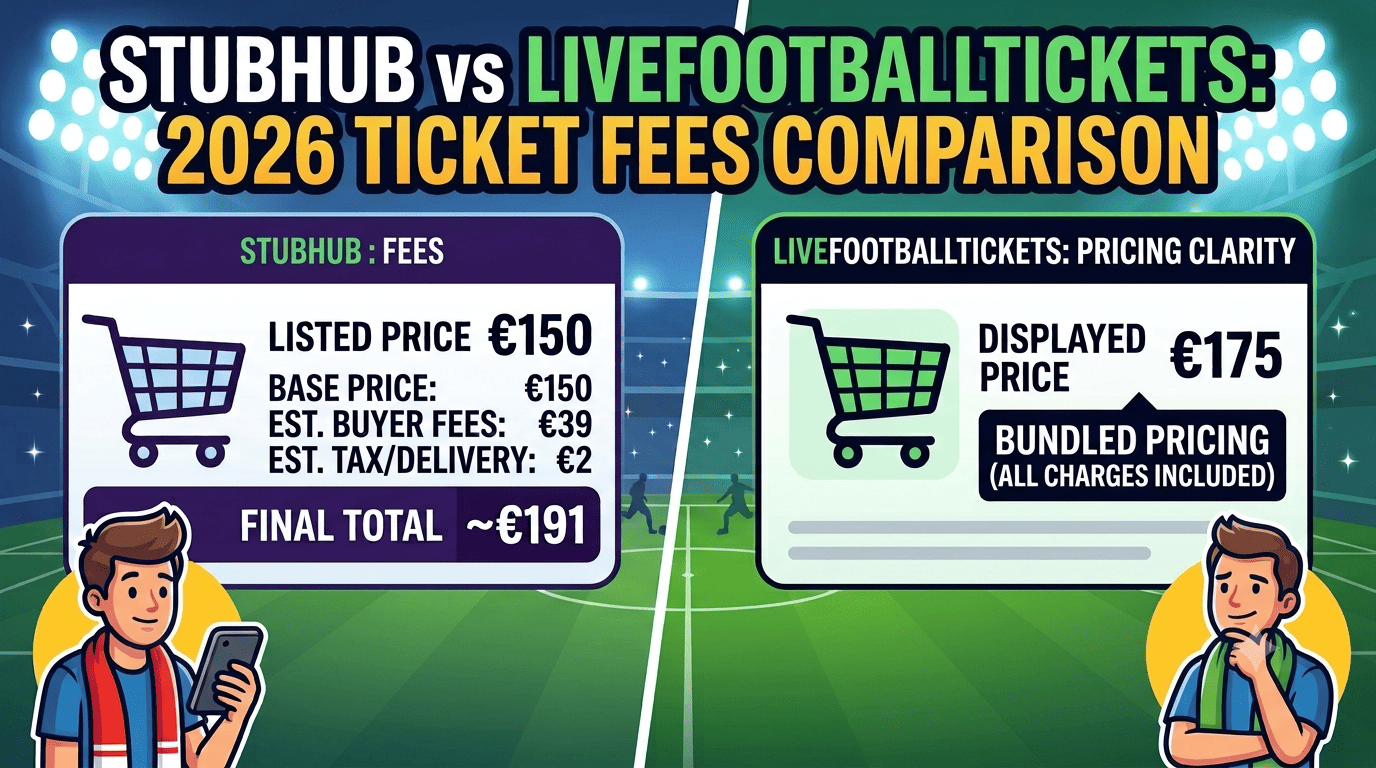
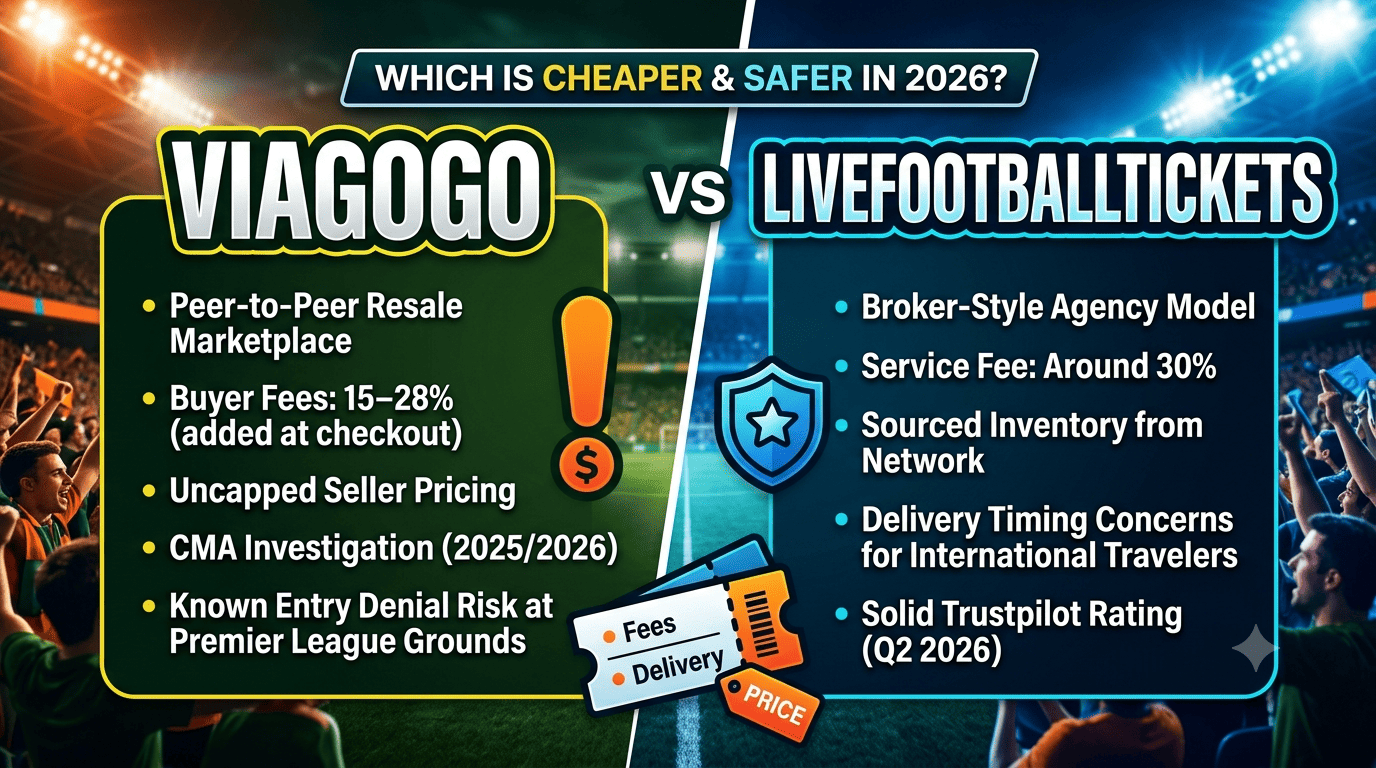
コメント