If you are buying tickets for a match, concert, or show in Europe and trying to decide between StubHub and viagogo, the honest starting point is that the two have more in common than the choice suggests. viagogo bought StubHub in 2020, and although UK and EU regulators later forced their European businesses into separate ownership, both still run on the same secondary-resale model — buyer fees that surface at checkout, prices marked well above face value, and a real risk of being turned away at the gate with a resold ticket. This comparison breaks down exactly how their fees, refund policies, and legitimacy stack up, and where a 0%-buyer-fee, official-ticket alternative like TicketX Europe changes the maths.
Side-by-Side Comparison Table
Here is a direct comparison of the two largest secondary ticket marketplaces operating in Europe. Every data point in this table reflects publicly available information current through mid-2026.
| Criteria | StubHub | viagogo | TicketX Europe |
| Founded | 2000 (San Francisco, US) | 2006 (London, UK) | Europe-focused platform |
| Owner (Europe) | Digital Fuel Capital (StubHub International, since 2021) | StubHub Holdings, Inc. | Independent |
| Primary Market | North America (StubHub.com); Europe via StubHub International | Europe / International | Europe |
| Ticket Type | Resale / Secondary | Resale / Secondary | Official / Verified |
| Buyer Fees | ~10%–15% | ~15%–28%+ | 0% |
| Fee Transparency | Fees shown at checkout, not on listing | Fees often shown only at final checkout step | Listed price = final price |
| Buyer Guarantee | FanProtect Guarantee | viagogo Guarantee | 100% Official Ticket Guarantee |
| Trustpilot Rating (2026) | ~1.3–1.5 / 5 | ~1.5–1.7 / 5 | Transparent pricing, no hidden charges |
| Entry Refusal Risk | Yes — resale tickets may be voided | Yes — resale tickets may be voided | No — official tickets accepted at gate |
| Regulatory Actions | Fee-transparency complaints (US & EU) | UK CMA court order (2018); Italian AGCM fines | None |
The pattern is unmistakable. Both platforms run on the same secondary-resale model, apply significant fees on top of already-inflated resale prices, and carry a documented risk of entry refusal at European venues. For buyers in Europe, the most immediate takeaway is that the “StubHub vs viagogo” debate may be the wrong question — because neither platform eliminates the core pain points of hidden fees and unverified ticket sourcing.
Why Neither Platform Offers 0% Buyer Fees
The business model of both StubHub and viagogo depends on fee extraction from two directions: sellers pay a commission to list, and buyers pay a service or booking fee to purchase. These buyer-side fees typically range from 10% to 28% depending on the platform, event, and region — and they are almost never visible on the initial listing page.
This structure exists because both platforms operate as secondary marketplaces. They do not own inventory. They do not issue tickets. They facilitate transactions between third-party sellers and buyers, taking a percentage from each side. Fee revenue is the primary income stream, which means reducing buyer fees to zero would require a fundamentally different business model.
TicketX Europe operates on that fundamentally different model: 0% buyer fees, transparent pricing where the listed price is the final price, and an inventory of official and verified tickets rather than third-party resale listings. For European event-goers comparing StubHub and viagogo, this distinction matters more than any feature-by-feature comparison between two platforms that ultimately rely on the same fee logic and attract many of the same consumer complaints.
- Are StubHub and viagogo the Same Company?
- StubHub vs viagogo Fee Breakdown — What You Actually Pay
- Is viagogo Legit? Is StubHub Safe? Trust & Legitimacy Compared
- StubHub vs viagogo Refund Policies Compared
- A Better Option — Official Tickets With 0% Buyer Fees
- Frequently Asked Questions — StubHub vs viagogo
Are StubHub and viagogo the Same Company?
The single most common question driving this search query is whether StubHub and viagogo are, in fact, the same entity. The honest answer is: it depends on where you are buying. viagogo bought StubHub in 2020, but UK and EU regulators forced the two apart in Europe a year later. The full story explains why that still matters for every ticket you buy.
Do They Share Ticket Inventory and Pricing?
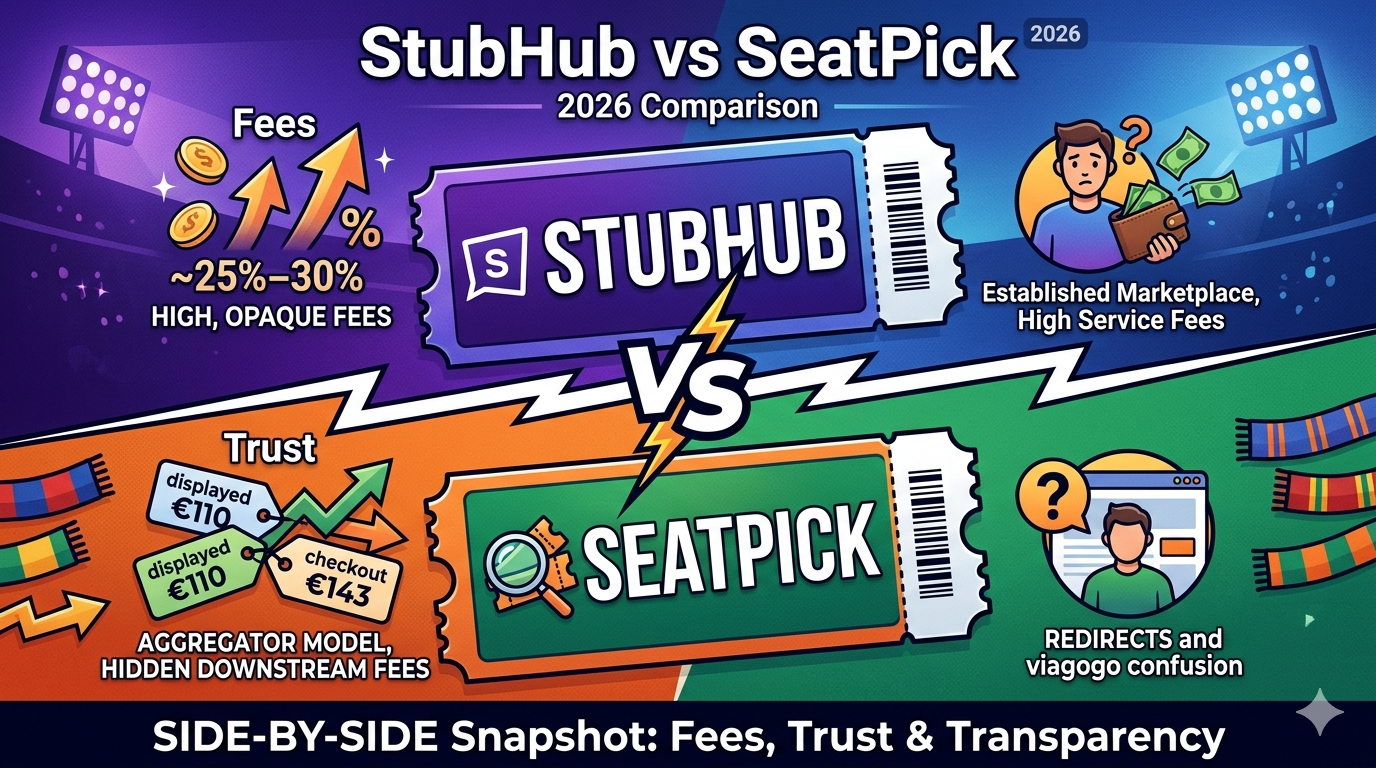
This is one of the most frequently asked questions on Reddit, Quora, and ticket-buyer forums — and the answer is nuanced. The two European businesses are now separately owned and run their own platforms, so there is no shared corporate inventory pool. What does create overlap is the seller side: the same professional resellers and brokers routinely list the same tickets across multiple marketplaces at once, so identical seats frequently appear on both StubHub and viagogo — often at different displayed totals because each platform applies its own fee structure at checkout.
What does this mean for you as a buyer? Comparing prices between StubHub and viagogo can produce an illusion of broad market competition. The listing price on viagogo might look lower, but after 20%+ in service and booking fees are added at final checkout, the total could exceed what StubHub charges. Or the reverse. Either way, you are navigating two fee structures both designed to maximize revenue per transaction — and in Europe, comparing them means comparing two separate resale operations that nonetheless share the same markup-plus-fees logic.
The regulator’s own view reinforces the point. In its final report, the CMA found that letting the merged business keep both brands in the UK would substantially lessen competition and risk higher fees and poorer service for fans — the explicit reason it forced the European separation.
StubHub vs viagogo Fee Breakdown — What You Actually Pay
Fees are the single largest pain point in the StubHub-vs-viagogo debate. Both platforms have built their revenue models around charging buyers more than the displayed listing price — a practice that has drawn regulatory enforcement, consumer backlash, and thousands of one-star reviews. Understanding exactly how these fees work is essential before you enter your payment details on either site.
StubHub Fees Explained (Buyer and Seller)
StubHub charges buyers a fee that typically ranges from 10% to 15% of the ticket price, added during the checkout process. This fee is not visible on the event listing page. You see a price when browsing, add the ticket to your cart, and then discover the buyer fee — along with potential delivery charges — on the payment screen.
On the seller side, StubHub takes a commission of approximately 10%–15% from the sale price, which incentivizes sellers to list at higher prices to offset their own costs. The result is a compounding effect: the seller inflates the listing price to cover their commission, and the buyer then pays an additional 10%–15% on top of that already-inflated price.
For US-based events, StubHub has made improvements to fee visibility in recent years, partly in response to regulatory pressure. For European events, however, transparency varies by market, and many users report that the total at checkout is meaningfully higher than what they expected from the listing page.
viagogo Fees and Hidden Charges Explained
viagogo has been the subject of more consumer complaints and regulatory actions related to fee transparency than virtually any other ticketing platform in Europe. The platform’s fee structure typically includes a service fee (often 15%–25% of the ticket price), a booking fee, and in some cases a delivery or handling fee — charges that are frequently revealed only at the very last step of the checkout process.
The UK CMA’s enforcement action against viagogo, which culminated in a court order on 27 November 2018, specifically cited the platform’s failure to disclose upfront that tickets were resale, that buyers risked being refused entry, and that the final price would include substantial fees not shown on the listing page.
While viagogo has made some checkout flow adjustments in response to the court order, ongoing Trustpilot reviews through 2026 continue to cite hidden fees as the primary complaint. The platform’s 1.5–1.7 out of 5 Trustpilot rating, based on over 60,000 reviews, is driven largely by this issue.
Real Checkout Comparison — £100 Premier League Ticket
To make the fee impact tangible, here is a simulated checkout comparison for a Premier League ticket with a £100 face value, based on documented fee ranges and competitor checkout simulations current through 2026:
| Cost Component | StubHub | viagogo | TicketX Europe |
| Listed / Display Price | £115 (resale markup) | £110 (resale markup) | £100 (listed price) |
| Buyer / Service Fee | ~£12–£17 (10–15%) | ~£22–£31 (20–28%) | £0 (0% buyer fees) |
| Delivery / Handling Fee | £0–£5 | £0–£8 | £0 |
| Total at Checkout | £127–£137 | £132–£149 | £100 |
| % Above Face Value | 27%–37% | 32%–49% | 0% |
The difference is not marginal. On a single ticket, the StubHub or viagogo buyer pays £27 to £49 more than the TicketX Europe buyer. Scale that to a pair of tickets or a group of four at a Premier League match, a Champions League final, or a multi-night concert run, and the savings from a 0%-buyer-fee platform become substantial.
Is viagogo Legit? Is StubHub Safe? Trust & Legitimacy Compared
Legitimacy and safety are the second-highest concern for users searching “StubHub vs viagogo,” right behind fees. Both platforms are legally registered businesses — they are not outright scams in the criminal sense. But “legitimate” and “trustworthy” are not synonyms, and the distinction matters when you are spending hundreds of pounds on event tickets.
viagogo Scam Complaints and the CMA Ruling
viagogo has accumulated one of the most extensively documented complaint histories of any consumer platform in Europe. Key facts:
- Trustpilot rating: 1.5–1.7 out of 5, based on over 60,000 reviews, with the dominant complaint categories being hidden fees, inflated prices, and difficulty obtaining refunds.
- UK CMA enforcement: The Competition and Markets Authority pursued legal action against viagogo from 2017 through 2018, securing a court order on 27 November 2018 requiring the platform to clearly disclose that tickets are resale, that buyers may be refused entry, and that the total price — including all fees — must be presented earlier in the checkout process.
- Italian AGCM fines: Italy’s competition authority has also fined viagogo for misleading commercial practices related to pricing transparency.
- Consumer advocacy complaints: Organizations including Which? UK, the European Consumer Organisation (BEUC), and multiple national consumer agencies have filed or supported complaints against viagogo’s checkout practices.
These are not isolated incidents from disgruntled individual buyers. They represent a pattern of systemic issues identified by government regulators, independent consumer organizations, and tens of thousands of verified purchasers. viagogo is a legal business, but buying through it requires accepting a documented risk profile that includes fee surprises, potential entry refusal, and historically difficult refund processes.
Is viagogo Legal in the UK and the EU?
Yes, viagogo is legal in both the UK and the EU. It operates as a registered secondary ticketing marketplace and has not been banned or shut down in any jurisdiction. However, “legal” does not mean “unregulated” or “without enforcement action.”
In the UK, viagogo operates under the conditions of the 2018 CMA court order, which mandates specific transparency requirements. In the EU, viagogo is subject to the Digital Services Act (DSA), consumer protection directives, and national laws governing ticket resale. In countries such as France, Belgium, and Italy, reselling tickets above face value is banned outright — yet resale listings for events in those countries have historically appeared on viagogo, creating legal ambiguity for both sellers and buyers.
The bottom line: viagogo can legally operate, but the legal protections available to buyers vary dramatically by country, and the platform’s compliance history with those protections has been contested by multiple regulatory bodies.
StubHub Safety and the FanProtect Guarantee
StubHub’s primary safety mechanism is its FanProtect Guarantee, which promises:
- Replacement tickets or a full refund if your tickets are not delivered in time for the event
- Replacement tickets or a full refund if your tickets are not valid for entry
- A refund if the event is canceled and not rescheduled
On paper, this is a meaningful buyer protection. In practice, consumer reviews indicate mixed experiences. Common complaints include:
- Long wait times for replacement ticket fulfillment
- Difficulty reaching customer support during high-volume event periods
- Refund processing delays, particularly for canceled or postponed events
- Cases where “replacement tickets” were in noticeably worse sections than the original purchase
StubHub’s Trustpilot score of approximately 1.3–1.5 out of 5 (US/UK combined) suggests that the FanProtect Guarantee, while providing a theoretical safety net, does not consistently deliver the seamless resolution experience buyers expect when spending hundreds of pounds on event tickets.
Can You Be Refused Entry With a Resale Ticket?
This is one of the most critical and under-discussed risks of buying through any secondary marketplace. The answer is unequivocally yes — you can be refused entry at the gate with a resale ticket, and this happens regularly at European events.
European football clubs are particularly aggressive about enforcing anti-resale policies. Many Premier League, La Liga, Serie A, and Bundesliga clubs explicitly prohibit ticket resale outside their own official channels. Clubs use digital ticketing systems, membership-linked entry passes, and ID verification at the gate to identify and void resold tickets.
If you purchase a Premier League ticket through StubHub or viagogo and the club’s system flags it as resold, you will be turned away at the turnstile — and your recourse is limited to whatever guarantee the platform offers after the fact, when you are already standing outside the stadium.
Major concert tours and festivals in Europe have also adopted non-transferable digital ticketing and name-on-ticket policies, further increasing the risk that resale tickets are voided at the door.
This risk is structurally eliminated when purchasing official or verified tickets through platforms like TicketX Europe, where every ticket is sourced through authorized channels and accepted at the venue gate without question.
StubHub vs viagogo Refund Policies Compared
When something goes wrong — a canceled event, invalid tickets, non-delivery — the refund policy is the last line of defense between you and losing your money. Both StubHub and viagogo offer buyer guarantees, but the real-world execution of those policies diverges sharply from the marketing promises.
StubHub Refund and Cancellation Policy
StubHub’s FanProtect Guarantee covers three core scenarios:
- Event canceled (not rescheduled): Full refund, typically processed within 30 days of official cancellation
- Tickets not delivered: Replacement tickets of comparable or better value, or a full refund
- Tickets invalid at the venue: Replacement tickets or a full refund
What the policy does not clearly cover:
- Postponed events: If an event is postponed rather than canceled, StubHub may hold your order open indefinitely rather than issue a refund. This has been a significant pain point for buyers during rescheduled concert tours and sporting events.
- “Comparable” replacement tickets: The definition of “comparable” is at StubHub’s discretion, and buyers have reported receiving replacement seats in substantially different sections than what they originally purchased.
- Processing timelines: While the policy states refunds will be processed, no binding timeline is guaranteed, and consumer reports indicate waits of several weeks to months in high-volume periods.
viagogo Refund and Cancellation Policy
viagogo’s buyer guarantee similarly promises ticket replacement or a refund for canceled events and invalid tickets. The documented difficulties, however, are more severe:
- Refund friction: Thousands of Trustpilot reviews describe extended delays, circular customer service interactions, and requirements to submit repeated documentation before a refund is processed.
- Credit vs. cash refunds: viagogo has historically offered site credit rather than cash refunds in certain scenarios, requiring buyers to make another purchase on the platform to recover their money.
- Postponed events: Similar to StubHub, viagogo’s policy for postponed events does not guarantee an immediate refund, leaving buyers locked into orders for events rescheduled months or even years into the future.
Customer Service and Complaint Resolution Compared
Both platforms have moved heavily toward automated customer service systems, reducing direct human support access. Users on Reddit, Quora, and Trustpilot consistently report:
- StubHub: Email-based support with response times ranging from 24 hours to several days. Phone support exists but is difficult to reach during peak periods. Resolution quality is inconsistent.
- viagogo: Primarily email- and chatbot-based support. Phone support is limited. Multiple users report needing to escalate through consumer protection agencies or credit card chargebacks to resolve disputes that the platform’s own support system failed to address.
For European buyers, the practical takeaway is that neither platform offers the kind of responsive, straightforward customer service you would expect from a transaction involving hundreds of pounds. If something goes wrong, be prepared for a process — not an instant resolution.
A Better Option — Official Tickets With 0% Buyer Fees
Once you strip away the fee structures and refund disputes, the StubHub-vs-viagogo question points to a simpler one: why pay a resale premium at all? Here is how an official-ticket, 0%-buyer-fee platform built for Europe removes the problems both resale sites are built around.
What TicketX Europe Offers That Resale Platforms Cannot
Every pain point surfaced in this comparison — hidden fees, inflated resale markups, entry-refusal risk, refund friction, regulatory scrutiny — traces back to a single structural issue: StubHub and viagogo are secondary resale marketplaces. They do not control ticket sourcing, they do not guarantee venue acceptance, and they fund their operations by layering fees on top of third-party markups.
TicketX Europe operates on a fundamentally different model. Here is exactly how it addresses each issue:
- 0% Buyer Fees: The listed price is the final price. No service fee, no booking fee, no delivery charge, no VAT surprise at checkout. What you see is what you pay. On a £100 ticket, you pay £100 — not £127 to £149.
- 100% Official & Verified Tickets: Every ticket on TicketX Europe is sourced through official or authorized channels. There is no third-party reseller in the middle, no risk of counterfeit tickets, and no ambiguity about whether the venue will accept your ticket at the gate.
- No Entry-Refusal Risk: Because tickets are officially sourced and verified, they are recognized by the venue’s entry systems. You will not be turned away at the turnstile because a club’s anti-resale system flagged your ticket.
- Transparent Pricing: TicketX Europe was built for the European market, where consumers have been burned by the exact checkout practices that regulators in the UK, Italy, and the EU have spent years trying to fix on resale platforms. Transparent pricing is not a feature — it is the foundation.
- European Market Focus: TicketX Europe is built specifically for fans attending events across Europe — Premier League matches, Champions League fixtures, West End shows, major concert tours, and music festivals.
For the European buyer who has spent time comparing StubHub and viagogo only to find similar fees and overlapping complaints on both, TicketX Europe represents what neither resale platform structurally can offer: a fee-free, officially sourced, transparent ticket-buying experience.
Frequently Asked Questions — StubHub vs viagogo
Quick answers to the questions European ticket buyers ask most often when weighing StubHub against viagogo — covering ownership, fees, refunds, and safer alternatives.
Which is cheaper — StubHub or viagogo?
Neither platform is consistently cheaper. StubHub’s buyer fees typically range from 10%–15%, while viagogo’s combined fees often reach 15%–28%+. However, listing prices vary by event and seller. The only reliable way to compare is to proceed to the final checkout on both platforms and compare total costs — or choose a 0%-buyer-fee platform like TicketX Europe where the listed price is the final price.
Why does viagogo add fees at the last step of checkout?
viagogo’s checkout flow has historically displayed the ticket price without fees on the listing and search pages, only adding service fees, booking fees, and delivery charges at the final payment step. The UK CMA took legal action against this practice, securing a court order in 2018 requiring viagogo to be more transparent about total pricing earlier in the checkout process. Despite these changes, many 2026 consumer reviews still report feeling surprised by the final total.
Can I get a refund from viagogo if my event is canceled?
viagogo’s guarantee states that buyers will receive a refund or replacement tickets if an event is officially canceled (not just postponed). In practice, thousands of consumer reviews report significant delays, requirements to submit repeated documentation, and offers of site credit rather than cash refunds. If your event is postponed rather than canceled, viagogo may hold your order open without issuing a refund.
Is there a ticket site with zero hidden fees in Europe?
Yes. TicketX Europe charges 0% buyer fees on all tickets. The listed price is the final price — no service fees, no booking fees, no delivery charges, and no surprise costs at checkout. All tickets are official or verified, eliminating the risk of entry refusal at European venues.
What happens if I receive fake tickets from a resale site?
Both StubHub (via FanProtect Guarantee) and viagogo (via its buyer guarantee) promise replacement tickets or a refund if your tickets are found to be invalid. In practice, the resolution process can involve extended wait times, difficulty reaching support, and uncertainty about whether replacement tickets will be comparable to what you originally purchased. Platforms that exclusively sell official and verified tickets — such as TicketX Europe — eliminate fake-ticket risk entirely because tickets are never sourced from unverified third-party resellers.
Is viagogo legal in the UK?
Yes, viagogo is legal in the UK. It operates as a registered secondary ticketing marketplace. However, it has been subject to enforcement action by the UK Competition and Markets Authority (CMA), which obtained a court order in 2018 requiring viagogo to improve pricing transparency, disclose that tickets are resale, and inform buyers of the risk of entry refusal. Legal status does not imply the absence of regulatory concerns or consumer complaints.

コメント